
LSA-2543
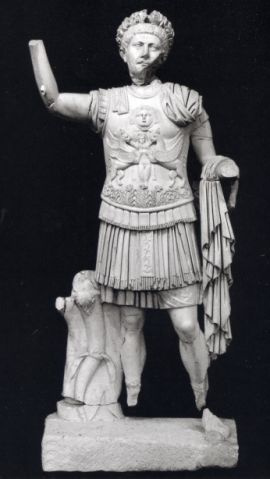
Armoured portrait statue of emperor. From Perge. Late third to early fourth century.
Record details
Photographs
Bibliography
- Edip Özgür, M., Skulpturen des Museums von Antalya, Ankara 2008, 142-3, no. 61 (Trajan, re-used end of 3rd c.)
Discussion
DESCRIPTION (Object)
Over life-size statue restored from c. 10 fragments. H: 230 cm. White marble.
The statue was found in c. 10 fragments and has been restored. Missing are: the left side of the face, the hands, the right foot, the outside of the left shin, and the object held in the raised right arm for which there is a strut on the forearm.
The head, which is supported by a thick neck pillar, has been re-cut from an earlier portrait. The hair beneath the corona civica has been turned into short straight locks that fall forward. The beard has been rendered also in short strands.
Each pupil has been marked by two large unattached drill holes which yield a broad U-shaped impression. The irises are engraved semi-circles.
PROVENANCE
Excavated in the stage building of the Theatre at Perge in 1992. Also found there were LSA-2542 and LSA-2544.
DESCRIPTION (Subject)
The statue shows an emperor who wears a corona civica, a military cuirass, a chlamys wound around his left arm and over his left shoulder, and closed shoes with straps. He probably held a spear in his raised right hand. He is supported by a tall tree trunk support that reaches his thigh and against which rests a cornucopia.
The head of the emperor turns to his left. He has short-cropped hair and a short beard that continues onto the neck. Two creases cross the brow, and vertical lines of contraction are visible above the nose. A long straight nose projects from a deep indentation at its root.
The cuirass is decorated with two griffins attacking a naked figure who wears a lion skin over his head, Herakles?. Above this is a Medusa head and below this are acanthus leaves and scrolls. There are no rounded ptyerges, and the skirt beneath features two rows of leather straps. The lower series is longer and has a prominent central strap decorated with a scroll motif.
DATE AND HONORAND
The head represents an Emperor of the later third century; his portrait has been re-cut from that of an earlier emperor. The corona civica, which was not worn after the early fourth century, provides a terminus ante quem.
Another imperial portrait from the same context in Perge, LSA-2542, is similar in terms of technique and type of honorand. That portrait of that emperor differs only in beard which does not extend down the neck.
These portraits are so close to LSA-464 and LSA-2354 that it is hard not to imagine that they too come from the same context. It is conceivable that these four portraits represented the Tetrarchs.
Cite: Last Statues of Antiquity, LSA-2543 (J. Lenaghan).