
LSA-2544
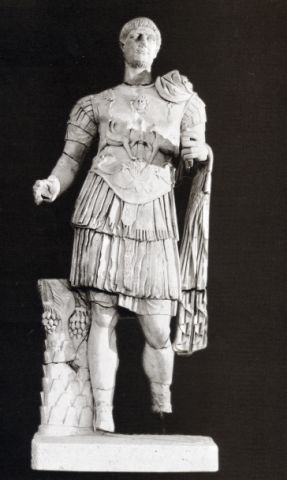
Armoured portrait statue of emperor. From Perge. Late third to early fourth century.
Record details
Photographs
Bibliography
- Edip Özgür, M., Skulpturen des Museums von Antalya, Ankara 2008, 144-5, no. 62 (Trajan, re-used in end of 3rd c)
Discussion
DESCRIPTION (Object)
Over life-size statue restored from c. 10 fragments. H: 240 cm. Fine-grained white marble.
The statue was found in c. 10 fragments and has been restored. Missing are: a section of the back of the head, the rim of the left ear, the tip of the nose, various fingers, most of the sword held in left hand, feet, and the plinth.
The head has been re-cut from an earlier portrait. The longer locks of the original portrait are visible at the top and back of the head. The hair has been carved into short C-shaped locks that turn to the right. A rough beard has been engraved into the surface. There is no neck support , and the head may not have been original to this statue.
Each pupil has been marked by two a U-shaped drilled out area. The irises are engraved semi-circles.
PROVENANCE
Excavated in the stage building of the Theatre at Perge in 1992. Also found there were LSA-2542 and LSA-2543.
DESCRIPTION (Subject)
The statue shows a man who wears a military cuirass, a chlamys wound around his left arm and over his left shoulder, and closed shoes with straps. He holds a sword in his left hand. He is supported by a tall support in the form of date tree with fruit; it reaches his thigh.
The head of the emperor turns to his left. He has short hair that forms an arching fringe over the brow and a short-cropped beard. The face is oval in shape with a small mouth and deep chin. The brow has one crease, and there are lines of contraction above the root of the nose.
The cuirass is decorated with two griffins flanking an incense burner. Above this is a Medusa head and below this is an acanthus calyx. The skirt beneath the breast plate features two rows of leather straps. The central strap is decorated with a vegetal motif.
DATE
The fashion style of the portrait and the re-cutting should place this head in the later third century. It was found with two imperial portraits LSA-2542 and LSA-2543 with which it shares many technical details. Unlike those heads, however, this does not have a bulky neck pillar which may reflect the fact that the head was not originally worked with this statue.
Moreover, this portrait differs slightly from those portraits in fashion and iconography; it wears a different hairstyle and no corona civica. This might perhaps indicate that this honorand was not an emperor.
Cite: Last Statues of Antiquity, LSA-2544 (J. Lenaghan).