
LSA-255
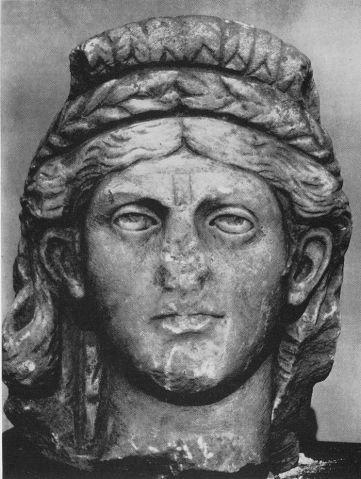
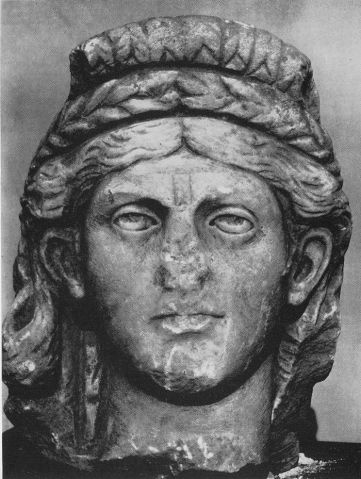
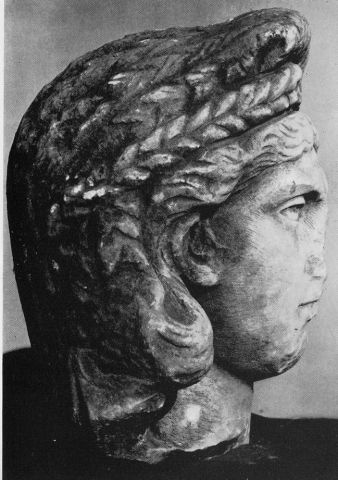
Portrait head of woman with tall central braid and encircling braid. Perge (Pamphylia). Late third century.
Record details
Photographs
Bibliography
- Inan, J., Antalya bölgesi Roma devri portreleri. Römische Porträts aus dem Gebiet von Antalya , Ankara 1965, 82-3, no. 28, pl. 29 (last quarter of third century)
- Inan, J. and E. Rosenbaum, Roman and Early Byzantine Portrait Sculpture in Asia Minor, Oxford 1966, 198, no. 273, pl. 150 (last quarter of third century)
Discussion
DESCRIPTION (Object)
Over life-size head. H: 35, W: 26 cm. Fine-grained white marble.
The head is broken through the base of the neck. The nose has broken off, and the lips and chin are chipped.
The cheeks and neck are covered with rasp marks. The right ear is awkwardly carved, especially in comparison with the left ear. The himation is visible on the right side of the neck and at the back of the head. It however does not rise to the top of the head and covers only the very back. For these reasons, Inan and Rosenbaum believe that the head has been re-carved. It cannot however be excluded that the head was gilded or painted (therefore with rasp marks), turned to its right (therefore poorly carved right ear) and belonged to a statue type which is usually shown with head covered.
The hair is not fully worked at the back and top of the head. The pupils of the eyes are rendered with two large drill holes and the canthi with one drill hole. The iris of the right eye has a thin engraved line to indicate the iris. The drill has been used to define the upper and lower edges of the encircling braids above the brow and to indicate locks of hair at the temples.
PROVENANCE
From Perge.
DESCRIPTION (Subject)
The portrait head comes from a draped statue. It turns to its right and depicts a woman with a complicated fashion hairstyle. The extant drapery along the right side of the neck and at the back of the head belongs to a himation which is pulled over the head in such a way that the entire hairstyle is visible. The position of the himation (as Inan and Rosenbaum suggest) and the turn of the head would suit a statue of the Large Herculaneum type.
The turned head has asymmetrically placed eyes and an asymmetrical 'central' part. The face has a large oval shape with a low brow and high arching eyebrows. The eyes have heavy lids and curving canthi. The mouth is damaged but clearly once had a pouting lower lip. Two incised lines, possibly intended to be creases, rise over the root of the nose.
The long wavy hair is centrally parted and pulled back around the ears. It is gathered at the nape and pulled upwards in a series of braids. Seven of these braids are pulled upwards and then folded under themselves. Two braids, one on each side, wrap around the head as a wreath. A small lock comes forward in front of each ear.
DATE
The hairstyle belongs securely after 270. Inan and Rosenbaum consider it to be like that of Ulpia Severina (270-275) on account of the broad central plait which folds under itself. Coin portraits of Ulpia Severina, however, do not show the encircling braids. The encircling braid (without the central braid) appears first in coin portraits of Galeria Valeria (305-311). Consequently, Bergmann dates the head slightly later, in the Tetrarchic period.
It is difficult to ascertain whether the head has been re-cut from an earlier one (see above under Description Object). To the arguments presented by Inan and Rosenbaum one might add the non-matching cutting of the irises and pupils.
COMPARANDA
Bergmann has grouped this head with a portrait in Berlin (LSA-1588) and one in the Villa Doria Pamphili (LSA-1298). Another example, which is certainly geographically closer, is the portrait in Copenhagen which was purchased in Izmir (LSA-256): it too shows a combination of central and encircling braids.
Discussion references
- Bergmann, M., Studien zum römischen Porträt des 3. Jahrhunderts n. Chr., Bonn 1977, 194-5, pls. 58.5 and 59.4 (280s-290s)
Cite: Last Statues of Antiquity, LSA-255 (J. Lenaghan).