
LSA-256
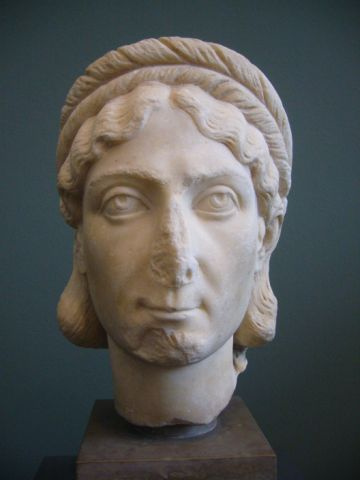
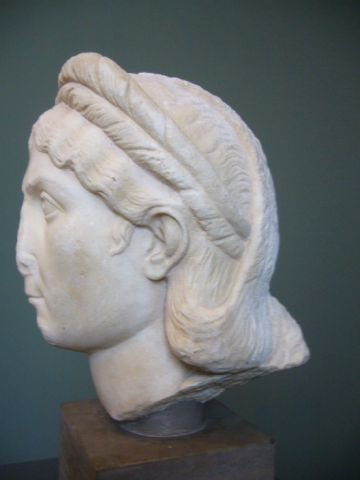
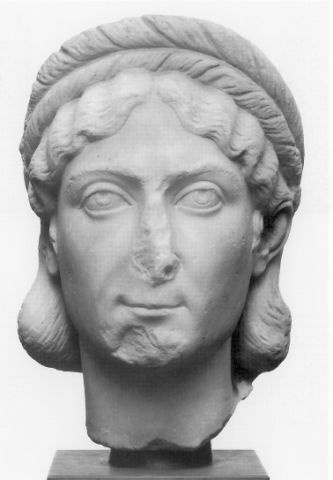
Portrait head of woman with crown-braid hairstyle. Perhaps from Smyrna. Early fourth century.
Record details
Photographs
Bibliography
- Johansen, F. , Catalogue of the Roman Portraits III; Ny Carlsberg Glyptotek, (Copenhagen 1995), no. 75
- Schade, K., Frauen in der Spätantike--Status und Repräsentation, Mainz 2003, 171-72, no. I 6, pl. 25
Discussion
DESCRIPTION (Object)
Over life-size head. H: 32 cm. H (chin to crown): 25.5 cm. White marble.
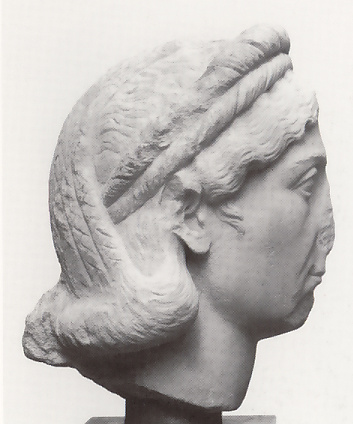
The head is broken around the base of the neck. The nose, chin, and shell of the right ear are significantly chipped.
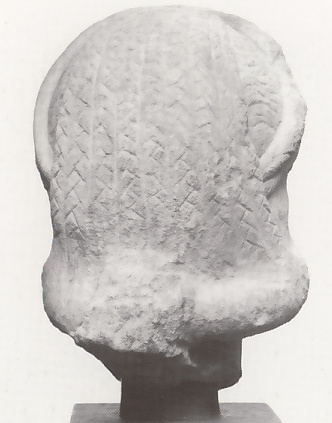
The head is was made in one piece with it statue. At the back of the nape, the left of centre, are the remains of a neck pillar, and on the left side of the neck is a trace of drapery.
The head is finely worked on all sides. The pupils are marked by two drill holes, and the iris by an engraved line of the flat chisel. The hair is mainly worked with a flat chisel.
PROVENANCE
Acquired by Arndt in 1902. He stated that it came from Smyrna. Schade is skeptical about this provenance. It merits note that Smyrna was probably a point of acquisition for objects from many points in southwest Turkey.
DESCRIPTION (Subject)
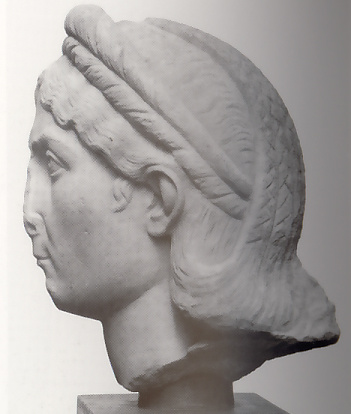
The head, which originally turned to its left, depicts a woman with a long oval face. The eyes are large; the nose was long and without a dip at the bridge; the mouth is small, thin-lipped, and with upturned corners. The naso-labial folds and the creases at the corners of the mouth are deep; and the chin recedes.
The hair is parted in the centre and pulled behind the ears in crimped waves. In front of the ears two locks fall onto the face. Behind the ears, it is gently folded up in a large plait made of c. 10 individual braids. This plait covers the top of the head and ends in line with the ears. Two other tresses emerge from under the 10 braids and wrap around the head forming a sort of diadem. They appear to be made of twisted hair and the upper one stands taller than the lower one.
DATE
The hairstyle combines the 'central braid' style popular in the late third century (for example, LSA-767) with the encircling braid style popular in the fourth century (for example, LSA-1294) . LSA-255 also from Asia Minor shows a similar combination.
Poulsen identified the portrait as Helena, mother of Constantine. Though it is a fine portrait, there is no positive evidence for any imperial identification.
Discussion references
- Demandt, A. and J. Engemann, (eds.), Konstantin der Grosse, Mainz 2007
, no. I.15.28 (J. Stubbe Østergaard) - Meischner, J., Bildnisse der Spätantike : 193-500 : Problemfelder : die Privatporträts , Berlin 2001, 76 (under 305-324)
- Poulsen, V., Les portraits romains II, Copenhagen 1974, no. 199
Cite: Last Statues of Antiquity, LSA-256 (J. Lenaghan).