
LSA-2564
Base for statue (subject unstated) set up by Flavius Andronicus. From Aphrodisias (Caria). Earlier fourth century.
Record details
Photographs
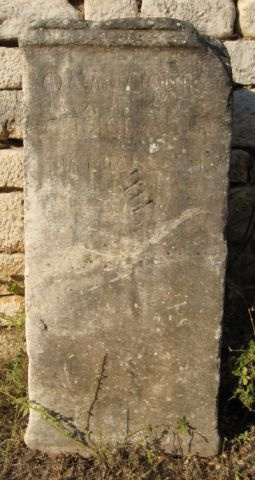
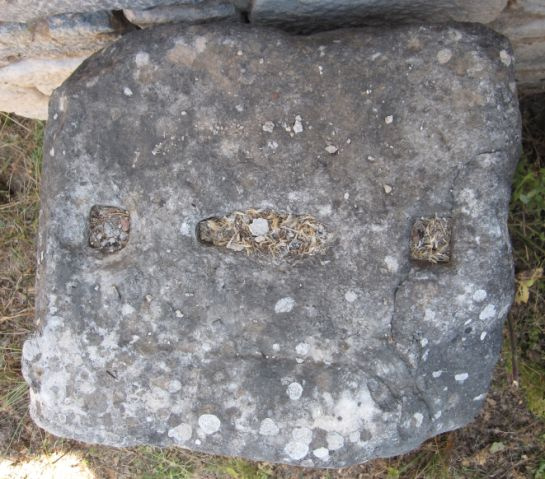
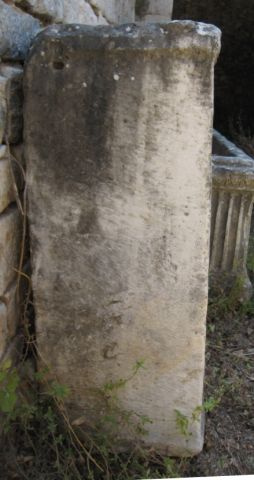
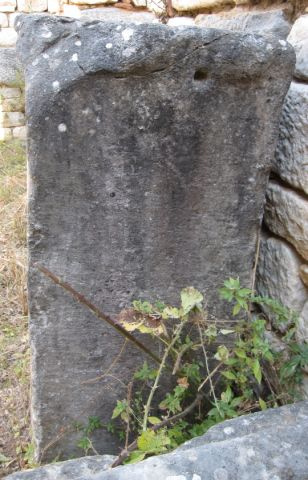
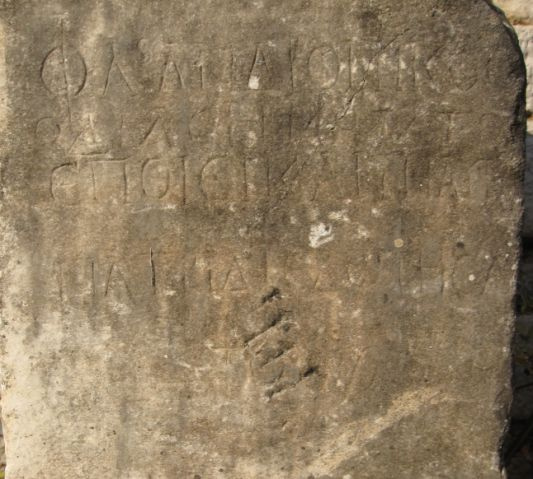
Inscription
Ἀγαθῇ Τύχῃ· / Φλ(άβιος) Ἀνδρόνικος / ὁ διασημότατο[ς] / ἐποίει καὶ τῇ αὑτο[ῦ] /(5) πατρίδι ἐδωρήσα/το. leaf
Inscription translation
With Good Fortune. Flavius Andronicus, perfectissimus, made (this) and gave it to his own homeland.
(Trans. C. Roueché)
Bibliography
- Roueché, C., Aphrodisias in Late Antiquity (Journal of Roman Studies Monograph 5), London 1989, no. 13
- Roueché, C. and K. Erim, 'Sculptors from Aphrodisias: New Inscriptions', Papers of the British School at Rome, 50, London 1982, 104-5, no. 3, pl. VIIb
Discussion
INSCRIPTION
In six lines:
Ἀγαθῇ Τύχῃ· / Φλ(άβιος) Ἀνδρόνικος / ὁ διασημότατο[ς] / ἐποίει καὶ τῇ αὑτο[ῦ] /(5) πατρίδι ἐδωρήσα/το. leaf
'With Good Fortune. Fl(avius) Andronicus, perfectissimus, made (this) and gave it to his own homeland.' (Trans: C. Roueché)
Letter height: line 1, probably 2nd century, 2 cm; otherwise 3 -5 cm.
DESCRIPTION
Tall base with simple upper and lower mouldings. H: 116.5, W: 54, D: 47.5 cm. White marble.
The top proper left corner is chipped. The back of the base was without the upper and lower mouldings. The top surface preserves a horizontal central lewis hole and two dowel holes on either side of it for the attachment of a block above. Also for the attachment of the block above are two small clamp cuttings, one on each side, just below the upper moulding towards the back of the base.
Line 1 is preserved from an earlier use. Line 3 appears to have been added at a second moment. It is shorter, less deeply inscribed, and appears squeezed in between the more regularly spaced, original three lines.
PROVENANCE AND CURRENT LOCATION
Excavated in 1964 in the area to the west of the Bouleuterion.
AWARDER AND DATE
Flavius Andronicus, the dedicator, a man of perfectissimus rank, claims both to have made and given this statue to his fatherland. He is known from two statue plinths found in Rome (IG 14 1266 = Squarciapino no. 14 and IG 14 1267 = Squarciapino no. 15) with statues and plinths signed by Flavius Zenon and Flavius Chryseros. These three details (rank, maker and donater, and signatures in Rome) link him closely to Flavius Zenon LSA-189 and LSA-190, with whom he shares the further coincidence of the name Flavius. Flavius Zenon can be placed in the early to mid-fourth century, and Flavius Andronicus should belong to the same period both by association and because of his own name, title, and the lettering on his gift. Just as Flavius Zenon, he seems more likely to have been the owner of a studio, probably a dealer in recycling and repairing of art works, rather than a sculptor. Roueché sees the procurement of the rank perfectissimus (added at a later moment to this base precisely in light of his importance as an art supplier rather than acquired through office which is otherwise unmentioned.
FURTHER DISCUSSION
The name Andronicus appears in another signature formula at Aphrodisias on a base set up by Iulia Paula in the forecourts at the Hadrianic Baths. The nomen Flavius, however, is absent there and thus cannot be assuredly associated with the same man.
Cite: Last Statues of Antiquity, LSA-2564 (J. Lenaghan).