
LSA-257
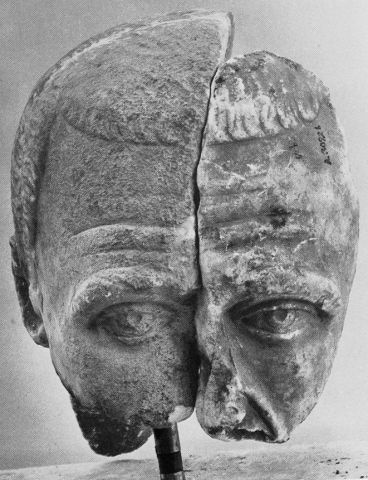
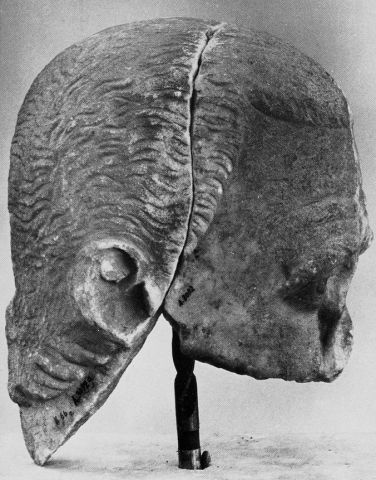
Fragmentary portrait head of man with short hair and furrowed brow. From Perge (Pamphylia). Fourth century.
Record details
Photographs
Bibliography
- Inan, J. & E. Alföldi-Rosenbaum, Römische und frühbyzantinische Porträ̈tplastik aus der Türkei : neue Funde, Mainz 1979, 256-7, no. 235, pl. 168
Discussion
DESCRIPTION (Object)
Over life-size head, preserved in three fragments. H: 27, W : 17 cm. Fine-grained white marble.
The head has been restored from three fragments: (1) the left side of the face from the nose to the fringe; (2) the right side of the face from the middle of the cheek to the hair behind the fringe; and (3) the back right part of the head
The head has been re-cut from an earlier portrait. The original hair was fuller with larger locks; some original locks are preserved behind the right ear. At the back of the head the hair has been worked over with a claw chisel. The current hairstyle is rendered entirely with a flat chisel, and the juncture between hair and brow has been precisely defined by a continous line (made either with a broad chisel or drill). The pupils are circular hollows, made with a drill, and the irises are engraved semi-circles, made with a flat chisel, which touch both upper and lower lids.
PROVENANCE
Found in 1957 on the colonnaded street.
DESCRIPTION (Subject)
The head depicts a short-haired older man. The brow is traversed by three heavy creases and the extant naso-labial fold is heavy. The eyebrows are bushy, and each is emphasized by a fine line of the flat-chisel above. The eyes are small and narrow.
The hair is cut short over the brow and recedes above the temples. It is brushed forward in long parallel strands. Not enough of the lower face remains to determine whether the portait was bearded or clean-shaven.
DATE
Inan and Rosenbaum date this head to the period of Constantine. They compare it to Dogmatius, LSA-903 , which has been similarly re-cut from an earlier portrait, and to another re-cut head in Rome, LSA-904. The portrait statue of Dogmatius is dated by its base to AD 325-337.
COMMENT
A date in the fourth century seems most likely on the basis of the fashion of the hair. The re-cutting, which is not mentioned by Inan and Rosenbaum, and the precise but restrained marking of the eyes make it difficult to place it any more specifically.
Cite: Last Statues of Antiquity, LSA-257 (J. Lenaghan).