
LSA-2571
Two fragments from base for statue of Constantine I (or just possibly Constantine II), emperor. Aquileia (Venetia et Histria). 306-340.
Record details
Photographs
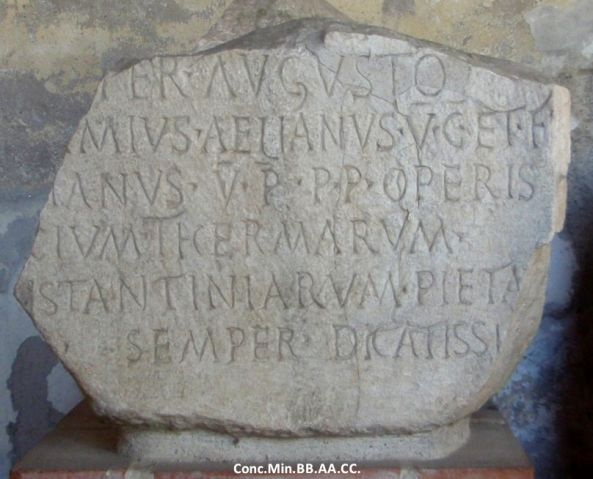
Inscription
[Restitutori operum publi]/corum, [d(omino) n(ostro) Fl(avio) Constantino], / maximo, [pio, felici, victori?,] / semper Augusto. /(5) Septimius Aelianus, v(ir) c(larissimus) et F[l(avius)] / Mucianus, v(ir) p(erfectissimus), p(rae)p(ositi) operis / [f]elicium thermarum / [Co]nstantinia<na>rum (sic for Constantinianarum), pieta[ti] / [eius] semper dicatissi[mi].
Inscription translation
To the restorer of public works, our lord Flavius Constantinus, the greatest, pious, fortunate, victorious(?), forever Augustus. Septimius Aelianus, of clarissimus rank, and Flavius Mucianus, of perfectissimus rank, overseers of the works on the fortunate Constantinian baths, most dedicated to his piety [set this up].
Bibliography
- L'Année épigraphique, , 2004, 1008 =AE 2001, 597=AE 1996, 694
- Rieß, W., Konstantin und seine Söhne in Aquileia, Zeitschrift für Papyrologie und Epigraphik 135, 2001, 267-83, 271-2 no. 2
Discussion
INSCRIPTION
Partly preserved in eight lines, here reproduced with completions in nine lines:
[Restitutori operum publi]/corum, [d(omino) n(ostro) Fl(avio) Constantino], / maximo, [pio, felici, victori?,] / semper Augusto. /(5) Septimius Aelianus, v(ir) c(larissimus) et F[l(avius)] / Mucianus, v(ir) p(erfectissimus), p(rae)p(ositi) operis / [f]elicium thermarum / [Co]nstantinia<na>rum (sic for Constantinianarum), pieta[ti] / [eius] semper dicatissi[mi].
'To the restorer of public works, our lord Flavius Constantinus, the greatest, pious, fortunate, victorious(?), forever Augustus. Septimius Aelianus, of clarissimus rank, and Flavius Mucianus, of perfectissimus rank, overseers of the works on the fortunate Constantinian baths, most dedicated to his piety [set this up].'
Letter height 3 – 4.5 cm.
We reproduce the inscription with the completions suggested by Rieß 2001.
DESCRIPTION (from Rieß 2001 and the published images)
Two adjoining fragments of a marble statue base broken on all sides. One of the fragments preserves a portion of the left margin of the epigraphic field with its surrounding frame. The measurements of the joint fragments are: H 91, W 83, D 63 cm.
PROVENANCE AND CURRENT LOCATION
The inscription was found in 1983 during excavations in the great baths north of the amphitheatre of Aquileia. It is very probable that the statue was originally set up in or at this building (see below, 'Honorand, Awarder and Date', and 'Further Discussion').
It is now in the Museo Archeologico Nazionale di Aquileia (without published inv. no.).
HONORAND, AWARDER AND DATE
The honorand was an emperor Constantine, as is evident from the extant bits of the imperial title (lines 3-4) and the reference to the Constantinian baths (lines 7-8). As Rieß 2001 points out, this suits both Constantine I (Augustus 306-37), and his son Constantine II (Augustus 337-40). However, Constantine I who visited Aquileia at least four times during his long reign is by far the more likely candidate than his short-lived son.
Constantine I, after the defeat of his rival Licinius in 324, assumed the title victor (instead of invictus) (line 3); this is usually considered a valid indicator of date. Unfortunately, our inscription is damaged where this piece of the imperial title would be legible; both, victori or invicto can possibly be restored. The outer dates for our inscription are provided by the reigns of Constantine and his successor Constantine II.
The inscription was set up by Septimius Aelianus and Flavius Mucianus; both held office as overseers of the works on the 'fortunate Constantinian baths' (praepositi operis felicium thermarum Constantinianarum, lines 6-8). The imperial name attributed to the building makes it claer that substantial work on the baths was executed under Constantine (see below, 'Further Discussion').
Aelianus was of senatorial (clarissimus) rank, Mucianus of the highest equestrian rank (perfectissimus). Both men are otherwise unknown, and no other imperial office is mentioned in the inscription; they were possibly members of the local aristocracy of Aquileia.
FURTHER DISCUSSION
The 'fortunate Constantinian baths' recorded in our inscription were almost certainly the same baths, which, according to another inscription in Aquileia (LSA-2572), were restored by Constantine's kind generosity after they had fallen into ruins.
Cite: Last Statues of Antiquity, LSA-2571 (Ulrich Gehn and Carlos Machado).