
LSA-2575
Fragment of base for statue of emperor. Rome. Late third-early fourth century.
Record details
Photographs
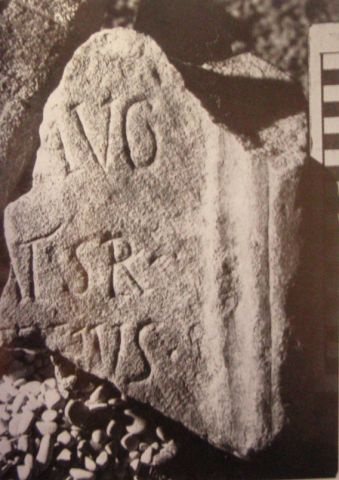
Inscription
------ / [---]++[.] / [---] Aug(usto), / [---r]at(ionalis) s(ummae) r(ei), / [devotus n(umini) m(aiestati)q]ụẹ ẹius / ------.
Inscription translation
To... Augustus, ... officer in charge of the imperial fisc, devoted to his divine spirit and majesty...
Bibliography
- Gregori, G. L. (ed.), La collezione epigrafica dell'Antiquarium comunale del Celio, Rome 2001, pp. 102-103, n. 19 (B. Barbieri)
- L'Année épigraphique, , 2001, 237
Discussion
INSCRIPTION:
Parts of three lines survive. Letter height 4.5-4 cm.
------ / [---]++[.] / [---] Aug(usto), / [---r]at(ionalis) s(ummae) r(ei), / [devotus n(umini) m(aiestati)q]ụẹ ẹius / ------.
'To... Augustus, ... officer in charge of the imperial fisc, devoted to his divine spirit and majesty...'
Only a small fragment of the original text survives. It is clear, however, that this is a dedication to an emperor by a rationalis summae rei, an officer in charge of the fisc. There are very a few dedications by financial officers from our period, all of them datable to the time of the Tetrarchy or Constantine. In fact, Barbieri pointed out the physical similarities between this base and another, dedicated to Constantine (LSA-1265), especially in the type of moulding and style of the letters.
The style of the letters suggests a late third-fourth century date.
DESCRIPTION (Barbieri):
Fragment of white marble base, 28.5 x 21 x 20. The piece corresponds to part of the right edge of the base, broken on the left, top and bottom.
PROVENANCE AND LOCATION:
The provenance of this base is not known. It is in the Antiquario del Celio, NCE 5229.
HONORAND, AWARDER AND DATE:
Our base is certainly a dedication to an emperor, as the reading of line three suggests. The base was dedicated by an unknown rationalis summae rei. Barbieri plausibly suggests a dedication to Constantine I, or perhaps to his co-emperor Licinius, based on the comparison with LSA-1265. This is not certain, however, and any emperor between the beginning of the Tetrarchy and Constantine would be possible.
Cite: Last Statues of Antiquity, LSA-2575 (Carlos Machado).