
LSA-2583
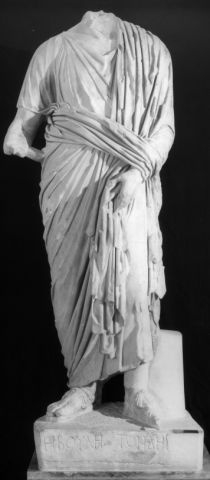
Headless statue of the 'Demos'. Aphrodisias (Caria). Fourth century
Record details
Photographs
Bibliography
- Smith, R.R.R., S. Dillon, C.H. Hallett, J. Lenaghan, and J. Van Voorhis, Aphrodisias II: Roman Portrait Sculpture at Aphrodisias, Mainz 2006, no. 44, pl. 34
Discussion
DESCRIPTION (Object)
Over life-size statue missing head. H: 225, W: 85, D: 54 cm. Plinth H: 15.5 cm. Large-grained marble with blue grey veins at left thigh and in drapery above statue support.
The statue without a head has been recomposed of nine fragments. In addition, the right hand holding a phiale is preserved but has not been re-attached. Missing: head; right forearm, wrist, and supporting strut; several fingers of left hand; lower left shin; statue support and proper left edge of plinth; back of plinth behind right foot; and a large fold hanging down on left side of body below arm.
The figure was carved from a single block of marble; struts were used to support the right arm and the falling drapery. The now missing head was supported behind uncarved area of marble. There is a measuring boss on the back of the left shoulder. The statue shows four ancient repairs. (1) A clamp cutting (L: 10 cm, W: 2.5 cm) in front of the left foot was for re-attaching the front left part of the plinth (part of the iron clamp is still in place). (2) The right forearm was re-attached by a dowel (3) A small pin-hole on the right hand served for the reattachment of the thumb. (4) A large strut that formerly extended from the upper right thigh to the right wrist was re-attached, or replaced, by means of a dowel.
PROVENANCE
Excavated in 1962 in the Bouleuterion. All of the fragments were found at the easternmost doorway of the stage building. The statue seems to have stood directly on the easternmost pedestal of the stage building of the Bouleuterion without an intervening base.
INSCRIPTION
The plinth of the statue bears an inscription (letter H: 7.0 cm): ἡ βουλὴ τὸν δῆ(μον)
"The Council (sets this statue up) for the Demos".
DESCRIPTION (Subject)
The figure is about twice life-size and wears a chiton, himation, sandals, and a ring. It stands with the weight over the right leg, the left set slightly forward and to the side. Both feet are firmly planted on the ground. The arms are lowered. The right arm was extended, and the hand held a large phiale. The tendons of the neck and the position of the neck support (possibly unworked ties of a priestly crown) indicate that the head was turned to its left. The body and pose present a slight adjustment of a well-known (Koan) type for himation statues.
DATE
The technique and carving of the statue place its original date of its manufacture in the later second century. The ritual action of the figure and the large ring worn on the left hand suggest that the statue was probably made to represent a local priest. The statue was however later transformed into a personification of the Demos (of the Aphrodisians) by the addition of an inscription.
The location, script, and text of the inscription show that it was added at a second moment. Text placed on the plinth is typical of re-use; other examples include LSA-555, LSA-556, LSA-559, LSA-2539 and LSA-2540. Here the letters are unevenly cut and irregular in size, unlike high imperial texts from Aphrodisias. The combination of assembly and people as honorand and/or dedicators appears with surprising frequency in inscriptions which are difficult to date but are generally placed in the late third or fourth century; see LSA-275, LSA-277, LSA-278, LSA-279, and LSA-2329.
The extensive ancient repairs were probably carried out at the same time as the inscription was added to the plinth. A building inscription from the stage building (http://insaph.kcl.ac.uk/ala2004/inscription/eAla028.html ) records a dedication by Antonius Priscus, praeses between 388 and 392 (see LSA-164, LSA-166 and LSA-167). It indicates a renovation of the stage building of the Bouleuterion at the end of the fourth century AD with which this statue of Demos might be connected.
Cite: Last Statues of Antiquity, LSA-2583 (J. Lenaghan).