
LSA-2586
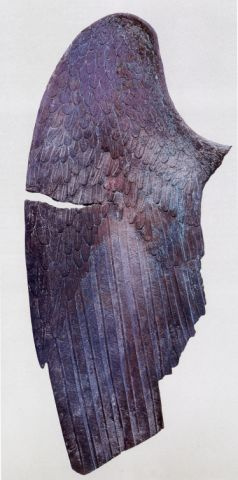
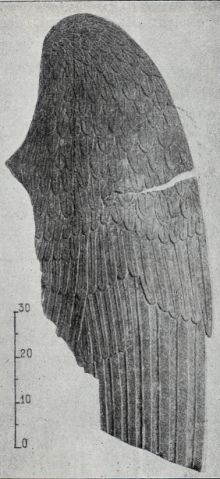
Wing of bronze statue of Victory, with LSA-2585 and LSA-2586. Rome (Pons Valentiani). 366-367.
Record details
Photographs
Bibliography
- Barnabei, F. 'Regione I. Alveo del Tevere', Notizie degli Scavi, Rome 1891, 287
- Dehn, G. 'Die Bronzefunde bei Ponte Sisto', Mitteilungen des Deutschen Archäologischen Instituts, Römische Abteilung 26, Rome 1911, 250-251, fig. 8
- Ensoli, S. and E. La Rocca (eds.), Aurea Roma: dalla città pagana alla città cristiana, Roma 2000, 462, no. 64 (Cioffarelli: 1st c. AD)
Discussion
DESCRIPTION (Object)
Fragment of over life-statue. H: 105, W: 43.5, D: 3 cm. Bronze, gilded.
The rectangular block was built into the balustrade. At least one side (the viewer’s left) was dressed to fit into and project from the balustrade. The base is now broken in three pieces and has a central hole. The crown mouldings are mainly broken and missing as is the top, viewer s right corner.
PROVENANCE
Found under the second arch of the Ponte Sisto on 9 September 1891on the right side. Two bases for statues of Victories (LSA-2584 and LSA-2585) were found in the same place. The bases with statues were incorporated at intervals into the balustrade of the ancient bridge. There were also at least five blocks bearing ex-voto inscriptions; these had a similar architectural function and may also have carried statues. On the Campus Martius end of the bridge there were probably also column monuments for the reigning emperors (see LSA-1820, LSA-1072, and LSA-580). All of the statuary fragments found at the bridge were in bronze (see also LSA-1072, LSA-580).
DESCRIPTION
The fragment preserves a large wing with carefully rendered feathers. It must have come from a statue of a Victory.
DATE
The original date of manufacture of the statue may be first century; this date is derived from technical assessments (Di Mino, Cioffarelli). Its use on balustrade of the bridge can be tightly placed between 365/6-367.
The dedicator and overseer of the statue is L. Aurelius Avianius Symmachus signo Phosphorius who is referred to as ex prefect of the city. He was prefect of the city in 364-365. In another statue base from the same context (LSA-1820) the emperors Valens his brother Valentinian are named without reference to Gratian. No element from the context of the bridge mentions Gratian. Thus, it should date before Gratian’s elevation to Augustus in 367. Therefore the base and statue can be dated between 365 and 367.
Discussion references
- Di Mino, M.R. and M. Bertinetti, Archeologia a Roma. La materia e la tecnica nell'arte antica, Rome 1990, 109-110, no. 97 (victory from attic of Arch, 1st c.)
Cite: Last Statues of Antiquity, LSA-2586 (J. Lenaghan).