
LSA-2587
Base for statue made and dedicated by (Fl.?) Palladius. From Aphrodisias. Fourth century.
Record details
Photographs
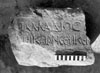
Inscription
[Φλ(άβιος)] Παλλάδιος v. ἐ[μὲ] |[ἐπ]οίει καὶ ἀνέθηκεν.
Inscription translation
'Flavius Palladius made and dedicated me.' (Trans: C. Roueché)
Bibliography
- Roueché, C., Aphrodisias in Late Antiquity (Journal of Roman Studies Monograph 5), London 1989, http://insaph.kcl.ac.uk/ala2004/inscription/eAla252.html
Discussion
INSCRIPTION
Fragmentarily preserved in two lines:
[?...] Παλλάδιος v. ἐ[?...]- / [π]οίει καὶ ἀνέθηκεν.
Roueché 2005 proposed the following completion:
[Φλ(άβιος)] Παλλάδιος v. ἐ[μὲ] |[ἐπ]οίει καὶ ἀνέθηκεν.
'Flavius Palladius made and dedicated me.' (Trans: C. Roueché)
Letter height 4 cm.
DESCRIPTION
Low base with upper and lower mouldings. White marble.
Both sides of the block are broken, and the mouldings are chipped
PROVENANCE AND CURRENT LOCATION
Excavated in 1913 by Boulanger in the large room of the aleipterion. Found by the NYU excavation in the room on the east side of the east court (exc. inv. 88-13). The inscription was recorded in the Aphrodisias museum by Roueché 2005.
HONORAND, AWARDER AND DATE
The dedicator is unknown but the claim both to have made and dedicated the statue link him to the monuments of Flavius Zeno and Flavius Andronicus; see LSA-189, LSA-190, and LSA-2564. This has led Roueché to suggest that his nomen was also Flavius.
All of the related monuments and individuals belong in the first half of the fourth century.
FURTHER DISCUSSION
Two other monuments set up by a man named Helladius (honoured with a statue LSA-222) are similar in find location, form, content, and style. Although Roueché suggested initially building inscriptions at ala 17 and 18, they are probably all better understood as architectural blocks re-used as low bases to be inserted into fabric of the Bath building.
Cite: Last Statues of Antiquity, LSA-2587 (J. Lenaghan).