
LSA-2588
Base for statue of Damocharis, almost certainly governor of Asia. Smyrna (Asia). Fourth to earlier fifth century
Record details
Photographs
Inscription
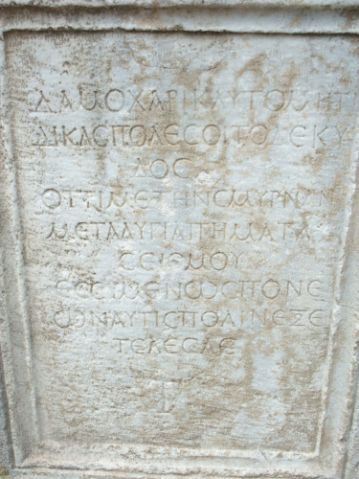
Δαμοχάρι κλητόμητι / δικασπόλε σοὶ τόδε κῦ/δος /
ὅττι γε τὴν Σμύρναν /(5) μετὰ λοίγια πήματα / σεισμοῦ
ἐσσυμένως πονέ/ων αὖτις / πόλιν ἐξε/τελέσας
Inscription translation
Damocharis, judge, selected for good judgement, you have this fame, that with Smyrna, after mortal disasters of an earthquake, working swiftly, you completed the city again.
Bibliography
- Merkelbach, R. and J. Stauber (eds.), Steinepigramme aus dem griechischen Osten. Bd. 1. Die Westküste Kleinasiens von Knidos bis Ilion , Stuttgart 1998, 506, no.5/1/10
Discussion
INSCRIPTION
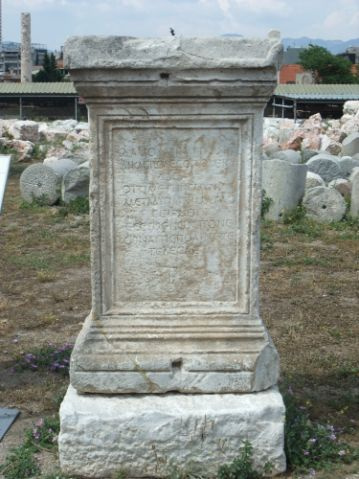
Verse inscription in three hexameters, laid out in 9 lines:
Δαμοχάρι κλητόμητι / δικασπόλε σοὶ τόδε κῦ/δος
ὅττι γε τὴν Σμύρναν /(5) μετὰ λοίγια πήματα / σεισμοῦ
ἐ ἐσσυμένως πονέ/ων αὖτις πόλιν ἐξε/τελέσας
'Damocharis, judge, selected for good judgement, you have this fame, that with Smyrna, after mortal disasters of an earthquake, working swiftly, you completed the city again.'
Letter height not recorded.
The epigram was already known, before the discovery of our base, from the Planudean Anthology, labelled 'On an image of Damocharis in Smyrna', εἰς εἰκόνα Δαμοχάριδος ἐν Σμυρνῃ, (Anthologia Palatina XVI 43, ed. Aubreton & Buffière 1980, 99):
Δαμοχάρι κλητόμητι δικασπόλε σοὶ τόδε κῦδος
ὅττι γε τὴν Σμύρναν μετὰ λοίγια πήματα σεισμοῦ
ἐ ἐσσυμένως πονέων αὖθις πάλιν ἐξετελέσσας
The slight variants in the final lines (πάλιν for πόλιν; ἐξετελέσσας for ἐξετελέσας) are modern 'corrections' of Planudes' reading (which in fact accurately recorded the original inscription).
DESCRIPTION
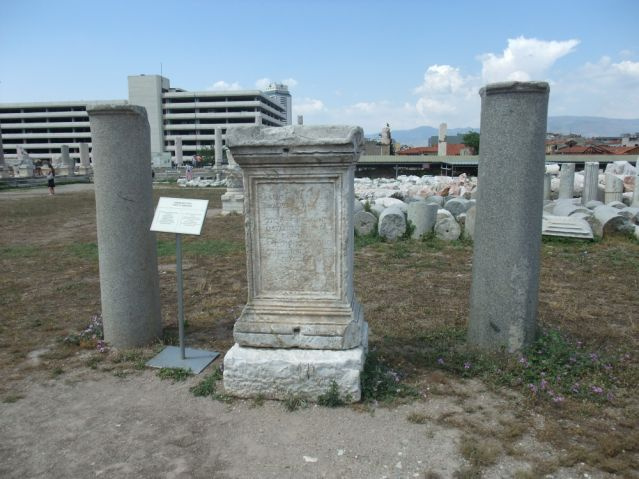
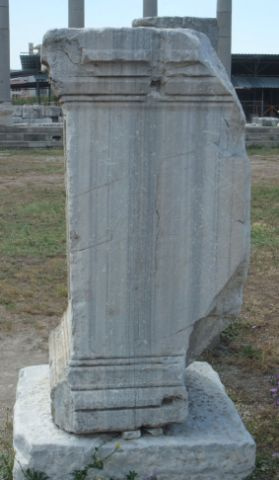
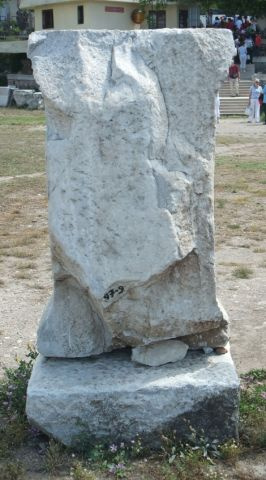
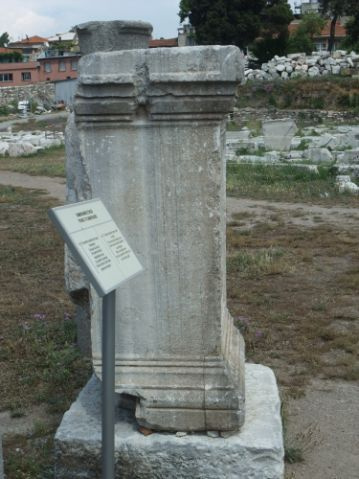
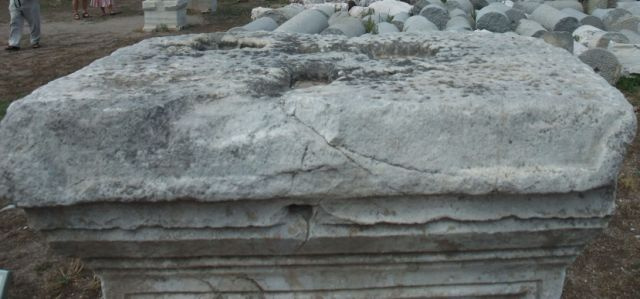
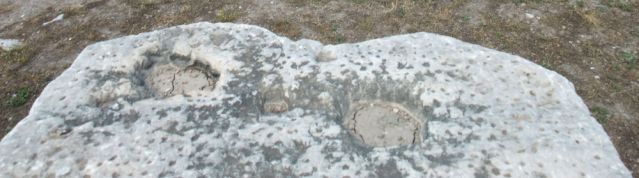
Rectangular marble base, moulded at top and bottom on three sides: H 150, W 90, D 77 cm. On the top right corner an acroterion is partially preserved. The uppermost portion of the front moulding and the lower right corner are broken; the back face is damaged, only the central portion of the surface preserved (finished with a point). On top, there is a central dowel hole and two larger holes for the fixing of a bronze statue. The sides are smoothly finished, whereas the epigraphic field is framed and finished with a claw chisel – an indicator that our inscription was carved over an erased earlier one. On the front, left and right sides there are clamp holes in both the upper and the lower mouldings. These probably date from the period of re-use of the base for Damocharis, and show that additional elements were fixed below and on top.
PROVENANCE AND CURRENT LOCATION
There is no published record of the base’s precise findspot, though it was evidently found on the Agora of Smyrna, where it is currently displayed in the centre of the square, inv. no. 97-9.
HONORAND, AWARDER AND DATE
Because our inscription praises Damocharis for 'having completed the city after mortal disasters', it was attributed by its excavators to the man responsible for a massive building programme on the agora after an earthquake in 193.
The verse form of the inscription, however, points to a late antique rather than Severan date. The formal and lexical elements fit the usual features of late antique honorific epigrams. Numerous expressions are poetic or taken from the epics: κύδος (lines 2-3); πήματα (line 5), ἐσσυμενως (line 7), αὖτις (= αὖθις , line 8); while δικάσπολε (line 2) is a term often used for late antique governors, but does not occur in inscriptions around 200. In our opinion, the grandiloquent praise of Damocharis is probably for a later, and much more mundane, programme of repair.
Damocharis is addressed as 'judge' (δικασπόλε, line 2), a standard way of addressing governors in late antique honorific epigrams (Robert 1948, 39); he was almost certainly a governor (proconsul) of Asia. He is indeed probably identical with the Damocharis governor of Asia, who was awarded a statue in Ephesus (LSA-727; PLRE II, 344 Damocharis). The identification of this Damocharis with our man was also proposed by Cameron & Cameron 1966, who furthermore equated both with the poet Damocharis of the mid-6th century (PLRE III, 387 Damocharis). The latter suggestion was, however, rejected by McCail 1969, in our opinion rightly (see our discussion of this issue under LSA-727 'Honorand, Awarder and Date').
The awarder of our statue is not named; but was presumably the city of Smyrna, in gratitude to Damocharis for his help after some disaster (such as a fire or earthquake).
In our view, the inscription most probably dates to the 4th or earlier 5th century, since we reject the equation of our man with the poet of the 6th century, and since dedications to governors in provincial cities are increasingly rare after the early 5th century.
Discussion references
- Aubreton,R. & F. Buffière, Anthologie Grecque XIII : Anthologie de Planude, Paris 1980, p. 99 no. 43
- Cameron, A. & A. D. E. Cameron, The Cycle of Agathias, Journal of Hellenic Studies 86, 1966, 6-25, p. 11
- Martindale, J. R., The Prosopography of the Later Roman Empire. Vol. II A.D. 395-527, Cambridge 1980
- Martindale, J. R., The Prosopography of the Later Roman Empire. Volume III A. D. 527-641, Cambridge 1992
- McCail, R. C., The cycle of Agathias: new identifications scrutinised, Journal of Hellenic Studies 89, 1969, 87-96, p. 89
Cite: Last Statues of Antiquity, LSA-2588 (Ulrich Gehn).