
LSA-2589
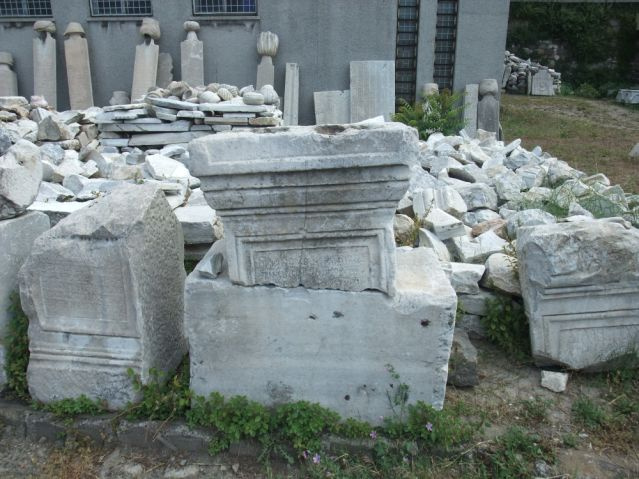
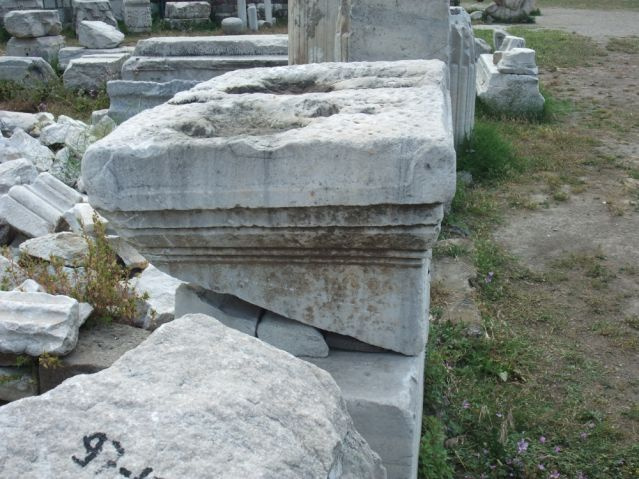
Base for statue of Constantine I or Constantine II, emperors, and another Constantinian emperor. Smyrna (Asia). 317-340
Record details
Photographs
Inscription
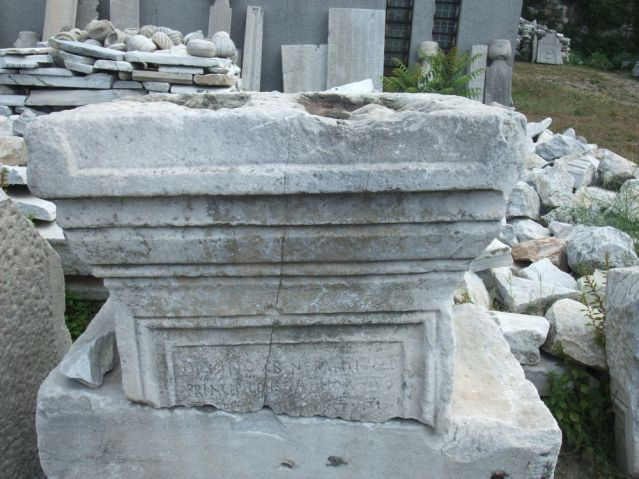
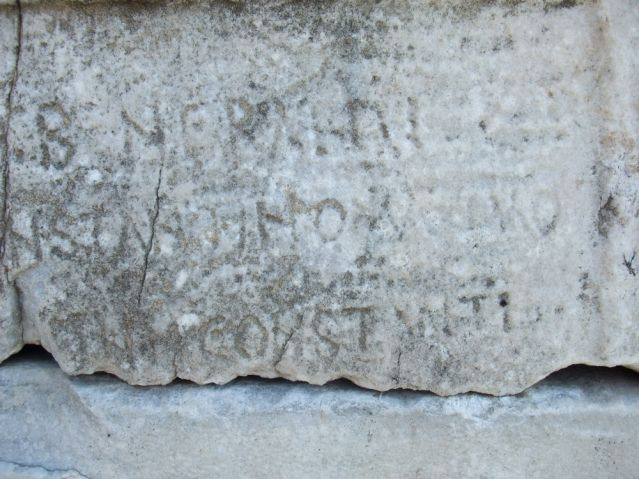
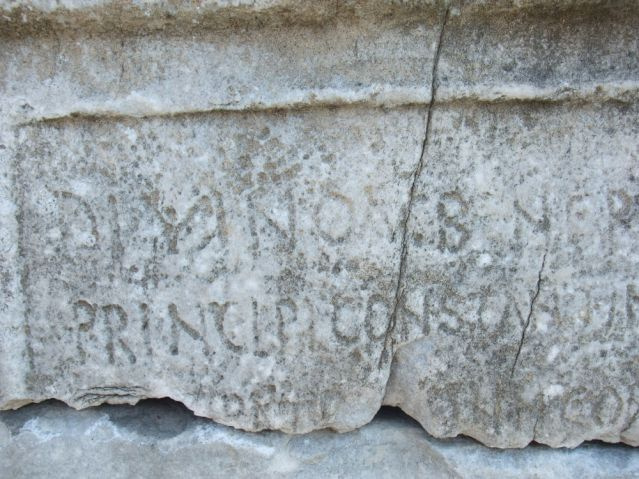
ḌIṂNOMBNEṚAIΠ (?) / principi Constantino ṃ—ọ / ----P̣Ṛ----NṂ Constạṇ̣ti/ ---
Inscription translation
... to the emperor Constantine ... Constan...
Discussion
INSCRIPTION
In three preserved lines:
Ḍ̣ I Ṃ̣ (or: Y I) N O M B N E Ṛ̣ A I Π̣̣
PRINCIPI CONSTANTINO Ṃ̣ –Ọ
----P̣̣Ṛ̣----NṂ̣ CONSTẠ̣Ṇ̣TI
'To the emperor Constantine .... and Constans (or Constantius, or Constantine) ...'.
Letter height 2-4 cm.
I am unable to offer an interpretation of the first line which possibly is from an earlier inscription.
DESCRIPTION
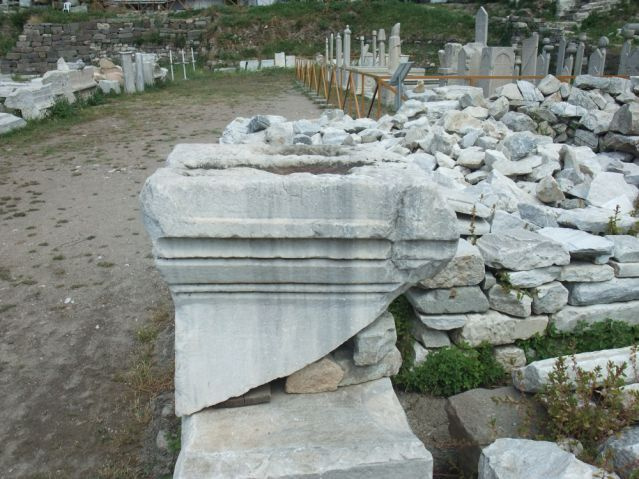
Fragment of a rectangular base of white marble with mouldings at top; H 61, W 80, D 75 cm. The base is broken under the mouldings, preserving only three lines of the inscription on the front face, and the back right corner is chipped off.
The epigraphic field is elaborately framed, the right margin chipped. The left and right sides are smoothly finished, the front face, in particular the epigraphic field, is worn. The back face, as far as still assessible, was only roughly finished; the mouldings are not elobarated at the back face. All four angles of the moulding are decorated with acroteria, the surface between the acroteria on left and right side finished with a claw contrasting the smooth finishing outherwise displayed on these sides.
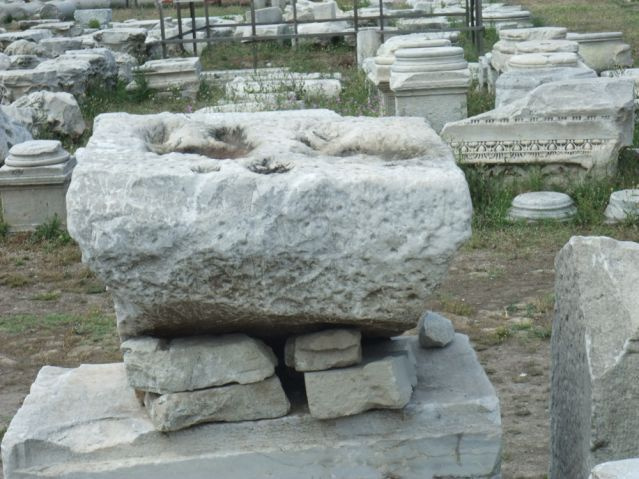
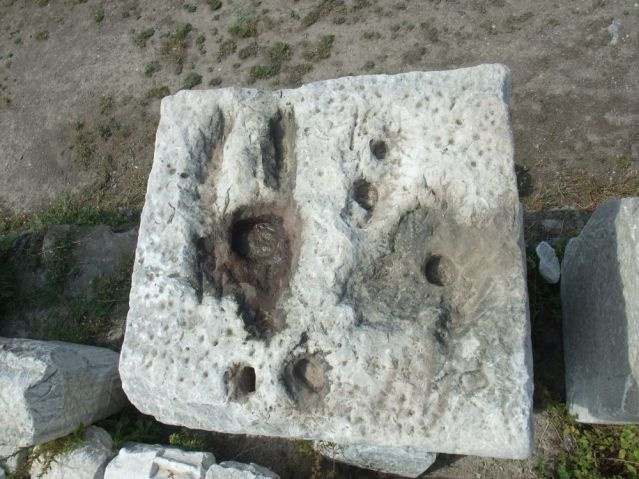
On the top face there are eight holes of which only a small rectangular hole at the back margin is a leverage device. The dominant large holes in the centre are for the fixing of a bronze statue; the two smaller holes at the front margin belong to a third foot for another bronze statue, probably from another use.
The upper moulding is without any clamp hole by which a further crowning element would have been fixed; the inscription was therefore possibly associated with a bronze statue.
PROVENANCE AND MOST RECENTLY RECORDED LOCATION
There is no published record of the base’s provenance, but it is probably from the agora. It was set up at southern end of Agora site in summer 2011, in front of the store house, together with LSA-516.
HONORAND, AWARDER, AND DATE
The inscription is either to Constantine I and one of his sons (Constantine II, Constantius II, or Constans), or to Constantine II and one of his brothers (Constans or Constantius II).
Constantine I was Augustus 306-37; Constantine II was Caesar 317-37 and Augustus 337-40; Constantius II was Caesar 324-37 and Augustus 337-61; Constans was Caesar 333-7 and Augustus 337-50.
The terminus post quem for our inscription is therefore 317 (Constantine I and Constantine II Caesar); the terminus ante quem is 340 (death of Constantine II).
Cite: Last Statues of Antiquity, LSA-2589 (Ulrich Gehn).