
LSA-2594
Base for statue of unstated subject, perhaps Victory. Novae (Moesia Secunda). Mid fourth century (367-368?)
Record details
Photographs
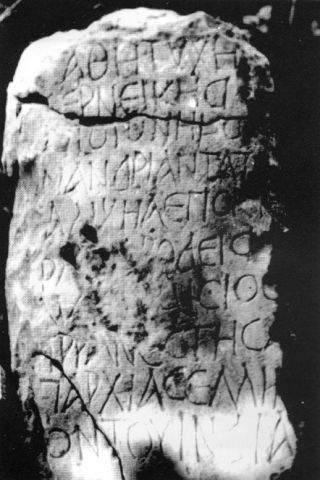
Inscription
[Ἀγ]αθῇ Τύχῃ. / [ὑπ]ὲρ νείκηςι (sic) / [δε]σποτῶν ἡμῶ[ν] / [τὸ]ν ἀνδριάντα τ[ῇ] /(5) [Ἰ]ταλιχῇ λεγιόνι / [Φ]Φλλ(άουιοι) [Ἀφ]ροδείσι[ος] / [κ]αὶ Ἀ[ρτε]μίσιος / [π]πρρ(ριμιπιλάριοι) ἀνέστησα[ν] /(9) [ἐ]παρχίας Ἑλλη[σ]/[π]όντου ἰνδ(ικτιῶνος) ια’.
Inscription translation
To Good Fortune. To the victory of our lords. Flavius Aphrodisius and Flavius Artemisius, primipilarii from the province of Hellespontus, set up the statue for the legion Italica, in the eleventh indiction.
Bibliography
- Kolendo J. & V. Božilova, Inscriptions grecques et latines de Novae (Mésie Inférieure), Paris 1997, pp. 180-1 no. 178
Discussion
INSCRIPTION
In ten lines:
[Ἀγ]αθῇ Τύχῃ. / [ὑπ]ὲρ νείκηςι (sic) / [δε]σποτῶν ἡμῶ[ν] / [τὸ]ν ἀνδριάντα τ[ῇ] /(5) [Ἰ]ταλιχῇ λεγιόνι / [Φ]Φλλ(άουιοι) [Ἀφ]ροδείσι[ος] / [κ]αὶ Ἀ[ρτε]μίσιος / [π]πρρ(ριμιπιλάριοι) ἀνέστησα[ν] /(9) [ἐ]παρχίας Ἑλλη[σ]/[π]όντου ἰνδ(ικτιῶνος) ια’.
'To Good Fortune. To the victory of our lords. Flavius Aphrodisius and Flavius Artemisius, primipilarii from the province of Hellespontus, set up the statue for the legion Italica, in the eleventh indiction.'
Letter height 3.5 cm.
DESCRIPTION (from Velkov 1994, Kolendo & Božilova 1997, and the published images)
Rectangular block of local sandstone, without mouldings: H 82, W 46, D 38 cm. All edges are chipped destroying the initial letters of all lines and the final letters of some. In the centre of the front face, a chip has destroyed some letters of lines 6 and 7.
PROVENANCE AND CURRENT LOCATION
The block was found in 1980 in Novae, used as building material in a 6th-century house (according to Kolendo & Božilova 1997, 180 in the episcopal basilica in the western part of Novae, sector X). It was recorded by Velkov 1994, 149 in the archaeological collections of the Novae excavations, inv. no. 764.
HONORAND, AWARDER AND DATE
The inscription explicitly refers to the erection of a statue (τὸν ἀνδριάντα ... ἀνέστησαν, lines 4 & 8); the subject of the dedication, however, is not named. Bresson, Drew-Bear & Zuckerman 1995, 143, assumed that it was a statue of Victory, mentioned in line 2. This interpretation was fully accepted by Kolendo & Božilova 1997, and is a real possibility.
The dediction was set up by Flavius Aphrodisius and Flavius Artemisius, primipilarii from the province of Hellespontus (lines 6-9). The primipilarii at this date were no longer the highest ranking centurions of a legion, but civilian officials – members of the militia inermis - in charge of the provision of food for the frontier troops (Bresson, Drew-Bear & Zuckerman 1995, 142; see also LSA-1102, LSA-1103, LSA-2445).
Our inscription is dated to the 11th indiction (line 10, ἰνδικτιῶνος ια’), that is the 11th declaration of the annual tax demand, within a cycle of 15 years. This cycle of fiscal demands started in 312/13, and was adopted as a method of dating (Bagnall & Worp 2004, 7-11). The 11th indiction thus refers to one of the following years: 322/3, 337/8, 352/3, etc. Bresson, Drew-Bear & Zuckerman 1995, 144-6, however, point out that the use of the indiction to identify a year is recorded in inscriptions only from the later 4th century. They therefore take 337/8 as a terminus post quem for our inscription, while arguing for a terminus ante quem of 382 (the year when the Altar of Victory was definitively removed from the Senate House in Rome). This suggests a date of 337/8, 352/3 or 367/8 for our dedication. The same authors favour 367/8, on the grounds that this best suits the use of the indiction for dating, and that a campaign in the Balkans by the emperor Valens in 367-9 might have provided the reason to celebrate an imperial victory. Their argument is fully adopted by Kolendo & Božilova 1997, and seems reasonable to us.
FURTHER DISCUSSION
In Novae, the practice of primipilarii setting up statues on completion of their terms of office continued as late as the 430s (LSA-1102, LSA-1103, and LSA-2445). These dedications, along with others by 4th-century primipilarii in nearby Oescus (LSA-2596, LSA-2597, and LSA-2598) form a remarkable group. They obviously continue an older tradition fostered by the primi pili of the 2nd and 3rd centuries (Kolendo 1980; Kolendo 1988). There is no way of knowing at present whether this was a very localised phenomenon, or a more widespread practice along the Danube frontier.
Discussion references
- Bagnall, R. S. & K. A. Worp, Chronological Systems of Byzantine Egypt, Leiden 2004
- Bresson, A., Drew-Bear, T. & C. Zuckerman, Une dédicace de primipilaires a Novae pour la victoire impériale, Antiquité Tardive 3, 1995, 139-46
- Kolendo, J., Le role du primus pilus dans la vie religieuse de la légion en rapport avec quelques inscriptions des principia de Novae, Archeologia. Rocznik Instytutu Historii Kultury Materialnej Polskiej Akademii Nauk 31, 1980, 49-60
- Kolendo, J., Les nouvelles inscriptions des primi pili de Novae, Archeologia. Rocznik Instytutu Historii Kultury Materialnej Polskiej Akademii Nauk 39, 1988, 91-103
- Velkov, V., Eine neue spätgriechische Inschrift aus Novae (Moesia secunda), Limes, ed. by G. Susini, , Bologna 1994
Cite: Last Statues of Antiquity, LSA-2594 (Ulrich Gehn).