
LSA-2595
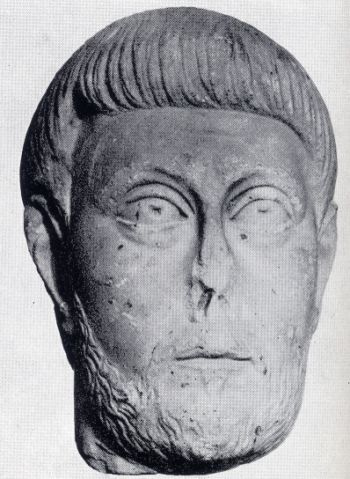
Portrait head of bearded man. From Italy?, now Varese. Later fourth to early fifth century.
Record details
Photographs
Bibliography
- Ragghianti, C.L. 'La Casa Pogliaghi, 3', Critica d'Arte 17 no.112, Florence 1970, 63-4, fig. 21
Discussion
DESCRIPTION (Object)
Head. Marble.
The head is broken through the neck. The nose is mainly missing.
The hair on the head and face is defined with flat chisel work. The pupils of the eyes are crescent shapes. The irises do not appear to be indicated. The inner canthi are drilled.
The head has probably been re-cut from an earlier portrait. The shelf-like termination of the fringe on the brow and the fineness of the nose and eyebrows suggest re-cutting.
PROVENANCE
In the house, now Museum, of Lodovico Pogliaghi (1857-1950) in Varese. Pogliaghi was an artist from Milan who collected a variety of ancient, renaissance, and modern art. He seems to have collected his material in Italy.
DESCRIPTION (Subject)
The head shows a mature man with medium-length lank hair and a full but tidy beard. Across the brow, the ends of the fringe all turn to the proper left. The face is oval and has fine, high-arching eyebrows and emphatically marked eyes which also have a stiff high-arching upper eyebrow. The nose is narrow and the lips small.
DATE
The fashion style of the beard and the length hair are similar to the portrait of Virius Audentius Aemilianus (LSA-46) which is dated by its base (LSA-41 ) to c. 364-379. The portrait of Oecumenius LSA-150 from Aphrodisias (and LSA-869 from Cyprus) also shows the same general fashion style and has similarly rendered pupils. Oecumenius, identified by his base at Aphrodisias (LSA-150), should be dated to the late fourth or early fifth century.
In this portrait the lack of styling of the hair (which is not deliberately brushed forward but falls naturally across the brow) may reflect either a date closer to the middle of the fourth century, or more simply might have been dictated by the shape of the original portrait from which this head was re-cut.
Cite: Last Statues of Antiquity, LSA-2595 (J. Lenaghan).