
LSA-2596
Inscribed block, possibly base for statue of the god Liber Pater. From Oescus (Dacia Ripensis). Earlier to mid fourth century
Record details
Photographs
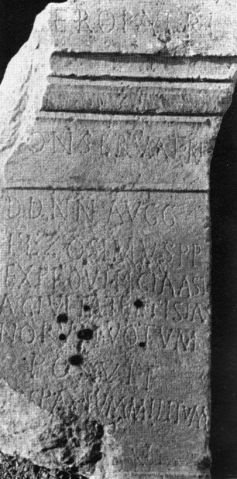
Inscription
Libero Patri, / conservatori / dd(ominorum) nn(ostrorum) Augg(ustorum), / Fl(avius) Zosimus p(rimi)pilarius) /(5) ex provincia A/sia, civitate Efisia/norum, votum / posuit / post pastum militum /(10) - - - [co(n)s(ulibus)].
Inscription translation
To Liber Pater, protector of our lords the Augusti. Flavius Zosimus, primipilarius from the province of Asia, from the city of Ephesus, set up what he had vowed, having finished his obligation to supply food for the soldiers. In the year of the consuls ...
Bibliography
- Gerov, B., Inscriptiones Latinae in Bulgaria repertae, Sofia 1989, no. 8b
Discussion
INSCRIPTION
In ten lines of which nine are preserved:
Libero Patri, / conservatori / dd(ominorum) nn(ostrorum) Augg(ustorum), / Fl(avius) Zosimus p(rimi)pilarius) /(5) ex provincia A/sia, civitate Efisia/norum, votum / posuit / post pastum militum /(10) - - - [co(n)s(ulibus)].
'To Liber Pater, protector of our lords the Augusti. Flavius Zosimus, primipilarius from the province of Asia, from the city of Ephesus, set up what he had vowed, having finished his obligation to supply food for the soldiers. In the year of the consuls ...'
Letter height 4 - 6 cm. Lines 1 and 2 are carved on the two bands of moulding at the top of the block.
The epigraphic formula fits an ex voto dedication better than a statue base. The block had been used, however, as a statue base at an earlier time (LSA-366, see also below, 'Description').
The letters cos in line 10 are recorded by Gerov; they were not recorded by the first editor, Kazarow 1926, and are not legible on the published photo.
DESCRIPTION (from Gerov 1989 and the published image)
Rectangular limestone block with mouldings at top: H 120, W 68, D 56 cm. The upper and the lower left corners are broken off, partly destroying lines 1-2 and 10. There are no published descriptions of the upper face, to give an indication of whether or not there are traces of fixings for a statue.
Our inscription is on the opposite face of a dedication to Diocletian of 290/92 (LSA-366).
The block is described as an altar (ara) by Gerov 1989. The earlier dedication to Diocletian, however, was probably for a statue, and from Novae there are four similar dedications by primipilarii, in these cases certainly for statues (LSA-1102, LSA-1103, LSA-2445, LSA-2594).
PROVENANCE AND CURRENT LOCATION
Found in 1906 during excavations in the military camp of Oescus on the river Danube (http://www.trismegistos.org/place/29839). Recorded in the Sofia Museum by Gerov 1989, without published inventory no., but with the photograph no. 85 CA.
HONORAND, AWARDER AND DATE
Liber Pater (a fertility god, often equated with Dionysus) was the recipient of this dedication. If it was a statue base, it presumably bore a statue of the god (see LSA-2594, also from Novae, for a 4th-century dedication perhaps associated with a statue of the goddess Victory).
Flavius Zosimus, the awarder was a primipilarius. In Late Antiquity this was no longer the highest ranking centurion of a legion, but a civilian official with a duty to supply food to the frontier troops. Primipilarii were selected from provinces with few troops, but with coastlines that allowed for the transport of foodstuffs to the Danube frontier.
The inscription was set up when two emperors were in office (line 3). The nomen 'Flavius' borne by the awarder points to the period of the Constantinian dynasty, when this was regularly bestowed on imperial officials. If so, the common reign of Constantine I and Licinius (313-24), or of Constans and Constantius II (340-50), or the common reign of Valentinian I and Valens (364-367) are possible dates for our inscription; the common reign of Constantine I and Licinius being perhaps the most likely. An inscription carrying an invocation to a pagan divinity, is very unlikely after the accession of Theodosius I in 379; if so, 367, the year of Gratian's elevation to the rank of Augustus is the terminus ante quem, since all imperial colleges thereafter consisted of more than two Augusti.
FURTHER DISCUSSION
The dedications by primipilarii in Oescus (our inscription LSA-2596, LSA-2597, and LSA-2598) and in nearby Novae (LSA-1102, LSA-1103, LSA-2445, and LSA-2594) form a remarkable group. They obviously continue an older tradition fostered by the primi pili of the 2nd and 3rd centuries (Kolendo 1980; Kolendo 1988). There is no way of knowing at present whether this was a very localised phenomenon, or a more widespread practice along the Danube frontier.
Discussion references
- Kazarow, G., Epigraphisches aus Bulgarien, Philologische Wochenschrift 46, 1926, 767-8
Cite: Last Statues of Antiquity, LSA-2596 (Ulrich Gehn).