
LSA-2597
Dedication, probably to a tutelary god of the emperors, possibly for a statue. From Oescus (Dacia Ripensis). Earlier to mid fourth century (313-367)
Record details
Photographs
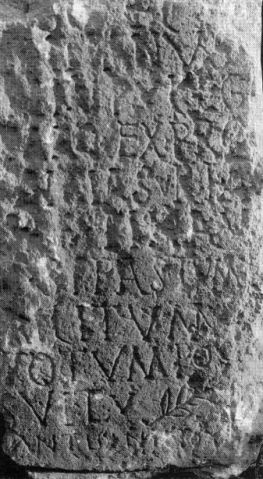
Inscription
[Dd(ominorum) nn(ostrorum))] / Auggustorum, Fl(avius) / Tatianus / primip(ilarius) leg(ionis) /(5) V Mac(edonicae), ex pro/vincia Suria / Palestina, / post pastum / militum /(10) votum po/suit. (branch) / Ἀντωνίνου
Inscription translation
...of our lords, the two Augusti. Flavius Tatianus, primipilarius of the 5th legion, the Macedonian, from the province of Syria Palestina, having finished his duty of providing the troops with food supply. Of Antoninus (the sculptor?).
Bibliography
- Gerov, B., Inscriptiones Latinae in Bulgaria repertae, Sofia 1989, no. 9
Discussion
INSCRIPTION
In twelve lines:
[Dd(ominorum) nn(ostrorum))] / Auggustorum, Fl(avius) / Tatianus / primip(ilarius) leg(ionis) /(5) V Mac(edonicae), ex pro/vincia Suria / Palestina, / post pastum / militum /(10) votum po/suit. (branch) / Ἀντωνίνου
'...of our lords, the two Augusti. Flavius Tatianus, primipilarius of the 5th legion, the Macedonian, from the province of Syria Palestina, having finished his duty of providing the troops with food supply. Of Antoninus (the sculptor?).'
Letter height 4 cm.
We reproduce the inscription in the reading and with the completions proposed by Bresson, Drew-Bear & Zuckerman 1995. The epigraphic formula suits a votive offering better than a statue base; however, a similar inscription is known from the nearby military camp of Novae, which is explicitly for a statue base (LSA-2594), while another inscription, like ours from Oescus, may also have been for a statue (LSA-2596).
The name in line 11 was identified as being in Greek, and was interpreted as the sculptor’s signature, by Bresson, Drew-Bear & Zuckerman 1995, 142. It had previously been read 'Co[nst] / ant(ino) Li[c]inio co(n)s(ulibus)' by Beševliev (1964), which led him to a date of 309 (see below, 'Honorand, Awarder and Date'). Gerov, who considered the final line as not interpretable, nonetheless adopted Beševliev’s date.
DESCRIPTION (from Gerov 1989 and the published images)
Rectangular limestone block: H 88, W 40, D 34 cm. The surface is badly damaged, the tops edge and both lateral margins chipped off. This damage renders large portions of the inscription illegible.
The block is described as an 'altar' (ara) by Gerov 1989, an interpretation which does indeed suit the votive-like inscription. However, similar dedications by primipilarii from Oescus, and from nearby Novae, certainly carried statues, making it possible that ours was also a statue dedication (Novae: LSA-1102, LSA-1103, LSA-2445, LSA-2594; Oescus: LSA-2596, LSA-2598) .
PROVENANCE AND CURRENT LOCATION
Found in 1906 during excavations in the military camp of Oescus on the river Danube (http://www.trismegistos.org/place/29839). Recorded by Gerov 1989 in the Sofia museum, inv. no. 7880.
HONORAND, AWARDER AND DATE
The addressee of the inscription is lost, but it is likely to have been a divinity, invoked as protector of the emperors('conservatori Augustorum', or similar). In Novae, a similar inscription was set on what was certainly the base for a statue (LSA-2594), and from Oescus another, similar, inscription is known (LSA-2596).
The awarder, Flavius Tatianus, was a primipilarius. In Late Antiquity, this was a civilian official with a duty to supply food for the frontier troops. Tatianus was of Syrian origin; primipilarii were selected from provinces with few troops, but with coastlines that allowed for the transport of foodstuffs to the Danube frontier.
Our inscription does not carry any secure indication of date. The nomen 'Flavius' borne by the awarder, however, points to the period of the Constantinian dynasty, when this name was regularly bestowed on imperial officials. If so, the common reign of Constantine I and Licinius (313-24), or of Constans and Constantius II (340-50), or the common reign of Valentinian I and Valens (364-367) are possible dates for our inscription; the common reign of Constantine I and Licinius being perhaps the most likely. An inscription carrying an invocation to a pagan divinity, is very unlikely after the accession of Theodosius I in 379; if so, 367, the year of Gratian's elevation to the rank of Augustus is the terminus ante quem, since all imperial colleges thereafter consisted of more than two Augusti.
FURTHER DISCUSSION
The dedications by primipilarii in Oescus (our inscription LSA-2597, LSA-2596, and LSA-2598) and in nearby Novae (LSA-1102, LSA-1103, LSA-2445, LSA-2594) form a remarkable group. They obviously continue an older tradition fostered by the primi pili of the 2nd and 3rd centuries (Kolendo 1980; Kolendo 1988). There is no way of knowing at present whether this was a very localised phenomenon, or a more widespread practice along the Danube frontier.
Discussion references
- Beševliev, V., Spätgriechische und spätlateinische Inschriften aus Bulgarien , Berlin 1964
- Bresson, A., Drew-Bear, T. & C. Zuckerman, Une dédicace de primipilaires a Novae pour la victoire impériale, Antiquité Tardive 3, 1995, 139-46
Cite: Last Statues of Antiquity, LSA-2597 (Ulrich Gehn).