
LSA-2598
Base for statue of unstated subject. From Oescus (Dacia Ripensis). Earlier to mid fourth century (313-367)
Record details
Photographs
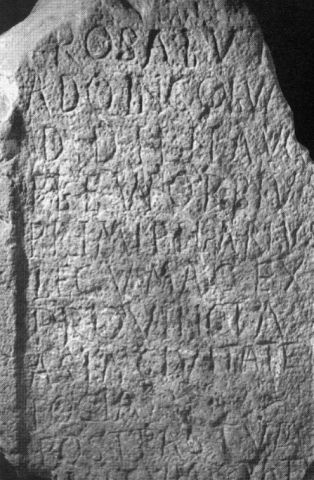
Inscription
Pro salut[e]/ adq(ue) incolum[it(ate)] / dd(ominorum) nn(ostrorum) Augg(ustorum), / Fl(avius) Euforbius /(5) primipilarius / leg(ionis) V Mac(edonicae), ex / provincia / Asia, civitate / Focia, /(10) post pastum / militum, statu/[am posuit].
Inscription translation
For the well-being and safety of our lords the two Augusti. Flavius Euforbius, primipilarius of the 5th legion, the Macedonian, from the province of Asia, (and) the city of Focia, set up the statue having fulfilled his duty of providing the troops with food.
Bibliography
- Gerov, B., Inscriptiones Latinae in Bulgaria repertae, Sofia 1989, no. 10
Discussion
INSCRIPTION
Preserved in twelve lines:
Pro salut[e]/ adq(ue) incolum[it(ate)] / dd(ominorum) nn(ostrorum) Augg(ustorum), / Fl(avius) Euforbius /(5) primipilarius / leg(ionis) V Mac(edonicae), ex / provincia / Asia, civitate / Focia, /(10) post pastum / militum, statu/[am posuit].
'For the well-being and safety of our lords the two Augusti. Flavius Euforbius, primipilarius of the 5th legion, the Macedonian, from the province of Asia, (and) the city of Focia, set up the statue having fulfilled his duty of providing the troops with food.'
Letter height 4 - 5 cm.
We reproduce the inscription with the reading proposed by Bresson, Drew-Bear & Zuckerman 1995, 141. Their reading completes the dedication as for a statue ('statuam posuit',lines 11-12), although the opening formula would better suit a votive altar, leading Gerov 1989 to propose a different reading and completion of lines 11-12: 'statu/i [velit]'. We agree with Bresson, Drew-Bear & Zuckerman, because we think their interpretation is justified in the light of similar inscriptions from Oescus and Novae (LSA-2596, LSA-2597 (Oescus); LSA-1102, LSA-1103,LSA-2445, LSA-2594 (Novae); see also below, 'Further Discussion').
DESCRIPTION (from Gerov 1989 and the published photos)
Rectangular limestone base broken at top and bottom: H 87, W 49, D 77 cm. The epigraphic field is contained within a simple frame, the surface worn.
The block was described as an altar (ara) by Gerov 1989; it is probable, however, that this was a statue base (see above, 'Inscription').
PROVENANCE AND CURRENT LOCATION
Found in 1906 during excavations in the military camp of Oescus on the river Danube http://www.trismegistos.org/place/29839). Recorded by Gerov 1989 in the Sofia museum, inv. no. 7879.
HONORAND, AWARDER AND DATE
The honorand is unstated in our inscription. It is possible that line 1 was preceded by an invocation, most probably to a divinity; in similar cases from Novae and Oescus (LSA-2594, LSA-2596), we think that the bases carried statues of the deity invoked.
Flavius Euforbius, the awarder, was a primipilarius charged with the pastus militus (lines 10-11), that is the provision of food for the 5th legion garrisoned in Oescus (line 6). The rank of primus pilus, formerly the highest ranking centurion of a legion, became a civilian office, linked to military supply, by the late 3rd century, probably after the reign of Aurelian (270-5) (Mócsy 1966, 316, 318, 322).
Our inscription does not carry any secure indication of date. The nomen 'Flavius' borne by the awarder, however, points to the period of the Constantinian dynasty, when this name was regularly bestowed on imperial officials. If so, since two emperors are referred to (line 3), the common reign of Constantine I and Licinius (313-24), or of Constans and Constantius II (340-50), or the common reign of Valentinian I and Valens (364-367) are possible dates for our inscription.
FURTHER DISCUSSION
The dedications by primipilarii in Oescus (LSA-2596, LSA-2597, and our inscription LSA-2598) and in nearby Novae (LSA-1102, LSA-1103, LSA-2445, LSA-2594) form a remarkable group. They obviously continue an older tradition fostered by the primi pili of the 2nd and 3rd centuries (Kolendo 1980; Kolendo 1988). There is no way of knowing at present whether this was a very localised phenomenon, or a more widespread practice along the Danube frontier.
Discussion references
- Bresson, A., Drew-Bear, T. & C. Zuckerman, Une dédicace de primipilaires a Novae pour la victoire impériale, Antiquité Tardive 3, 1995, 139-46
- Kolendo, J., Le role du primus pilus dans la vie religieuse de la légion en rapport avec quelques inscriptions des principia de Novae, Archeologia. Rocznik Instytutu Historii Kultury Materialnej Polskiej Akademii Nauk 31, 1980, 49-60
- Kolendo, J., Les nouvelles inscriptions des primi pili de Novae, Archeologia. Rocznik Instytutu Historii Kultury Materialnej Polskiej Akademii Nauk 39, 1988, 91-103
- Mócsy, A., Das Lustrum Primipili und die Annona Militaris, Germania 44, 1966, 312-26
Cite: Last Statues of Antiquity, LSA-2598 (Ulrich Gehn).