
LSA-26
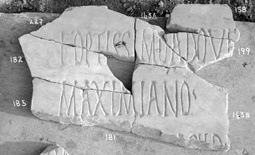
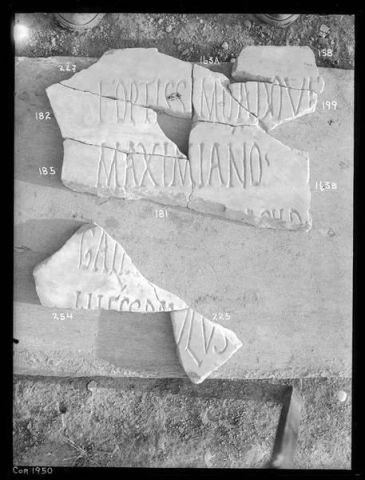
Plaque from base for statue of Maximian, emperor. Corinth (Achaea). 285-305
Record details
Photographs
Inscription
Fortissimo adque [---] / Maximiano [---] / Ạc̣ḥ(aiae) d(icavit) ṇ(umini) [m(aiestati)q(ue) e(ius) semper devotus].
Inscription translation
To the most powerful and ... Maximianus ... governor of Achaea, dedicated [this], always devoted to his divine spirit and majesty.
Textual evidence
FORTISSIMO ADQUE---
MAXIMIANO---------
ach d n (letters should be marked with subsbscribed point, not well legible)
Translation
To the strongest and ----
Maximian ----
(Province of (?)) Ach(aia) with devotion to his numen
Bibliography
- Brown West, A., Latin inscriptions, 1896-1926: Corinth VIII, 2, Princeton 1931, no. 24
Discussion
INSCRIPTION
In three lines:
Fortissimo adque [---] / Maximiano [---] / Ạc̣ḥ(aiae) d(icavit) ṇ(umini) [m(aiestati)q(ue) e(ius) semper devotus].
'To the most powerful and ... Maximianus ... governor of Achaea, dedicated [this], always devoted to his divine spirit and majesty.'
Brown West ascribed this inscription to Galerius (full name: Caius Galerius Valerius Maximianus), not to Maximian (full name: Marcus Aurelius Valerianus Maximianus). He argued this on the basis of the introductory formula, as more suitable for a Caesar than for an Augustus, and different from the formula used to honour the Augustus Diocletian on a statue base which was set up here in central Corinth, almost certainly at the same time (LSA-16). However, other fragments of identical type, from a dedication to Galerius (which has to be separate from this one because of the arrangement of the lines), were found in the same findspot (LSA-50). Since these inscriptions (our inscription, LSA-16, and LSA-50), all from the same area of Corinth, are so similar in appearance (and all, unusually, on plaques), it is almost certain that they are from a group of statues to the four emperors of the first tetrarchy, erected at the same time in the same place: i.e. to the Augusti, Diocletian (LSA-16) and Maximian (our inscription), and to the Caesars, Galerius (LSA-50) and Constantius I (missing from the evidence). We are therefore convinced that our inscription refers to Maximian.
DESCRIPTION
Eight fragments of a white marble plaque, only very partially preserved: H 26, W 41, D 2 cm.
PROVENANCE AND CURRENT LOCATION
Found in 1901 and 1902 in the Northwest-Stoa of the Agora, in the centre of Ancient Corinth. Now in the Corinth Museum, inv. nos. 158-163A-163B-181-182-185-199-227
HONORAND, AWARDER, AND DATE
The honorand, Maximian, was Augustus from 285 or 286, until 305 (Kienast 1996, 272).
If, as seems likely, this dedication forms part of a single group to the first tetrarchy (see 'Inscription' above, and 'Further Discussion', below), then the awarder will have been the governor (praeses) of Achaea, Lucius Sulpicius Paulus, known from the inscription to Diocletian (LSA-16).
FURTHER DISCUSSION
The inscription is very similar in appearance and date to two other fragmentary tetrarchic inscriptions found in the Northwest Stoa of Corinth, one to Diocletian (LSA-26), the other to Galerius (LSA-50). It is almost certain that all three were part of a single contemporary group for the colleagues of the first tetrarchy; this would raise the terminus post quem for our base to 293.
Discussion references
- Kienast, D., Römische Kaisertabelle. Grundzüge einer römischen Kaiserchronologie, Darmstadt (2)1996
Cite: Last Statues of Antiquity, LSA-26 (Ulrich Gehn).