
LSA-260
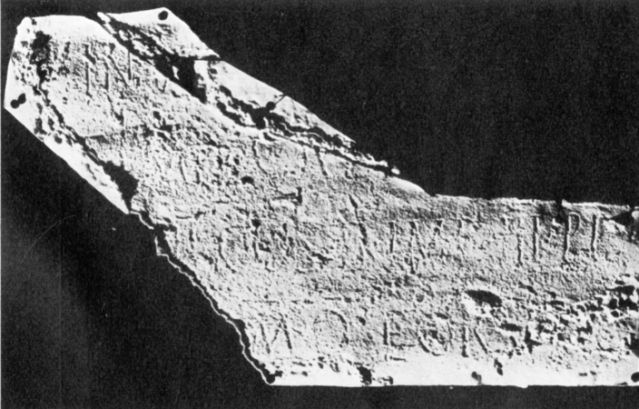
Impression on cement floor preserving inscription for Diocletian and Maximian, probably from statue base. Side (Pamphylia). 288.
Record details
Photographs
Inscription
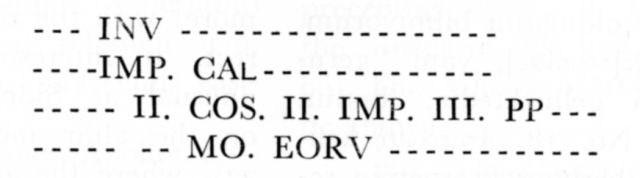
[---]inv(icto)[ ---] / [---]imp(eratori) Cae[s(ari ---] / [trib(unicia) pot(estate) ...]II, co(n)s(uli) II, imp(eratori) III, p(atri) p(atriae),[ ---]/ d(evotus) n(umini)] m(aiestati) q(ue) eoru[m].
Inscription translation
...to the unconquered ... emperor Caesar ..., holding tribunician power for the second(?) time, twice consul, proclaimed emperor (imperator) three times, father of the fatherland, ... devoted to their divine spirit and majesty.
Bibliography
- L'Année épigraphique, Paris, 1966 no. 461
- Nollé, J. , Side im Altertum : Geschichte und Zeugnisse (Inschriften griechischer Städte aus Kleinasien ; Band 43), Bonn 1993, vol. 43, no. 45
Discussion
INSCRIPTION
In four preserved lines:
[---]inv(icto)[ ---] / [---]imp(eratori) Cae[s(ari ---] / [trib(unicia) pot(estate) ...]II, co(n)s(uli) II, imp(eratori) III, p(atri) p(atriae),[ ---]/ d(evotus) n(umini)] m(aiestati) q(ue) eoru[m].
'...to the unconquered ... emperor Caesar ..., holding tribunician power for the second(?) time, twice consul, proclaimed emperor (imperator) three times, father of the fatherland, ... devoted to their divine spirit and majesty.'
Letter height 5 cm. In the final line, bars above the letters M and Q indicate the abbreviations.
At the beginning of the third line, where tribunician power was certainly listed, it is impossible to be sure from the surviving '...II', whether the number should be completed as 'II', 'III' or 'IIII'.
DESCRIPTION
The inscription is only preserved as an impression, set in a cement floor; of the inscribed stone itself (which must have been re-used upside-down within the floor) nothing has been found. There are no published measurements.
The wording of the inscription, with the honorand in the dative, and with a typical closing formula of devotion, strongly suggests that it was from a statue base. Since it was re-used in a floor, the inscription is more likely to have been inscribed on a plaque than on a full-sized base.
PROVENANCE AND CURRENT LOCATION
Set in the concrete floor of a room in the Great Baths of Side (Mansel 1978, 221-32; map: kk; see above, 'Description'). It remains in situ.
HONORAND, AWARDER AND DATE
The extant letters of the final line are from the usual dedicatory formula of the late 3rd and early 4th century; a similar date is indicated by the title 'invictus, unconquered' in line 1 (on the date of the titles see Nollé 319-20; the proposal by Bean 1965, that the honorand was Commodus (180-192), can be ruled out). The plural 'eorum' indicates that the dedication was made at a time when there was a college of emperors. Very possibly our inscription once mentioned more than one emperor; but bases could also be set up as part of a group, each dedicated to a single emperor, but each expressing dedication to the entire college.
Our emperor (lines 2-4) must be an Augustus, since his imperial acclamation is computed (Barnes 1982, 252). A precise identification and date are provided by the second consulship and the third imperial acclamation, as recorded in line 3. The only Augustus of the period who held his second consulship in the time of his 3rd imperial acclamation is Maximian (Augustus 286-305), who was consul for the second time in 388. The imperial acclamation shows that the inscription was set up after 1 April 288, the 'dies imperii' of Maximian on which his imperial acclamation was renewed.
If two emperors were once honoured in the inscription, the other must have been Diocletian (Augustus 284-305) - Caesars were never named in inscriptions before Augusti.
FURTHER DISCUSSION
The identification of the honorands as Diocletian and Maximian was first proposed by L'Année Épigraphique 1966 ('Les seuls princes possibles sont Dioclétien et Maximien'). The slight doubts over this identification, expressed by Pasqualini 1979, Appendice 1, and Nollé 1993, 320, appear unneccessary to us.
Discussion references
- Barnes, T. D., The New Empire of Diocletian and Constantine, Cambridge (Mass.) 1982
- Bean, G. E., Side Kitabeleri. The inscriptions of Side, Ankara 1965
- Mansel, A. M., Side, Ankara 1978
- Pasqualini, A., Massimiano Herculius. Per un'interpretazione della figura e dell'opera., Roma 1979
Cite: Last Statues of Antiquity, LSA-260 (Ulrich Gehn).