
LSA-2602
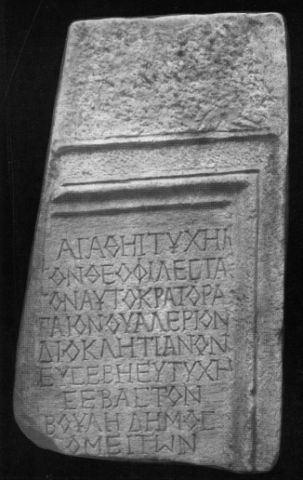
Fragmentary plaque from base for statue of Diocletian, emperor. From Constantia (Tomis) (Scythia). 284-305
Record details
Photographs
Inscription
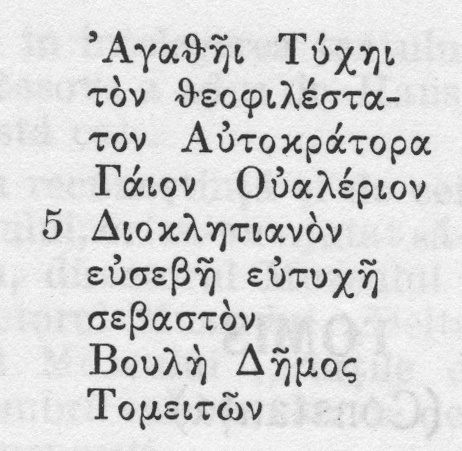
Ἀγαθῇ τύχῃ. τὸν θεοφιλέσ/τατον Αὐτοκράτορα / Γάιον Οὐαλέριον /(5) Διοκλητιανὸν / εὐσεβῆ εὐτυχῆ / σεβαστὸν / βουλὴ δῆμος / Τομειτῶν.
Inscription translation
To Good Fortune. The god-loving emperor Gaius Valerius Diocletianus, pious and fortunate Augustus. The council (boule) [and] the people (demos) of Tomis [honour him].
Bibliography
- Popescu, E., Inscripțiile grecești și latine din secolele IV-XIII descoperite în România, Bucarest 1976, pp. 35-6 no. 1
Discussion
INSCRIPTION
In nine lines:
Ἀγαθῇ τύχῃ. τὸν θεοφιλέσ/τατον Αὐτοκράτορα / Γάιον Οὐαλέριον /(5) Διοκλητιανὸν / εὐσεβῆ εὐτυχῆ / σεβαστὸν / βουλὴ δῆμος / Τομειτῶν.
'To Good Fortune. The god-loving emperor Gaius Valerius Diocletianus, pious and fortunate Augustus. The council (boule) [and] the people (demos) of Tomis [honour him].'
Letter height 5 - 7 cm.
The standard Greek epigraphic formula, with the honorand in the accusative and the awarder in the nominative, makes it certain that this was a statue dedication.
DESCRIPTION (from Popescu 1976 and the published image)
Marble plaque broken at bottom and left: H 112, W 67, D 32 cm. The plaque must have been attached to a base made primarily of other materials.
PROVENANCE AND CURRENT LOCATION.
First recorded by Suțu 1881; according to him the inscription was found in Constanța (then called Custendjé), the site of ancient Tomis, and brought to the Bucarest museum. Popescu 1976 recorded it in the Bucarest National Archaeological Museum, inv. no. MNA, L, 333.
HONORAND, AWARDER AND DATE
Diocletian, the honorand, was Augustus 284-305.
The inscription was set up by the municipal bodies (council and people, boule and demos) of Tomis.
Discussion references
- Suțu, M, Monuments antiques de la Dobrudja, Revue archeologique 42, 1881, 287-304, p. 297
Cite: Last Statues of Antiquity, LSA-2602 (Ulrich Gehn).