
LSA-2603
Fragmentary base for statue of unknown man, possibly governor of Scythia or praetorian prefect of Illyricum. Constantia (Tomis) (Scythia). Probably fourth century
Record details
Photographs
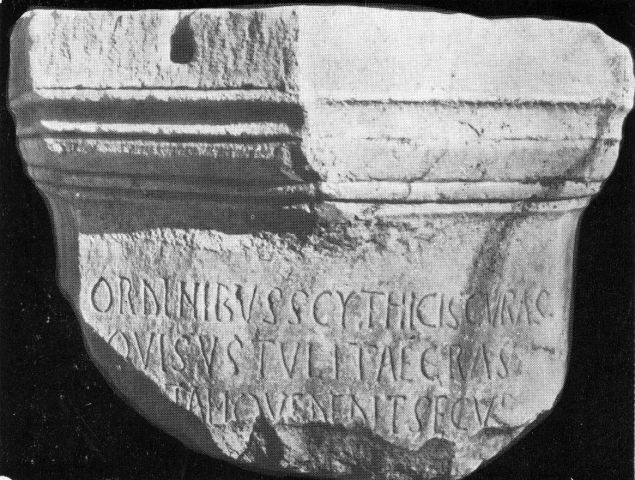
Inscription
Ordinibus Scythicis curas / qui sustulit aegras /
[---]tamque dedit secur[ ------] / ---
Inscription translation
Who sustained the sorrowful cares of the Scythians councillors and gave them ... secure ...
Bibliography
- Popescu, E., Inscripțiile grecești și latine din secolele IV-XIII descoperite în România, Bucarest 1976, pp. 38-9 no. 4
Discussion
INSCRIPTION
Verse inscription in hexameters, of which one is complete and another one fragmentarily preserved, in three preserved lines:
Ordinibus Scythicis curas / qui sustulit aegras /
[--]tamque dedit secur[e] / [-----] /
...
'Who sustained the sorrowful cares of the Scythian councillors and gave them ... secure ...'.
Letter height 4.5 cm.
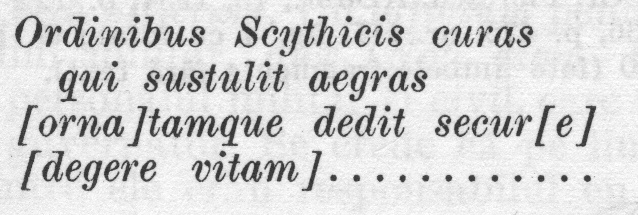
Albertini 1938 proposed the following completion to lines 3-4:
'Ordinibus Scythicis curas / qui sustulit aegras / [orna]tamque dedit secur[e] / [degere vitam] / ... - 'Who sustained the sorrowful councillors of the Scythian decurions, and enabled them to lead a dignified and safe life, ...'
DESCRIPTION (from Popescu 1976 and the published photograph)
Fragment of a marble base with crown moulding: H 58, W 82, D 42 cm. The base is broken and lost after line 3 of the inscription.
The published photograph shows a polygonal crown moulding, with a corner protruding above the centre of the epigraphic field, which seems to have been created by flattening and amalgamating two faces of the shaft. The current shape may well have been the result of a late antique recutting of a polygonal (perhaps hexagonal) pillar; similar adaptations are known from Tegea in the Peloponnese (LSA-355, LSA-356).
In the crown moulding, on the left, there is a rectangular hole, possibly a clamp hole for fixing an element above. On the top face there are holes for the insertion of a bronze statue.
PROVENANCE AND CURRENT LOCATION
First recorded as being from Constanța by Mercklin 1850, from records made by the Russian admiral Heyde (in the earlier 19th century). Popescu 1976 recorded it in the Constanța museum, inv. no. 1 460.
HONORAND, AWARDER AND DATE
The honorand’s name and title are not preserved; he is praised as having helped the city councillors (decurions) of Scythia (ordinibus Scythicis, line 1) by sustaining their sorrowful cares (curas qui sustulit aegras, lines 1.-2). The latter may refer to the municipal obligations (munera) which had to be taken on by the decurions. The honorand was therefore probably a high-ranking imperial office holder with the authority to influence municipal budgets, a provincial governor or a praetorian prefect.
Although the awarder's name is lost, the surviving words of the inscription suggest that our base was erected by a group of city councillors from the province of Scythia.
The verse form dates our inscription to Late Antiquity. Verse was used in the Greek East for honorific inscriptions to high-ranking imperial office holders through the 4th and into the 6th century. Our inscription is a rare example of a Latin verse inscription, in a region, however, which was heavily influenced by Greek culture. The reference to the 'Scythian decurions' (line 1) probably refers to the province (not the generic region) of Scythia, a province which was founded in the wake of the provincial reforms of the tetrarchy in the 290’s or later. Dedications to state officials in provincial cities became rare in the later 5th century; there are, however, two outstanding monuments to military commanders known from the Balkans in that period (LSA-10; LSA-367). While we think that the inscription is probably from the 4th century, a date in the 5th century is also possible.
Discussion references
- Albertini, M. E., Compte-rendu des séances de la société des études Latines, Revue des études Latines 16, 1938, 27
- Mercklin, L., Epigraphisches. Inschriften aus Mösien, Denkmäler, Forschungen und Berichte, als Fortsetzung der Archäologischen Zeitung 1 (= Archäologische Zeitung 7), 1849, 139-42, col. 140 no. 4
Cite: Last Statues of Antiquity, LSA-2603 (Ulrich Gehn).