
LSA-2604
Votive inscription testifying to a statue of Sol (the Sun god). Salsovia (Scythia). 317-324, perhaps 323-324
Record details
Photographs
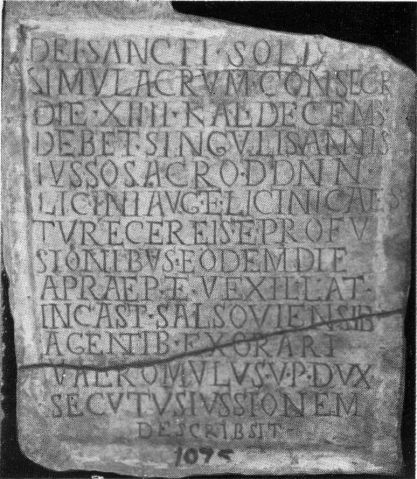
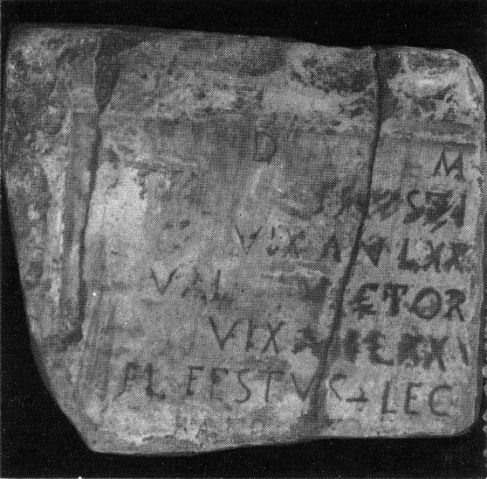
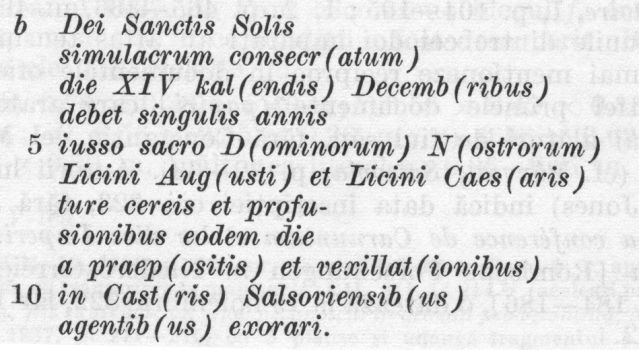
Inscription
Dei sancti Solis / simulacrum, consecr(atum) / die XIV kal(endis) Decemb(ribus), / debet singulis annis, /(5) iusso sacro dd(ominorum) nn(ostrorum) / Licini Aug(usti) et Licini Caes(aris), / ture, cereis et profu/sionibus eodem die / a praep(ositis) et vexillat(ionibus) / (10) in cast(ris) Salsoviensib(us) / agentibus exorari. / Val(erius) Romulus, v(ir) p(erfectissimus), dux, / secutus iussionem, / describsit.
***Should we have 'exorari (sic, for 'exornari')'?****
Inscription translation
The statue of the holy god Sol (which was) consecrated on the 18th November, by order of our lords Licinius Augustus and Licinius Caesar, must be decorated with incense, candles and libations, every year on the same day, by the commanders and military units garrsioned in the barracks of Salsova. Valerius Romulus, of perfectissimus rank, commander (dux), wrote this down, obeying order.
Textual evidence
Dei sancti solis / simulacrum consecr(atum) / die XIV kal(endis) Decemb(ribus) / debet singulis annis /(5) iusso sacro dd(ominorum) nn(ostrorum) / Licini Aug(usti) et Licini Caes(aris) / ture cereis et profu/sionibus eodem die / a praep(ositis) et vexillat(ionibus) / (10) in cast(ris) Salsoviensib(us) / agentibus exorari. / Val(erius) Romulus v(ir) p(erfectissimus) dux / secutus iussionem / describsit.
Translation
The statue of the holy god Sol (which was) consecrated on the 18th november, by order of our lords Licinius Augustus and Licinius Caesar, must be decorated with incense, candles and libations, every year on the same day, by the commanders and military units garrsioned in the barracks of Salsova. Valerius Romulus, of perfectissimus rank, commander in chief (dux), wrote this down, obeying order.
Bibliography
- Dessau, H., Inscriptiones latinae selectae, Berlin 3rd ed. 1962, 8940
- Dorutiu-Boilǎ, E., Inscripţiile antice din Dacia şi Scythia Minor = Inscriptiones Daciae et Scythiae Minoris antiqvae, ser. 2, vol. 5, Bucureşti 1980, 290
- Popescu, E., Inscripțiile grecești și latine din secolele IV-XIII descoperite în România, Bucarest 1976, no. 271
Discussion
SOURCE
A votive inscription laid out in 14 lines:
Dei sancti Solis / simulacrum, consecr(atum) / die XIV kal(endis) Decemb(ribus), / debet singulis annis, /(5) iusso sacro dd(ominorum) nn(ostrorum) / Licini Aug(usti) et Licini Caes(aris), / ture, cereis et profu/sionibus eodem die / a praep(ositis) et vexillat(ionibus) / (10) in cast(ris) Salsoviensib(us) / agentibus exorari (sic, for 'exornari'). / Val(erius) Romulus, v(ir) p(erfectissimus), dux, / secutus iussionem, / describsit.
'The statue of the holy god Sol (which was) consecrated on the 18th November, by order of our lords Licinius Augustus and Licinius Caesar, must be decorated with incense, candles and libations, every year on the same day, by the commanders and military units garrsioned in the barracks of Salsova. Valerius Romulus, of perfectissimus rank, commander (dux), wrote this down, obeying order.'
Letter height not recorded.
DESCRIPTION (from Popescu 1976 and the published image)
Marble plaque horizontally broken into two pieces: H 63, W 50, D 7.5 cm. The epigraphic field is framed, the upper right corner of the frame broken off and lost. Our inscription is on the back side of an earlier funerary inscription of the 2nd/3rd century. For our inscription, the plaque was rotated, so that the original left side is now the top edge.
PROVENANCE AND CURRENT LOCATION
First recorded in 1865 in the ruins of the military camp of Salsovia, at the western margins of the modern village of Mahmudia. Recorded in the 'Historical Museum of the Socialist Republic of Romania (Muzeul de istorie al Republicii Socialiste România)', inv. no. 17865, by Popescu 1976.
HONORAND, AWARDER AND DATE
Sol, the Sun god, was a protective divinity much favoured by the Roman army in the 3rd and 4th centuries.
The statue being honoured was probably set up by the soldiers or officers of the military unit garrisoned at Salsovia. Valerius Romulus, the military commander (dux) who ordered the celebrations (line 12) is only known from this inscription (PLRE I, 772 Valerius Romulus 6).
The two emperors who ordered the veneration of Sol on the 18th November were Licinius I, Augustus 308-24, and his son Licinius II, Caesar 317-24. 18 November was New Year’s day in the Syro-Macedonian calendar obeyed in Licinius’ main residence of Antioch. Our inscription dates from the common reign of the two Licinii, 317-24.
In conflict with Constantine, Licinius’ troops marched under the protection of Sol (Domaszewski 1909, 206-8). Our inscription was therefore dated by Domaszewski to 323/4, the year of the final conflict between the two emperors. The omission of Constantine’s name lends support to a date when the two emperors were at loggerheads.
Discussion references
- Domaszewski, A. v., Abhandlungen zur römischen Religion, Leipzig 1909
- Jones, A. H. M. et al., The Prosopography of the Later Roman Empire. Vol. I 260-395, Cambridge et al. 1971 (1975)
Cite: Last Statues of Antiquity, LSA-2604 (Ulrich Gehn).