
LSA-261
Base for statue of Diocletian, emperor. Side (Pamphylia). 284-305.
Record details
Photographs
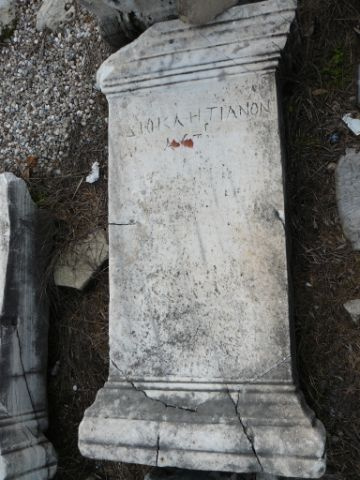
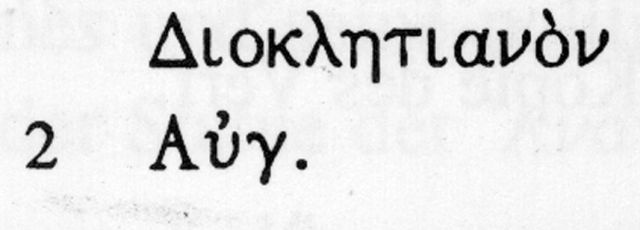
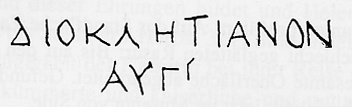
Inscription
Διοκλητιανὸν Ἀυγ(οῦστον)
Inscription translation
To Diocletianus Augustus
Bibliography
- Nollé, J. , Side im Altertum : Geschichte und Zeugnisse (Inschriften griechischer Städte aus Kleinasien ; Band 43), Bonn 1993, vol. 43, no. 46
Discussion
INSCRIPTION
In two lines:
Διοκλητιανὸν Ἀυγ'(οῦστον)
'To Diocletianus Augustus'.
Letter height not recorded. 'Ἀυγ' is followed by an abbreviation mark.
DESCRIPTION (from Bean 1956 and Nollé 1993)
Rectangular base of white marble, back broken; H 147, W 61, D 30 cm. Bean 1956, 82 stresses the fine quality of the base, equal to the other imperial dedications of the fourth century (see below, 'Provenance and Location'), in sharp contrast to the poor quality of the script. Unlike those on the other bases, our inscription to Diocletian was not carved over an erasure; Bean assumed that it was carved on the back face of the original base, the original front face now broken away. It is indeed very likely that our base was a re-used piece, like the surviving 4th-century dedications in Side.
PROVENANCE AND CURRENT LOCATION
The base was found in 1948 close to the main gate of Side, where the two great colonnaded streets of the city part (for a map see Mandel 1978; the main gate is 'A 3', the colonnaded streets are B and C). It is one of a set of seven late antique statue bases, all re-used, with dedications to emperors (our base, LSA-262, LSA-263, LSA-264, LSA-265, LSA-266) and in one case to the personification of Imperial Education (LSA-276), probably all set up along the large colonnaded street running from the main gate towards the agora and the theatre (Nollé 1993, 321; for the colonnaded streets Mansel 1965, 17-24; Mansel 1978, 21-34 and map).
HONORAND AND DATE
Diocletian, the honorand, was Augustus 284-305.
Discussion references
- Bean, G. E., Inscriptions, Mansel, A. M., Bean, G. E. & J. Inan, Die Agora von Side und die benachbarten Bauten. Bericht über die Ausgrabungen im Jahr 1948, pp. 79-98, Ankara 1956, pp. 80-2 no. 46
- Mansel, A. M., Side, Ankara 1978, map on last page
Cite: Last Statues of Antiquity, LSA-261 (Ulrich Gehn).