
LSA-2618
Base for statue of Diocletian, emperor. Gerasa (Arabia). 284-286
Record details
Photographs
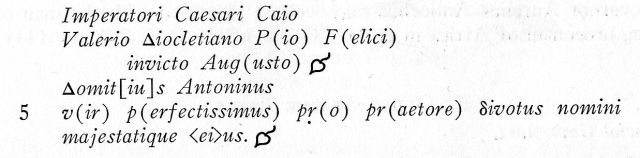
Inscription
Imperatori Caesari Caio / Valerio Δiocletiano, p(io), f(elici), / invicto Aug(usto), (leaf) / Δomit[iu]s Antoninus /(5) v(ir) p(erfectissimus) pr(aeses) pr(ovinciae), divotus (sic, for devotus) nomini (sic, for numini) / maiestatique eius (leaf).
Inscription translation
To the emperor Caesar Caius Valerius Diocletian, pious, fortunate, unconquered Augustus. Domitius Antoninus, of perfectissimus rank, governor (praeses) of the province, devoted to his divine spirit and majesty.
Bibliography
- Welles, C. B., The Inscriptions, Gerasa. City of the Decapolis (ed. by C. H. Kraeling), New Haven 1938, 355-616, p. 431 no. 160 pl. CXXXVIII a
Discussion
INSCRIPTION
In six lines:
Imperatori Caesari Caio / Valerio Δiocletiano, p(io), f(elici), / invicto Aug(usto), (leaf) / Δomit[iu]s Antoninus /(5) v(ir) p(erfectissimus) pr(aeses) pr(ovinciae), divotus (sic, for devotus) nomini (sic, for numini) / maiestatique eius (leaf).
'To the emperor Caesar Caius Valerius Diocletian, pious, fortunate, unconquered Augustus. Domitius Antoninus, of perfectissimus rank, governor (praeses) of the province, devoted to his divine spirit and majesty.'
Letter height 4.5 cm.
Welles 1938 completed the title of the awarder (line 5) to pr(o) pr(aetore). The rank of the provincial governors before the provincial reforms of the tetrarchy was that of a legatus Augusti pro praetor; this title, however, is usually abbreviated to leg(atus) Aug(usti) pr(o) pr(aetore) (eg. Welles 1938 no. 165). praeses, on the other hand, is widely used informally for governors in the region in the 3rd century before it became an official title in the wake of the provincial reforms (LSA-1151), and pr(aeses) pr(ovinciae) is a widely used abbreviation here and elsewhere.
In this Latin inscription the names both of the honorand Diocletian (line 2) and of the awarder Domitius Antoninus (line 4) begin with a Greek delta.
DESCRIPTION (from Welles 1938 and the published image)
Cylindrical base moulded at top and bottom, H 62, diameter 46 cm (Welles 1938 no. 165). The lower moulding is set on a cylindrical plinth, and on top of the upper moulding, there is a second cylindrical plinth worked from the same block. The upper plinth is broken on top; moreover there is an outbreak on the upper moulding. Our inscription is carved on the opposite side of an earlier one to the provincial governor Caius Allius Fuscianus (mid-2nd century, Welles 1938 no. 165).
PROVENANCE AND CURRENT LOCATION
The inscription was recorded in the garden next to the mosque in the modern village by Welles 1938. There is no more recent record of its location.
HONORAND, AWARDER AND DATE
Diocletian, the honorand, was Augustus 284-305. The imperial name as given in lines 1-2 (Caius Valerius Diocletianus) was in use before Maximian was elevated to be co-Augustus in 386; after that, Diocletian took on the additional name Aurelius (Caius Aurelius Valerius Diocletianus). This dates our inscription to 284-6.
Domitius Antoninus, the awarder, is only known from this inscription (PLRE I, 75 Domitius Antoninus 9). He was governor of the province of Arabia. The province was administered by pro-praetors (legati Augusti pro praetore) until the late 3rd century; in the wake of the provincial reforms in the 290s it came under a praeses of equestrian (perfectissimus) rank. The imperial title dates our inscription earlier than the reform (see above, last paragraph, and ‘Inscription’).
Discussion references
- Jones, A. H. M. et al., The Prosopography of the Later Roman Empire. Vol. I 260-395, Cambridge et al. 1971 (1975)
Cite: Last Statues of Antiquity, LSA-2618 (Ulrich Gehn).