
LSA-2620
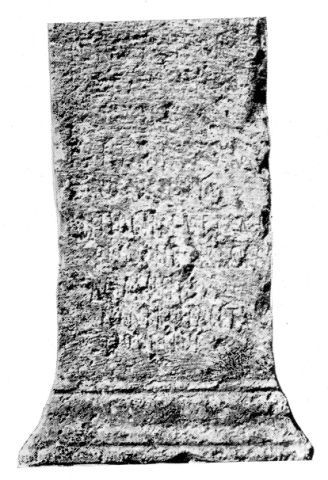
Base for statue of emperor, name lost (probably tetrarch). Gerasa (Arabia). Late third to early fourth century
Record details
Photographs
Inscription
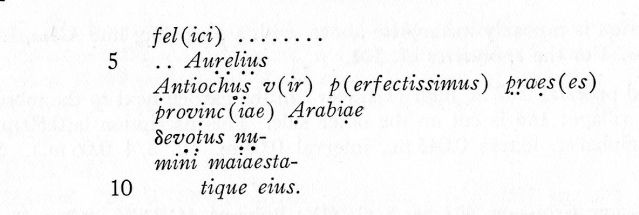
--- / ---/ --- / fel(ici) --- /(5) -- Aurelius / --- Antiochus v(ir) p(erfectissimus) praes(es) / provinc(iae) Arabiae / devotus nu-/mini maiesta-/tique eius
Inscription translation
To …, fortunate … . …Aurelius Antiochus, of perfectissimus rank, governor (praeses) of the province of Arabia (set this up), devoted to his divine spirit and majesty.
Bibliography
- Corpus Inscriptionum Latinarum; , III 6035, 14157
- Welles, C. B., The Inscriptions, Gerasa. City of the Decapolis (ed. by C. H. Kraeling), New Haven 1938, 355-616, no. 162
Discussion
INSCRIPTION
Originally in ten lines, the first three of which are now destroyed:
--- / ---/ --- / fel(ici) --- /(5) -- Aurelius / --- Antiochus v(ir) p(erfectissimus) praes(es) / provinc(iae) Arabiae / devotus nu-/mini maiesta-/tique eius
‘To …, fortunate … . …Aurelius Antiochus, of perfectissimus rank, governor (praeses) of the province of Arabia (set this up), devoted to his divine spirit and majesty.’
Letter height 4.5 cm.
DESCRIPTION (from Welles 1938 and the published image)
Rectangular base with mouldings at bottom; height of epigraphic field 33, width 44 cm (more measurements possibly in Clermont Ganneau, EAO II, 87-9 no. H).
PROVENANCE AND CURRENT LOCATION
The inscription was recorded on the west side of the cardo of Gerasa, close to the nymphaeum by Welles 1938.
HONORAND, AWARDER AND DATE
The honorand is an emperor, as is clear from the extant formula; however, the imperial name in the first three lines is lost.
The awarder, Aurelius Antiochus, was governor of the province of Arabia; he known from our inscription, and probably from another one, likewise to a single emperor, Oum-idj-Djimal (Arabia) (Année Épigraphique 1913, 144; the name is mutilated) (PLRE I, 72 Aur. Antiochus 12).
Provincial governors of Arabia held the title of praeses, together with the rank attribute perfectissimus, from the tetrarchic period onwards; however, the term is used in an unofficial way to refer to the provincial governor already in the mid-3rd century (LSA-1151, ‘Honorand, Awarder and Date’). While a somewhat earlier date in the later 3rd century cannot be ruled out entirely, the epigraphic formula in general and the governor’s title in particular fit a tetrarchic date perfectly.
Welles 1938, 432 argued that the awarder could well be identical with the proconsul of Africa of the same name in 285/90 (PLRE I, 72 Aur. Antiochus 13). However, the proconsulship in Africa remained a privilege of the Roman senatorial aristocracy through the tetrarchic period; provincial governorships like the one in Arabia, on the other side, were usually entrusted to men of equestrian rank who took their rise in the imperial entourage.
Discussion references
- Jones, A. H. M. et al., The Prosopography of the Later Roman Empire. Vol. I 260-395, Cambridge et al. 1971 (1975)
Cite: Last Statues of Antiquity, LSA-2620 (Ulrich Gehn).