
LSA-2630
Fragment of base for statue of Constantine I, emperor. Thebae (Thebais). 310-324
Record details
Photographs
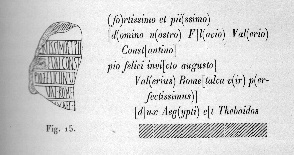
Inscription
[fo]rtissimo et pii[ssimo --] / [-- F]l(avio) Val(erio) Const[antino --] / pio felici invi[cto ---] / Val(erius) Rome[talca --] /[d]ux Aeg(ypti) e[t --].
Inscription translation
To the most powerful and pious ... Flavius Valerius Constantinus ..., pious, fortunate, unconquered ... . Valerius Rometalca, military commander (dux) of Egypt and ... .
Bibliography
- Lacau, P., Inscriptions latines du temple de Louxor, Annales du Service des Antiquités de l’Égypte 34, 1934, 17-46, 38-9 no. IV B
Discussion
INSCRIPTION
Partly preserved in five lines:
[fo]rtissimo et pii[ssimo --] / [-- F]l(avio) Val(erio) Const[antino --] / pio felici invi[cto ---] / Val(erius) Rome[talca --] /[d]ux Aeg(ypti) e[t --]
'To the most powerful and pious ... Flavius Valerius Constantinus ..., pious, fortunate, unconquered ... . Valerius Rometalca, military commander (dux) of Egypt and ... .'
Letter height not recorded.
DESCRIPTION (from Lacau 1934)
Fragment of a block of sandstone, broken on all sides; D ca. 45 cm. The block is compared to the inscribed front block of another base to Constantine in Thebes, LSA-1180, by Lacau 1934.
PROVENANCE AND CURRENT LOCATION
The fragment was found in 1889 in the Roman military camp built onto the area of the temple of Ammon at Thebes, in the Great court of Amenophis III, at the northern wall in its western portion. This court is placed on the central axis of the camp leading to the room for the imperial cult; along this axis, another statue to Constantine, awarded by the same man (LSA-1180; see below, ‘Honorand, Awarder and Date’), was set up (see also LSA-2629).
There is no published record of the fragment’s current location.
HONORAND, AWARDER AND DATE
The honorand, Constantine I, was Augustus 306-337, but fully recognized in the East only from 310 (Kienast 1996). In 324, on the defeat of Licinius, he substituted his earlier title invictus (as in our inscription) with a new title victor.
The awarder, Valerius Rometalca, is known from this inscription and a better preserved similar one from Thebae (LSA-1180). A further, mutilated yet very similar inscription now in Alexandria might be attributable to him, LSA-1179 (PLRE I, 770, Val. Rometalca). He was the commander of the frontier troups in the provinces of Egypt and Libya (dux Aegypti et Thebaidos utrarumque Libyarum).
FURTHER DISCUSSION
The rank of dux was held by commanders of frontier troops in the late Roman army. In the Constantinan period one such commander was responsible for all the provinces of Egypt and Lybia (Mommsen 1889, p. 211 n. 2).
Discussion references
- Jones, A. H. M. et al., The Prosopography of the Later Roman Empire. Vol. I 260-395, Cambridge et al. 1971 (1975)
- Kienast, D., Römische Kaisertabelle : Grundzüge einer römischen Kaiserchronologie, Darmstadt, 1996
- Mommsen, T., Das römische Militärwesen seit Diocletian, Hermes 24, 195-279, Berlin 1889
Cite: Last Statues of Antiquity, LSA-2630 (Ulrich Gehn).