
LSA-2631
Base for statue of Constantius I, emperor. Thebae (Thebais). 302-304
Record details
Photographs
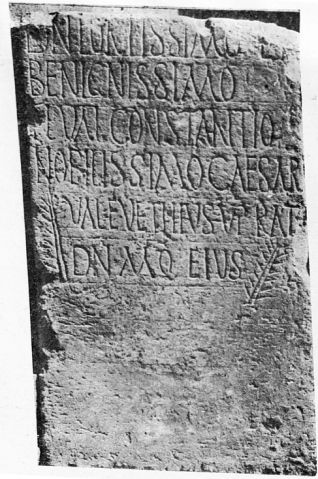
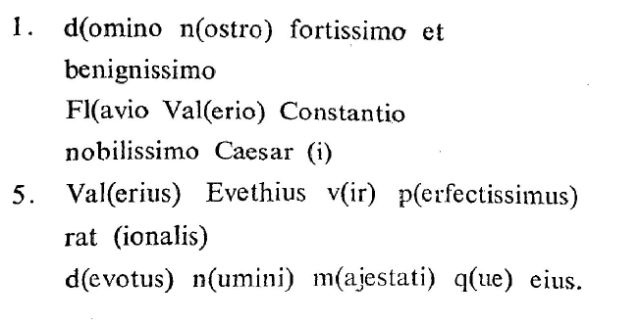
Inscription
D(omino) n(ostro) fortissimo et / benignissimo / Fl(avio) Val(erio) Constantio / nobilissimo Caesar(i) /(5) Val(erius) Euethius v(ir) p(erfectissimus) / rat(ionalis) / d(evotus) n(umini) m(aiestati)q(ue) eius
Inscription translation
To our most powerful and benign lord, Flavius Valerius Constantius, most noble Caesar. Valerius Eustathius, of perfectissimus rank, rationalis, (set this up), devoted to his divine spirit and majesty.
Bibliography
- Riad, H., Quelques inscriptions grecques et latines du temple de Louxor, Annales du Service des Antiquités de l'Égypte 60, 281-95, Cairo 1968, 291-4 no. 22 pl. IV
Discussion
INSCRIPTION
In seven lines:
D(omino) n(ostro) fortissimo et / benignissimo / Fl(avio) Val(erio) Constantio / nobilissimo Caesar(i) /(5) Val(erius) Euethius v(ir) p(erfectissimus) / rat(ionalis) / d(evotus) n(umini) m(aiestati)q(ue) eius
‘To our most powerful and benign lord, Flavius Valerius Constantius, most noble Caesar. Valerius Eustathius, of perfectissimus rank, rationalis, (set this up), devoted to his divine spirit and majesty.’
Letter height not recorded.
The final two lines are flanked by palm twigs.
DESCRIPTION (from Riad 1968 and the published image)
Rectangular block of sandstone, H 150, W 68, D 30 cm.
PROVENANCE AND CURRENT LOCATION
The block was found in the military camp (former sanctuary of Ammon) at Thebes (Luxor), west of the hall of Ramses II, during excavations in 1958/9. A similar provenance, ‘western part of the camp’ has been recorded for the twin inscription to the other Caesar of the tetrarchy, Galerius (LSA-2629). Both inscriptions (and possibly additional ones to the Augusti) were possibly set up at one of the roads leading to the tetrapylon with the dedications to the tetrarchs (LSA-2625, LSA-2626, LSA-2627, LSA-2628).
There is no published record of the inscription’s present location.
HONORAND, AWARDER AND DATE
Constantius I, the honorand, was Caesar 293-305.
Valerius Euethius, the awarder, was rationalis Aegypti, that is the highest ranking finance officer of the diocese (PLRE I, 291 Valerius Euethius 2). He is known from several papyri which can be dated to 302-4 (PLRE l. c.). He set up another, similar inscription to Galerius in the camp at Thebae (LSA-2629).
Discussion references
- Jones, A. H. M. et al., The Prosopography of the Later Roman Empire. Vol. I 260-395, Cambridge et al. 1971 (1975)
Cite: Last Statues of Antiquity, LSA-2631 (Ulrich Gehn).