
LSA-2636
Base for statue of Justinian, emperor. Cyrrhus (Euphratensis). 527-565 (probably 527-548)
Record details
Photographs
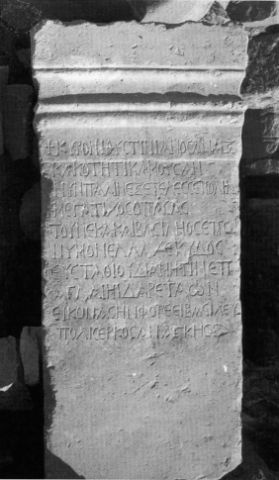
Inscription
κῦρον Ἰουστινιανὸς ἄναξ / κακότητι καμοῦσαν /
νῦν πάλιν ἐξετέλεσσε πόλιν, / μέγα τ(ε)ῖχος ὀπάσας. / (5) Τοὔνεκα καὶ βασιλῆος ἐπώ/νυμον ἔλλαχε κῦδος / Εὐσταθίου διὰ μῆτιν. Ἐπ‘ / ἀγλαΐῃ δ‘ἀρετάων / εἰκόνα σὴν φορέει, βασιλεῦ, /(10) πόλις ἕρκος ἀνάγκης·
Inscription translation
The emperor Justinian now raised again to supreme power (κῦρον) the city which had suffered badly through wickedness, by providing it with a large wall. Thereby she also gained the glory of bearing the emperor’s name, through the wisdom of Eustathius. To [honour] the splendour of your virtues, the city carries your image, Emperor, as a defence against evil.
Bibliography
- Alpi, F.,Base de statue de Justinien ornée d'une inscription métrique, Syria 88, 2011, 342-3
Discussion
INSCRIPTION
Verse inscription of five hexameters laid out in ten lines:
(cross) κῦρον Ἰουστινιανὸς ἄναξ / κακότητι καμοῦσαν /
νῦν πάλιν ἐξετέλεσσε πόλιν, / μέγα τ(ε)ῖχος ὀπάσας. /
(5) Τοὔνεκα καὶ βασιλῆος ἐπώ/νυμον ἔλλαχε κῦδος /
Εὐσταθίου διὰ μῆτιν. Ἐπ‘ / ἀγλαΐῃ δ‘ἀρετάων /
εἰκόνα σὴν φορέει, βασιλεῦ, /(10) πόλις ἕρκος ἀνάγκης· (ivy leaf)
'The emperor Justinian now raised again to supreme power (κῦρον) the city which had suffered badly through wickedness, by providing it with a large wall. Thereby she also gained the glory of bearing the emperor’s name, through the wisdom of Eustathius. To [honour] the splendour of your virtues, the city carries your image, Emperor, as a defence against evil.'
The general sense of the inscription is clear, though the precise meaning of the first line of verse is not entirely certain.
Letter height 4 cm.
DESCRIPTION (from Alpi 2011 and the published images)
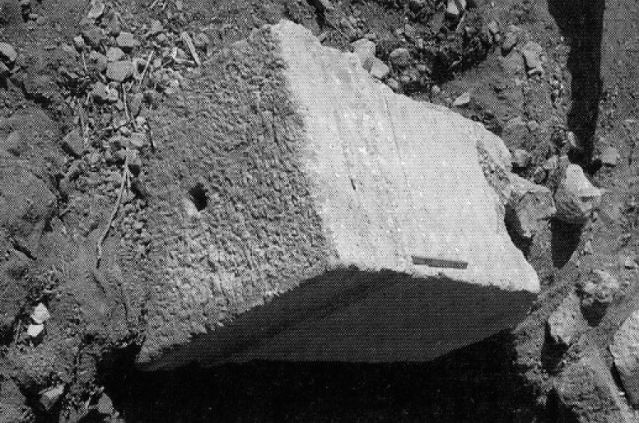
Rectangular limestone block with mouldings at top: H 150, W 72, D 80 cm. The four sides are smooth. The top face is roughly finished; at its centre there is a rectangular dowel hole to fix a crown moulding, or the plinth of a statue. The first line of the inscription is carved on the upper moulding.
PROVENANCE AND CURRENT LOCATION
The inscription was first recorded in Cyrrhus in 1964, and was re-recorded in 2010. It was built into a post-antique wall on the cardo of Cyrrhus, in the area of the theatre. There is no published record of its present location.
HONORAND, AWARDER AND DATE
Justinian, the honorand, was emperor 527-65.
Eustathius (line 7) who advised the city to adopt the imperial name ('Justiniana'), and who presumably gained this privilege from the emperor, is most probably the magister utriusque militiae of that name who is recorded in an acclamation in the nearby provincial capital Hierapolis (PLRE III, 470-1 Eustathius 4; inscription: L’Année Épigraphique 1947, 195; see also below, ‘Further Discussion’). The inscription from Hierapolis also records acclamations to Justinian and Theodora (died 548) and is therefore datable to 527/48.
The inscription was set up by the city of Cyrrhus (line 10).
The wickedness that the city had suffered (line 2), necessitating its new defences, may well have been devastation during the Persian invasion of 540; if so, this would narrow the date of our inscription to 540/8.
FURTHER DISCUSSION
There are other men with the name of Eustathius, who are possibly identical to the one named in our inscription (for instance a prefect of the city of Constantinople of 530/1, PLRE III, 469-70 Eustathius 1); but in our context Eustathius the magister utriusque militiae recorded at Hierapolis is the most likely contender. He probably succeeded Belisarius as supreme commander on the Persian front.
The splendor (ἀγλαΐῃ, line 8) referred to by our inscription possibly mirrors the material of the statue (perhaps of bronze; possibly even gilded).
This is very late for a provincial statue to an emperor - however LSA-365 at Pisidian Antioch, also to Justinian, and also apparently related to defensive work, provides a close parallel.
ACKNOWLEDGEMENTS
We are grateful to Prof. Jean-Pierre Sodini, Paris, for alerting us to this important inscription.
Discussion references
- Cameron, A., Ward-Perkins, B. & M. Whitby, Late Antiquity: Empire and Successors, A.D. 425-600 (The Cambridge Ancient History Volume XIV), Cambridge 2000, 595 (H. Kennedy)
- Martindale, J. R., The Prosopography of the Later Roman Empire. Volume III A. D. 527-641, Cambridge 1992
Cite: Last Statues of Antiquity, LSA-2636 (Ulrich Gehn).