
LSA-2637
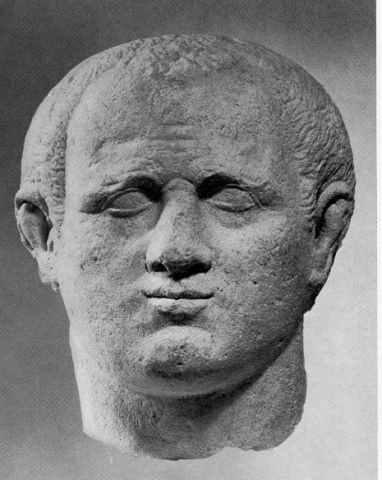
Portrait herm of Vespasian? Welschbillig (Belgica II). Later fourth century.
Record details
Photographs
Bibliography
- Wrede, H., Die spätantike Hermengalerie von Welschbillig : Untersuchung zur Kunsttradition im 4. Jahrhundert n. Chr. und zur allgemeinen Bedeutung des antiken Hermenmals , Berlin 1972, 56-7, 115, no. 92, pls. 15.3, 16.1
Discussion
DESCRIPTION (Object)
Portrait head broken from its herm. Jura limestone.
PROVENANCE
Found around the pool of the imperial villa at Welschbillig. It is one of 70 extant herms and one of an original total of 108-112 (94-98) herm portraits; see also LSA-1075, LSA-2638, LSA-2639, and LSA-2640. These herm portraits punctuated the balustrade around the pool which has not been completely uncovered (thus, the discrepancy in the total count). This herm was excavated in 1841 with four others. It is a pair with Herm no. 91 with which it was found.
DESCRIPTION (Subject)
The portrait bust shows a clean-shaven man, older man. He has a balding brow with short hair that is combed forward. The brow is marked by three creases. The eyebrows sag over the eyes, and at the root of the nose is a dep crease. The mouth is small and the chin prominent.
DATE
The Villa at Welschbillig, to which the pool belonged, was almost certainly imperial and of the fourth-century. The date is confidently placed in the latter part of the fourth-century on the basis of historic, archaeological, and art historic considerations. An imperial presence in Trier is either known or can be assumed (from the numerous laws issued there) for the period between 367-390; the re-use of funerary material in the basin floor post-dates Julian until which point desecration of cemeteries was forbidden; and there is an iconographic similarity between many of the herm portraits and members of the Theodosian court as represented on the Obelisk in Istanbul and in other media.
HONORAND
Wegner identified this portrait and its pendant as Vespasian. Although this cannot be proved, it seems convincing. Among the Welschbillig herms are several that appear to represent Romans of the imperial period. This portrait shows a fashion style (hair and beard) of the late first century and gives the salient details of the portraits of Vespasian; the tall balding and creased brow and the prominent chin. Portraits of past emperors appear elsewhere in late-antiquity as examples of good ruler of the past.
Cite: Last Statues of Antiquity, LSA-2637 (J. Lenaghan).