
LSA-2639
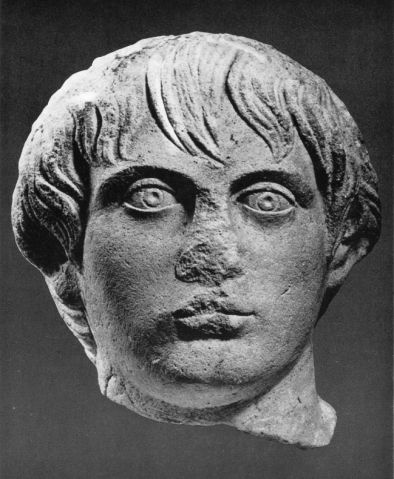
Portrait herm of Vibullius Polydeuces. Welschbillig (Belgica II). Later fourth century.
Record details
Photographs
Bibliography
- Wrede, H., Die spätantike Hermengalerie von Welschbillig : Untersuchung zur Kunsttradition im 4. Jahrhundert n. Chr. und zur allgemeinen Bedeutung des antiken Hermenmals , Berlin 1972, 54, 113, pls. 12.1, 14.1, 4
Discussion
DESCRIPTION (Object)
Portrait head. Jura limestone.
The head has broken off a herm. The nose is missing, and the lips are chipped.
PROVENANCE
Found in 1891-2 around the pool of the imperial villa at Welschbillig. It is one of 70 extant herms and one of an original total of 108-112 (94-98) herm portraits; see also LSA-1075, LSA-2637, LSA-2638, and LSA-2640. These herm portraits punctuated the balustrade around the pool which has not been completely uncovered (thus, the discrepancy in the total count). It was excavated in the first museum excavation under a medieval wall in the southeast side of the pool.
DESCRIPTION (Subject)
The head shows a boy with wavy, slightly tousled, medium to long hair that mainly covers his ears. The hair across the brow falls in three separate sections which leave triangular areas of the brow visible. The middle lock turns to his left, and the left lock curves back towards the middle lock. The right section is made of smaller locks which have slight parts between them. The locks almost touch the eyebrows. The face itself is full and regular with a pouting lower lip. This portrait is a version of the portrait type used for Herodes Atticus’ favourite pupil, Polydeuces.
DATE
The Villa at Welschbillig, to which the pool belonged, was almost certainly imperial and of the fourth-century. The date is confidently placed in the latter part of the fourth-century on the basis of historic, archaeological, and art historic considerations. An imperial presence in Trier is either known or can be assumed (from the numerous laws issued there) for the period between 367-390; the re-use of funerary material in the basin floor post-dates Julian until which point desecration of cemeteries was forbidden; and there is an iconographic similarity between many of the herm portraits and members of the Theodosian court as represented on the Obelisk in Istanbul and in other media.
HONORAND
Wrede convincingly identified this as a portrait of Polydeuces. The portrait of this pupil of Herodes Atticus is known in several later-second century copies which correspond closely to this herm portrait. The herm here is important as a testimony to the cultural and historic pretensions of the Welschbillig villa and as a methodological key for the modern scholar. Many of the portraits at Welschbillig were based on imperial-period models.
Cite: Last Statues of Antiquity, LSA-2639 (J. Lenaghan).