
LSA-264
Base for statue of Constantius II, emperor. Side (Pamphylia). 353-361.
Record details
Photographs
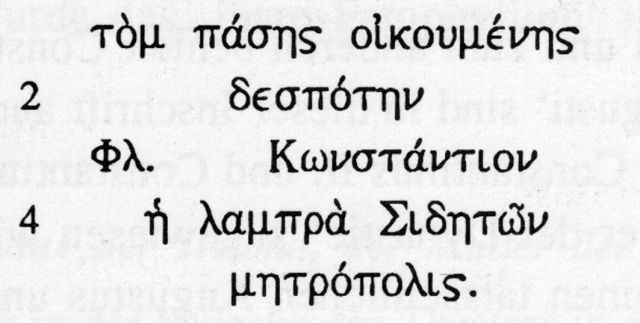
Inscription
τὸμ (sic) πάσης οἰκουμένης / δεσπότην, / Φλ(άουιον) Κωνστάντιον, / ἡ λαμπρὰ Σιδητῶν / μητρόπολις.
Inscription translation
The ruler of the entire civilised world, Flavius Constantius; the shining metropolis of the Sidetans [honours him].
Bibliography
- Nollé, J. , Side im Altertum : Geschichte und Zeugnisse (Inschriften griechischer Städte aus Kleinasien ; Band 43), Bonn 1993, vol. 43, no. 49
Discussion
INSCRIPTION
In five lines:
τὸμ (sic) πάσης οἰκουμένης / δεσπότην, / Φλ(άουιον) Κωνστάντιον, / ἡ λαμπρὰ Σιδητῶν / μητρόπολις.
'The ruler of the entire civilised world, Flavius Constantius; the shining metropolis of the Sidetians [honours him].'
Letter height 3-4 cm. Φλ in line 3 is followed by an abbreviation mark.
DESCRIPTION (from Nollé 1993)
Rectangular white marble base with moulding recorded at the top: H 103, W 44, D 43 cm. The inscription is carved over the erasure of an earlier one. Of the original surface, a broad strip under the upper moulding and a narrow one on the left side are preserved.
PROVENANCE AND CURRENT LOCATION
The base was found on the western great colonnaded street, in the area of the 'triumphal arch’ at the northwest corner of the agora (Mansel 1978, map, D). It is now in the courtyard of the Side museum, inv. no. 1415.
HONORAND, AWARDER AND DATE
The honorand, Constantius II, was Augustus 337-361.
As Nollé 1993, 326 points out, the formula 'τὸν πάσης οἰκουμένης δεσπότην, the ruler of the entire civilised world' (lines 1-2) indicates that the inscription was set up after Constantius II’s victory over Magnentius in 353 and the execution of his cousin Gallus in 354, when Constantius assumed undisputed power over the whole empire.
The inscription was set up by the city of Side, here proudly styled a metropolis, as in an inscription to Helena LSA-262.
Cite: Last Statues of Antiquity, LSA-264 (Ulrich Gehn).