
LSA-2640
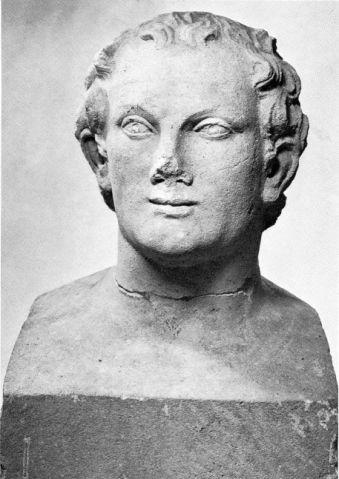
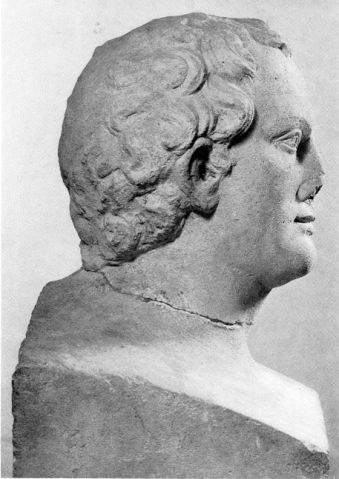
Portrait herm of Menander? Welschbillig (Belgica II). Later fourth century.
Record details
Photographs
Bibliography
- Wrede, H., Die spätantike Hermengalerie von Welschbillig : Untersuchung zur Kunsttradition im 4. Jahrhundert n. Chr. und zur allgemeinen Bedeutung des antiken Hermenmals , Berlin 1972, 52-4, 108, no. 35, pl. 10.1-2
Discussion
DESCRIPTION (Object)
Portrait head on herm. H: 98, W: 35, D: 28 cm. Jura limestone.
The head was found broken from its herm to which it has now been restored. The tip of the nose is missing.
PROVENANCE
Found around the pool of the imperial villa at Welschbillig. It is one of 70 extant herms and one of an original total of 108-112 (94-98) herm portraits; see also LSA-1075, LSA-2637 ,LSA-2638, and LSA-2639. These herm portraits punctuated the balustrade around the pool which has not been completely uncovered (thus, the discrepancy in the total count). This herm excavated in the second museum excavation in 1892 and seems to be a pair with Herm no. 41
DESCRIPTION (Subject)
The portrait bust shows a clean-shaven man who turns to his right. He has medium-length hair which is full and brushed forward at the sides but recedes over the brow. At the centre of the brow two locks come forward and turn in different directions. The eyebrows arch; the cheeks sag slightly; and the chin is strong and projecting. The outline of the hair, the central lock, and all the details of the face correspond to those of portrait of Menander.
DATE
The Villa at Welschbillig, to which the pool belonged, was almost certainly imperial and of the fourth-century. The date is confidently placed in the latter part of the fourth-century on the basis of historic, archaeological, and art historic considerations. An imperial presence in Trier is either known or can be assumed (from the numerous laws issued there) for the period between 367-390; the re-use of funerary material in the basin floor post-dates Julian until which point desecration of cemeteries was forbidden; and there is an iconographic similarity between many of the herm portraits and members of the Theodosian court as represented on the Obelisk in Istanbul and in other media.
HONORAND
Although the head is not a tight copy of the well-known type for Menander, it probably was intended to represent him. First in the same series at Welschbillig there was a portrait of Socrates and one of Polydeuces (LSA-2638 andLSA-2639) that loosely but clearly follow the high-imperial models. Second Menader was one of the favourite intellectuals of both the high-imperial and late-antique period. Other late-antique versions of his portrait include LSA-238, LSA-680, LSA-1193, LSA-2106 ,LSA-2109, LSA-2110, and LSA-2111. Most of these portraits also are only loosely related to the original model.
Cite: Last Statues of Antiquity, LSA-2640 (J. Lenaghan).