
LSA-2645
Two fragments of possible base for statue of military commander, name lost. Augusta Vindelicorum (Raetia II). Early fifth century
Record details
Photographs
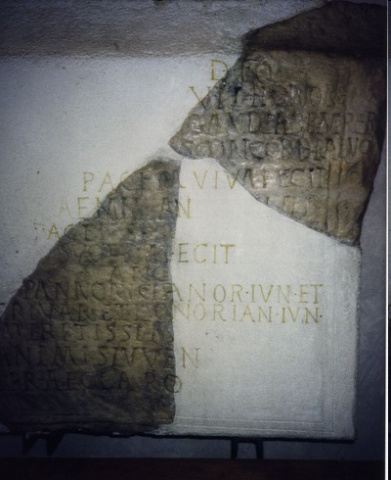
Inscription
I:
[---]no
[---]vit honore
[---] gaudia semper
[---]S concordia IVC
[---]VA fecit
[---]I III
II:
[---]CEN[---]
[---]milia[---]
[---]CEN SE[---]
[---]S votum [---]
[---]ATNC[---]
[---]Pannonicia[n---]
[--- Ang]rivar. et Ho[noraia---]
[---]animis iuve[n---]
[---] praeclaro
Inscription translation
I:
... with honor ... always joy ... unity ... made ...
II:
... vote ... Pannonian (?) ... minds (?) youth (?) ...distinguished ...
Bibliography
- Scharf, R., Der Iuthungenfeldzug des Aetius. Eine Neuinterpretation einer christlichen Grabinschrift aus Augsburg, Tyche 9, 1994, 131-145
Discussion
INSCRIPTON
Fragmentarily preserved in 15 lines (see also below, 'Description'):
I:
[---]no / [---]vit honore / [---] gaudia semper / [---]S concordia IVC /(5) [---]VA fecit / [---]I III
' ... with honor ... always joy ... unity ... made ...'
II:
[---]CEN[---] / [---]milia[---] / [---]CEN SE[---] / (10) [---]S votum [---] / [---]ATNC[---] / [---]Pannonicia[n---] / [--- Ang]rivar. et Ho[noraia---] / [---]animis iuve[n---] (15) [---] praeclaro
'... vote ... Pannonian (?) ... minds (?) youth (?) ...distinguished ...'
DESCRIPTION
The inscription is carved on two fragments of a block (I and II) which don't join; it is possible therefore that there were lines between the two blocks which are now completely lost.
PROVENANCE AND CURRENT LOCATION
The inscription was first recorded in 1956/7, reused in the area of the former church of St. John (St. Johannis) south of the Augsburg cathedral (BRGK 37/38, 1956/57, 228 Nr. 46).
HONORAND, AWARDER AND DATE
The inscription is to damaged to provide secure information. It was traditionally considered a Christian funerary inscription of ca. 400. However, it does not have Christian symbols or othe good indicators of Christian cult or religion. It was suggested recently that it was an honorary inscription to a merited general of the 5th century (Scharf 1994).
Cite: Last Statues of Antiquity, LSA-2645 (Christian Witschel).