
LSA-265
Lost base for statue of Julian, emperor. Side (Pamphylia). 361-363.
Record details
Photographs
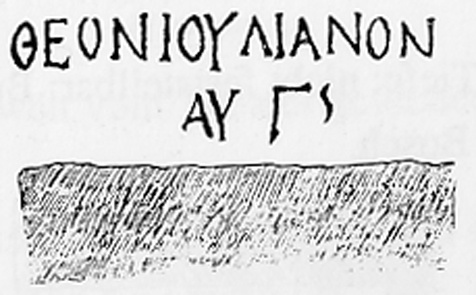
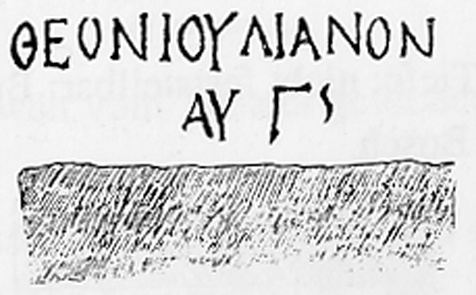
Inscription
θεὸν Ἰουλιανὸν / Αὔγ(ουστον) / [[...]]
Inscription translation
... [honours] the divine Julian Augustus.
Bibliography
- Nollé, J. , Side im Altertum : Geschichte und Zeugnisse (Inschriften griechischer Städte aus Kleinasien ; Band 43), Bonn 1993, vol. 43, no. 50
Discussion
INSCRIPTION
In two recorded lines:
θεὸν Ἰουλιανὸν / (vacat) Αὔγ(ουστον) (vacat) / [[...]]
'... [honours] the divine Julian Augustus ...'
Letter height 4-6 cm. Αὔγ in line 2 is followed by an abbreviation mark.
DESCRIPTON (from Bean 1956 and Nollé 1993)
White marble base: H 153, W 57 cm; the depth could not be measured before it was lost (Bean 1956, 81). Below the inscription there was an erasure.
PROVENANCE AND CURRENT LOCATION
The inscription was found in 1948, along with another base (LSA-276), built into a modern house on the great colonnaded street, south of the theatre (Bean 1956, 80-1; Mansel 1978, map, C). Today it is lost.
HONORAND AND DATE
Julian, the honorand, was Augustus 360-3, but only recognised in the East after the death of Constantius II in 361.
FURTHER DISCUSSION
The epithet 'θεός, divine', though rare in the 4th century, is not unparalleled; it is, however, unique among the imperial dedications in Side(LSA-261, LSA-262, LSA-263, LSA-264, our inscription, LSA-266, LSA-276). It may reflect the divine adoration many Greek cities payed to the pagan Julian (Nollé 1993, 327).
This base is of the same material and of similar dimensions to other 4th-century dedications to emperors in Side (for links see above; Bean 1956, 82).
Discussion references
- Bean, G. E., Inscriptions, Mansel, A. M., Bean, G. E. & J. Inan, Die Agora von Side und die benachbarten Bauten. Bericht über die Ausgrabungen im Jahr 1948, pp. 79-98, Ankara 1956, pp. 80-2 no. 48
- Mansel, A. M., Side, Ankara 1978
Cite: Last Statues of Antiquity, LSA-265 (Ulrich Gehn).