
LSA-2651
Base for statue of Archelaus, worshipper of Dionysus. Lerna (Achaea). Later fourth century
Record details
Photographs
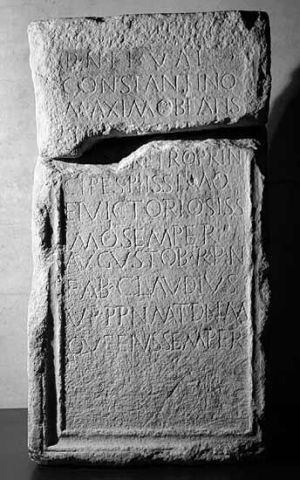
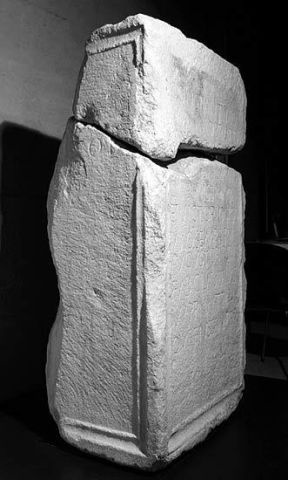
Inscription
Βάκχῳ μ[ε] Βάκχον καὶ προσυμναί[ᾳ] / θεῶι /
στάσαντο Δεοῦς ἐν κατηρεφ[εῖ] / δόμω[ι, /
(5) τὸν Ἀρχε[λά]ου πα[ῖ]δα ὁ[μ]ών[υ]-/μ[ον] πατ[ρί. /
ταὐτῷ δ[έ] μ‘ ἐξ[ῆρε] ἐν χρόνῳ δ[ά]-/μα[ρ] κλυ[τ]ῶι / (9) Βάκχον Λ[υ]αίω[ι. γῆ]ς δὲ πυρφό-/[ρ]οι[ς] θεα[ῖς] /
Φοίβῳ Λυκεί[ωι θ‘] – ο[ὕ]νεκα ἀντίτων / λ[άχ]οι - /
δά]μα[ρ με ν]εῖμε καὶ προσυ[μ-/ν]αῖος λε[ὼς /(15)
α[ὐτοῦ] τε Φοίβου [π]υρφόροι λ[υ-/κοκτόνο[υ.
Inscription translation
To Bacchus (= Dionysus) and to the goddess praised in hymns (= Demeter); they set me up, the bacchanal, son of Archelaus, of the same name as the father, in the roofed house of Demeter. In the same year, my consort set up me, the bacchanal, to the illustrious (god) who releases, Bacchus Lyaius; to the torchbearing goddesses of the earth (= Demeter and Kore) and to Phoebus (= Apollo) Lyceius - in order that she might receive the recompense - my consort dedicated me, together with the chanting people [= the worshippers of Demeter Proshymnia referred to in lines 1-2], and the torchbearers of that wolf-killing Phoebus.
Bibliography
- Inscriptiones Graecae, VI 666
Discussion
INSCRIPTION
Verse inscription laid out in 16 lines:
Βάκχῳ μ[ε] Βάκχον καὶ προσυμναί[ᾳ] / θεῶι /
στάσαντο Δεοῦς ἐν κατηρεφ[εῖ] / δόμω[ι, /
(5) τὸν Ἀρχε[λά]ου πα[ῖ]δα ὁ[μ]ών[υ]-/μ[ον] πατ[ρί. /
ταὐτῷ δ[έ] μ‘ ἐξ[ῆρε] ἐν χρόνῳ δ[ά]-/μα[ρ] κλυ[τ]ῶι / (9)
Βάκχον Λ[υ]αίω[ι. γῆ]ς δὲ πυρφό-/[ρ]οι[ς] θεα[ῖς] /
Φοίβῳ Λυκεί[ωι θ‘] – ο[ὕ]νεκα ἀντίτων / λ[άχ]οι - /
δά]μα[ρ με ν]εῖμε καὶ προσυ[μ-/ν]αῖος λε[ὼς /(15)
α[ὐτοῦ] τε Φοίβου [π]υρφόροι λ[υ-/κοκτόνο[υ.
'To Bacchus (= Dionysus) and to the goddess praised in hymns (= Demeter); they set me up, the bacchanal, son of Archelaus, of the same name as the father, in the roofed house of Demeter. In the same year, my consort set up me, the bacchanal, to the illustrious (god) who releases, Bacchus Lyaius; to the torchbearing goddesses of the earth (= Demeter and Kore) and to Phoebus (= Apollo) Lyceius - in order that she might receive the recompense - my consort dedicated me, together with the chanting people [= the worshippers of Demeter Proshymnia referred to in lines 1-2], and the torchbearers of that wolf-killing Phoebus'.
Letter height not recorded.
We reproduce the inscription with the completions proposed by Fränkel (Inscriptiones Graecae (IG) IV). Although expressed as a dedication to the gods Dionysus and Demeter (who are addressed in the dative, the usual way to address the honorands statues), this is from a statue base for their priest, the noble Athenian Archelaus (see below, ‘Honorand, Awarder and Date’).
DESCRIPTION (from IG IV and the published image)
Rectangular base broken at bottom and with mouldings at top, H 91, W 35, D 31 cm. On the top face there were three or four holes (in summo latere foramina tria vel quattuor, IG).
PROVENANCE AND CURRENT LOCATION
The inscription was first recorded in the mid-19th century in the village of Myloi, on the coast south of Argos; this is the location of ancient Lerna. It was already lost when Fränkel published the inscriptions of Inscriptiones Graecae IV in 1902.
Our inscription was set up in the joint sanctuary of Dionysus and Demeter Prosymna (the προσυμναῖα θεός – the ‘goddess celebrated in songs’ of lines 1-2) in Lerna. On the sanctuary see Pausanias 2, 37, 1 (see also below, ‘Further Discussion’).
The inscription is now lost.
HONORAND, AWARDER AND DATE
Archelaus, the honorand, is styled Bakchos (bacchanal, a worshipper of Dionysus) in our inscription. He is probably identical to an Archelaus who set up two taurobolium altars in Athens, both datable to 387 (IG 2, 4841 = IG II/III (2) 13252). This latter Archelaus was a member of an established Athenian family (Traill 1994, 342-3 no. 209915; Frantz 1988, 50-1); the inscriptions in Athens praise his noble origins. Moreover, they inform us that he led the life of a mystic in Argos where he was a priest (kleidouchos) of Hera. He also received the mystic torches in Lerna, and was a priest (dadouchos) of Kore in Eleusis. Our Archelaus is also probably the same man who awarded a statue to the proconsul Phosphorius in Argos, LSA-595.
The latter half of the inscription refers to at least one, perhaps even four statue dedications by Archelaus’ wife to her priest husband, all devoted to a deity, as usual with priests (see above, 'Insccription', and below, 'Further Discussion'). Lines 14-16 we understand in such a way that they refer to the awarders of our inscription (and statue), the honorand's wife together with the worshippers of Demeter and of Apollon (see below, ‘Further Discussion’).
FURTHER DISCUSSION
It is not entirely clear how many statues this epigram refers to. It certainly refers to a statue of Archelaus in the temple of Dionysus at Lerna, and the references to further cults and further devotees could all be associated with the same temple and the same statue. However it is also possible that further statues are referred to: one set up by the honorand’s consort to Dyonisus Lyaios; and one set up to Demeter and Kore (the ‘torchbearing goddesses of the earth’, line 9-10) and still another one to Apollo Lyceius.
Apollo Lyceius had a famous sanctuary in the agora of Argos (Pausanias 2, 19, 3).
ACKNOWLEDGEMENT
We are grateful to Sebastian Prignitz, Berlin, for help with this inscription.
Discussion references
- Inscriptiones Graecae, II 4841
- Inscriptiones Graecae, II/III(2) 13252
- Frantz, A., Late Antiquity A. D. 267 - 700: The Athenian Agora XXIV, Princeton 1988
- Traill, J. S., Persons of Ancient Athens. Volume 2, Alexarchos to Aponius, Toronto 1994
Cite: Last Statues of Antiquity, LSA-2651 (Ulrich Gehn).