
LSA-2654
Fragment of base for statue of emperor (name lost); probably Diocletian or Constantine I. Narbo (Narbonensis I). Late third to early fourth century
Record details
Photographs
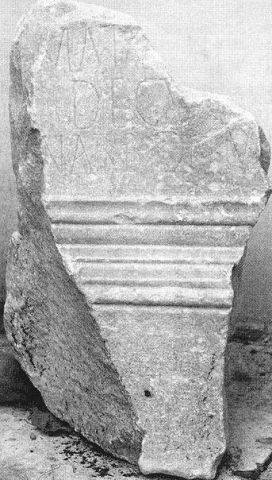
Inscription
------ / [--- Sar]mati[co(?) max(imo) ---] / [---] Decu[mani] / [---] Narb(onenses) d(evotus) n(umini) m(aiestatique) [e(ius)]
Inscription translation
... most powerful victor over the Sarmatian people. The decurions of Narbo, devoted to his divine spirit and majesty.
Bibliography
- Corpus Inscriptionum Latinarum; , XII 4349
Discussion
INSCRIPTION
Three lines preserved:
------ / [--- Sar]mati[co(?) max(imo) ---] / [---] Decu[mani] / [---] Narb(onenses) d(evotus) n(umini) m(aiestatique) [e(ius)]
' ... most powerful victor over the Sarmatian people. The decurions of Narbo, devoted to his divine spirit and majesty.'
DESCRIPTION
Fragment of a marble statue base moulded at bottom, H 82, W 56 cm. The upper part and both sides are broken.
PROVENANCE AND CURRENT LOCATION
The inscription was recorded in Salles-d’Aude, Château Tapié-Mangot, by CIL in 1888. It was probably brought there from nearby Narbo (Narbonne) where it was probably set up (http://www.trismegistos.org/place/20422).
HONORAND, AWARDER AND DATE
The honorand was an emperor of the late 3rd or 4th century, probably Diocletian or Constantine.
The inscription was set up by the city of Narbo.
FURTHER REMARK
The article by M. Christol, Un hommage public à Narbonne au Bas-Empire, Bulletin de la Commission Archéologique et Littéraire de Narbonne 47-48, 1996/97, 41-44, was not accessible to me.
Cite: Last Statues of Antiquity, LSA-2654 (Christian Witschel).