
LSA-2659
Broken 2nd-century base for statue of Concordia, re-erected, perhaps with original statue, by Septimius Theodulus, governor of Venetia et Histria. Aquileia (Venetia et Histria). Earlier to mid fourth century
Record details
Photographs
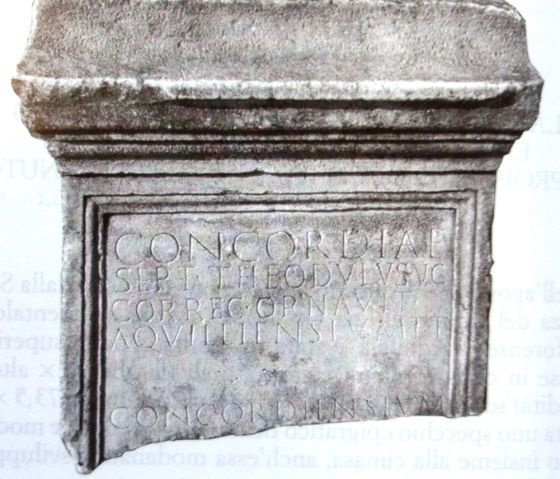
Inscription
Concordiae. / Sept(imius) Theodulus, v(ir) c(larissimus), / correc(tor), ornavit. / Aquileiensium et / Concordiensium / [------].
[lines 2-3 are the 4th-century additions to the original inscription]
Inscription translation
To the Harmony (Concordia) of the people of Aquileia and Concordia. Septimius Theodulus, of clarissimus rank, governor (corrector), decorated [the forum with this].
[As set out on the inscription, Theodulus' record of his work interrupts the original dedication.]
Bibliography
- L'Année épigraphique, , 1999, 697a-b
- Zaccaria, C., "La 'trasformazione' del messaggio epigrafico tra II e IV secolo d.C. A proposito di un palinsesto rinvenuto nel foro di Aquileia", Varia Epigraphica. Atti del Colloquio Internazionale di Epigrafia. Bertinoro, 8-10 giugno 2000, 475-494, Faenza 2001, 463-475
Discussion
INSCRIPTION
In five lines:
Concordiae. / Sept(imius) Theodulus, v(ir) c(larissimus), / correc(tor), ornavit. / Aquileiensium et / Concordiensium / [------].
[Lines 2-3 are the 4th-century additions to the original inscription].
'To the Harmony (Concordia) of the people of Aquileia and Concordia. Septimius Theodulus, of clarissimus rank, governor (corrector), decorated [the forum with this].'
[As set out on the inscription, Theodulus' record of his work interrupts the original dedication].
Letter height:
Original inscription (lines 1., 4. & 5): 4 - 5.3 cm.
Reuse inscription (lines 2-3): 4 - 4.2 cm.
DESCRIPTION (from Zaccaria 2001 and the published image)
Upper portion of a limestone base moulded at top, H 82, W 85, D 35 cm. The block is broken at the rear. The epigraphic field is surrounded by a moulded frame. As Zaccaria 2001, 476 points out, the shape of the upper moulding suggests a date of the original block in the 2nd century.
The five lines of inscription now visible belong to two uses of the base at different times. Lines 1, 4 & 5 were probably carved for the original use of the base in the 2nd century; lines 2-3 were carved when the base was reused in the 4th century (see above, ‘Inscription’, and below, ‘Honorand, Awarder and Date’). The original inscription was not worked back for the reuse; Zaccaria 2001, 485 plausibly suggests that it was plastered or cemented over at the time the second inscription was carved, since the five lines read together make no sense (on this practice see Orlandi 1999; Bakker 1994; but see also Zaccaria 2000, 98 who suggests that the original inscription was incorporated into the reuse).
PROVENANCE AND CURRENT LOCATION
The inscription was found, apparently in situ, at the western margin of the ancient forum of Aquileia in 1999 (Maselli-Scotti 1999).
It was recorded at its findspot by Zaccaria 2001 (without published inv. no.).
HONORAND AWARDER AND DATE
When re-erected by Septimius Theodulus (see next paragraph), the base possibly still carried the statue addressed in the original inscription, to the Harmony (Concordia) between the people of Aquileia and those of its neighbouring city Iulia Concordia (styled Concordienses in our inscription), though, as we have seen, the original words may well have been plastered over.
The inscription was set up by Septimius Theodulus, governor (corrector) of the province of Venetia et Histria (on him see LSA-1233) in the earlier or mid-4th century.
FURTHER DISCUSSION
Septimius Theodulus set up two further statue bases on the forum of Aquileia, in the same spot where our inscription was found (LSA-1233, LSA-1234). His dedications probably contributed to a pictorial programme by which the city centre was decorated with statues commemorating and reaffirming the city’s great traditions and history (cf. LSA-1234, ‘Further Discussion’).
Discussion references
- Bakker, L., Der Siegesaltar zur Juthungenschlacht von 260 n. Chr. Ein spektakulärer Neufund aus Augusta Vindelicum/ Augsburg, Antike Welt 1993-1994, 274-7
- Maselli-Scotti F., Foro romano. Indagini e restauri 1999, Aquileia nostra LXX, 1999, 360-7, Aquileia 1999, 361-2 and fig. 1
- Orlandi, S., Due note di epigrafia tardoantica, Rendiconti della Accademia nazionale dei Lincei. Classe di scienze morali, storiche e fililogiche 9, 10, 1999, 575-94, 583 n. 29
- Zaccaria, C., Permanenza dell’ideale civico romano in epoca tardoantica: nuove evidenze da Aquileia, Antichità Altoadriatiche 47, 2000, 91-113, Aquileia 2000, 97-8
Cite: Last Statues of Antiquity, LSA-2659 (Ulrich Gehn and Carlos Machado, discussion added 5/2014).