
LSA-2660
Base for statue of Publius Valerius Maro, father of the poet Vergil. Aquileia (Venetia et Histria). Fourth Century.
Record details
Photographs
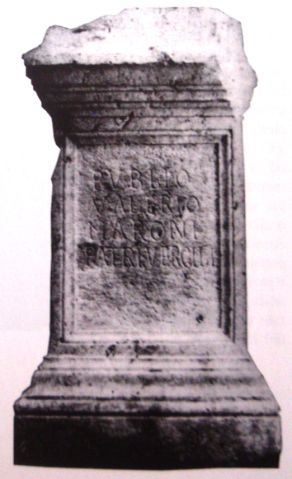
Inscription
Publio / Valerio / Maroni, / patri Vergili.
Inscription translation
To Publius Valerius Maro, father of Vergil.
Bibliography
- Bertacchi, L., Aquileia nostra LVII, 1986, 401-12, Aquileia 1986
- Lettich, G., Itinerari Epigrafici Aquileiesi. Guida alle epigrafi esposte nel Museo Archeologico Nazionale di Aquileia (Antichità Alto Adriatiche 50), Trieste 2003, n. 30
Discussion
INSCRIPTION
In four lines:
Publio / Valerio / Maroni, / patri Vergili.
'To Publius Valerius Maro, father of Vergil.'
Letter height 5.5 – 6 cm.
The inscription with the honorand in the dative suits a statue base; however, strikingly no awarder is mentioned (see below, 'Description').
DESCRIPTION (from Bertacchi 1986, Paci 1987, and the published images)
Rectangular block of local limestone (Pietra di Aurisina), moulded at top and bottom; H 136, W 79, D 60 cm. The right front angle of the upper moulding is broken; the lateral faces are abraded, and the back is heavily damaged. The plinth above the upper moulding is damaged. Close to the front margin, there is a circular hole with a cast channel, and a similar fitting was observed at the back margin of the top face by Bertacchi 1986. These are possibly the remains of fittings for a bronze statue.
The epigraphic field is surrounded by a moulded frame. Our inscription is carved over an erased earlier one. The erasure was executed with a point; bits of the earlier surface, which was smoothly finished, are visible at the bottom of the epigraphic field (Paci 1987, 296 fig. 2). Bertacchi 1986, 408 observed traces of red colour in the letters.
The block was assessed as a commemorative altar (ara) by its first editor, Bertacchi 1986. However, Paci 1987 suggested it was rather a statue base; this was accepted by di Stefano Manzella 1995, 166, and by Lettich 2003.
PROVENANCE AND CURRENT LOCATION
The inscription was found during excavations in the eastern part of the forum of Aquileia in 1986; it was probably lying at or close to the spot where it was set up in antiquity.
It is now in the Museo Archeologico Nazionale of Aquileia (without published inv. no.).
HONORAND, AWARDER AND DATE
Publius Valerius Maro, the honorand, was probably the stepfather of the poet Publius Vergilius Maro (Bertacchi 1986, 409-10; the poet is simply referred to by his nomen gentile in our inscription). Little is known about the honorand. His identification is based on a note in the vita vergiliana (Life of Vergil) of Aelius Donatus (4th century) according to which Vergil had a brother called Valerius Proculus; Vergil must have been adopted into the gens Valeria at some point in his life. It remains unclear, however, how the cognomen Maro, probably inherited by the poet from his biological father, fits his stepfather (see also below, 'Further Discussion').
The awarder is not recorded in our inscription; this is unusual for a honorific monument and has no ready explanation (see below, 'Further Discussion').
Bertacchi 1986, the first publisher, pointed out that the elaborate mouldings align with early imperial works from Aquileia. However, she suggested a 2nd century date for our inscription, contemporary with the building of the forum in Aquileia; she argued that the letter forms suited this date.
The date of the inscription suggested by Bertacchi 1986 was challenged by Paci 1987 who pointed out that an earlier inscription was erased for ours (see above, 'Description'). Paci argued that the asymmetrical layout of the inscription, some inconsistencies in the letter shapes (A, L), and some letter forms (A, L, M, P) have no parallels in the epigraphy of the 2nd century in Aquileia, but do have in the 4th century. This was confirmed by the scrutiny of the letter forms by Di Stefano Manzella 1995. Paci 1987, moreover, followed by Di Stefano Manzella 1995, pointed out that the celebration of Vergil and his family suits the strong interest in the poet’s work and biography in the 4th century. It is now widely agreed that the inscription was carved in the 4th century (see also below, 'Further Discussion').
FURTHER DISCUSSION
Many problems raised by this enigmatic inscription remain unsolved. Paci 1987, 303-4 suggested that the inscription was best understood as a 'late antique forgery', an invention which was possibly connected to the strong interest in the poet and his work in the 4th century.
The statue of Vergil’s otherwise unknown stepfather was probably accompanied by a statue of the poet himself, and possibly of further family members.
The particular relationship of Vergil and his family with Aquileia, which possibly triggered this unparalleled public honour, remains obscure (Vergil was a native of Mantua). The inscription, set up at a prominent location in the city centre, apparently refers to such a relationship, be it real or fictional.
Discussion references
- Di Stefano Manzella, I., Problemi di paleografia epigrafica latina, Acta Colloquii Epigraphici Latini Helsingiae, 3-6 sept. 1991 habiti, 163-81, Helsinki 1995, 164-72
- Maselli-Scotti, F. and C. Zaccaria, Novità epigrafiche dal foro di Aquileia, Epigrafia romana in area adriatica (Actes de la IXe rencontre franco-italienne sur l’épigraphie du monde romain, Macerata, 10-11 Novembre 1995, 113-60, Macerata 1998, 154-5
- Paci, G., Sull’iscrizione “virgiliana” di Aquileia, Aquileia nostra LVIII, 1987, 293-308, Aquileia 1987
- Paci, G., Virgilio ad Aquileia, Quaderni Catanesi I, 1989, 167-86
Cite: Last Statues of Antiquity, LSA-2660 (Ulrich Gehn and Carlos Machado, discussion added 5/2014).