
LSA-2662
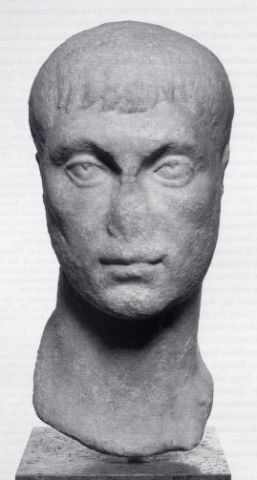
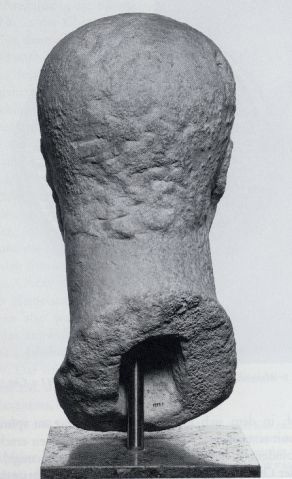
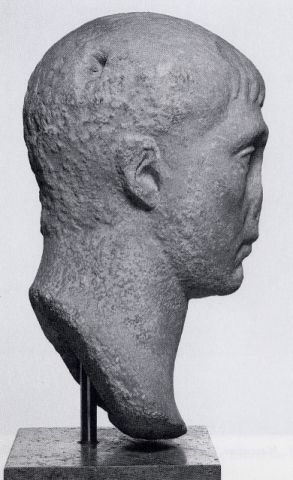
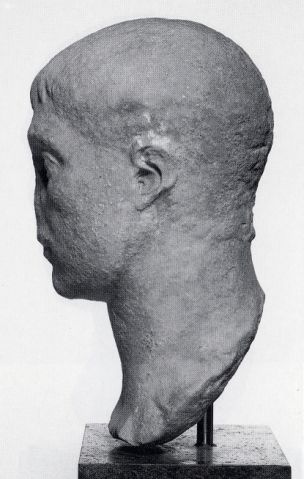
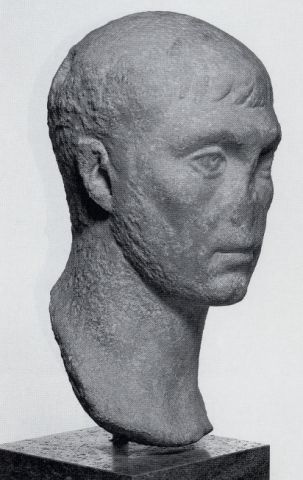
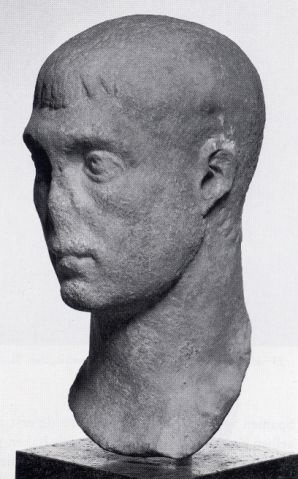
Portrait of Maxentius in Dresden-Stockholm type. From Italy. Early fourth century.
Record details
Photographs
Bibliography
- Evers, C. 'Betrachtungen zur Ikonographie des Maxentius' , Niederdeutsche Beiträge zur Kunstgeschichte 31, Munich 1992, 9-22, figs. 1,4,7, 9, 11, and 12
Discussion
DESCRIPTION (Object)
Over life-size, worked separately. H: 49 cm. Marble.
The head was worked separately and was attached by a large dowel for which there is a hole in the middle of the neck. It is missing its nose and parts of the ear.
The hair is rendered with a flat chisel around the brow; at the back it is roughly picked. A light beard has been indicated on a slightly raised surface. The pupils are drilled in a small U-shape. The cut of the neck line is square with more chest area at the front than at the sides.
The roughly removed hair at the back of the head and the close-set earlobes suggest that this portrait has been re-carved from an earlier head.
PROVENANCE
The head is from Italy. It was donated to the Kestner Museum by Dr. A. Pakzad.
DESCRIPTION (Subject)
The head shows a young man who turns to his right. He has straight hair that is combed forward onto the brow and a light beard and moustache. The hair follows a particular pattern over the brow. There is a parting over the left eye; a section of hair above the nose that is longer than the rest and turns to the proper right; and there are two small partings over the right eye. The hair falls low on the brow.
The face has a ‘Julio-Claudian’ structure with a horizontal brow and widely-spaced cheekbones. The eyes are emphatically marked and outlined by the lower lids. The mouth is broad but thin-lipped. The upper edge of a round projecting chin softly defined beneath the lower lip. The beard and moustache were light and are badly preserved.
DATE AND HONORAND
This portrait is over life-size and known in three other replicas or variants: LSA-895, LSA-896, and LSA-897. The size and number of replicas indicate that this represented an imperial figure. All of the extant versions of the type are from Italy, and none wear a crown or diadem. Numismatic evidence makes it clear that the honorand was Maxentius. It should date between 306 when he was proclaimed Emperor (at c. 27 years of age) and 312 when he lost to Constantine at the Milvian bridge.
STATUE AND STYLE
The square cut of the chest area indicates that this head was originally made to be inserted into the neckline of a cuirassed statue. There is no reason to believe that this was not the case in its second use. The style of the head, as Evers, duly points out, is softer and more classical than the other versions.
Cite: Last Statues of Antiquity, LSA-2662 (J. Lenaghan).