
LSA-2663
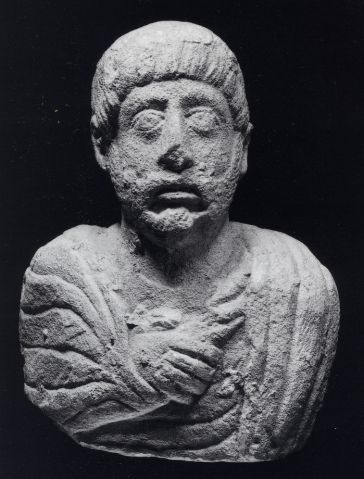
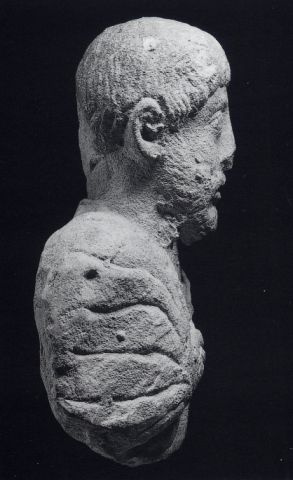
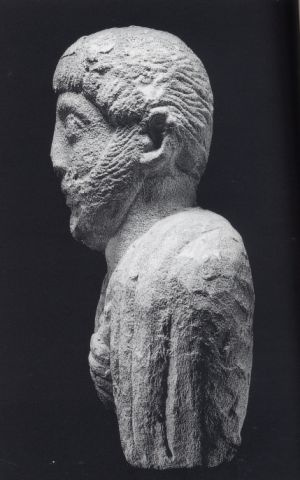
Shield portrait of bearded man in himation. Noviomagus Regnensium (Maxima Caesarienis). Fourth century.
Record details
Photographs
Bibliography
- Padgett, M. (ed.), Roman Sculpture in the Art Museum, Princeton University, Princeton 2001, 80-82, no. 20 (fourth century)
- Winkes, R., Clipeata imago: Studien zu einer römischen Bildnisform, Bonn 1969, 204-205 (fourth century)
Discussion
DESCRIPTION (Object)
Life-size bust, probably shield portrait. H: 40.1, W: 31.2, D: 15.7 cm. Chalk.
The tip of the nose is missing. The back right side of the neck is broken, and the area behind the right shoulder seems to be worked down (Winkes). The surface is worn and chipped. The back has been roughly picked (Winkes), and two holes have been made for mounting at the back (Padgett et al). Another hole exists in the bottom surface. Winkes identified this as a shield portrait.
The eyes are exceptionally large with drilled pupils. The beard is a unified raised surface onto which the texture has been engraved.
PROVENANCE
From Chichester.
DESCRIPTION (Subject)
The bust shows a bearded man with straight hair that is combed forward onto the brow. The hair is cut around the ears. The face is long with eyes that slant downwards at their outer corners; the nose is long; and the chin is deep and receding. He holds his right arm across his body; the right hand lies over the left sternum. It seems to be holding drapery.
He wears two garments, a chiton and himation. The inner garment or chiton has a high neckline and is devoid of folds. The outer garment, himation, is draped over the left shoulder and envelops the right arm. Folds belonging to it cross the body horizontally at chest level.
STYLE, DATE, COSTUME,
The bust is a provincial product which makes it difficult to assess—both because of the lack of adherence to metropolitan Roman technique and because there is little comparanda for it. Nonetheless, the combination of the combed forward hairstyle and of the technical style of the eyes suggests a date in the fourth century. Winkes compares it to works of the post-Constantinian period, for example LSA-584.
The surprising feature of the bust is that it does not wear a toga (pace all publications). The right arm of a togate figure is never wrapped within the toga. The figure seems to be wearing traditional Greek clothing which is a strange detail in a bust from Roman England.
Cite: Last Statues of Antiquity, LSA-2663 (J. Lenaghan).