
LSA-2669
Honorific arch to Constantine, emperor; dedicated by the Senate and People of Rome. Rome. 315-316
Record details
Photographs
Inscription
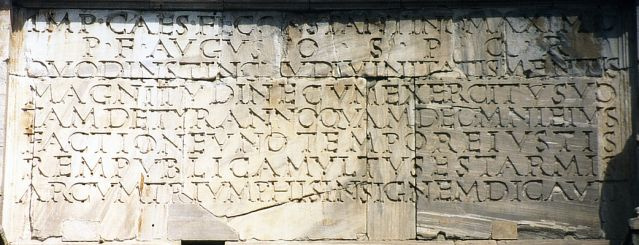
Imp(eratori) Caes(ari) Fl(avio) Constantino, maximo, / p(io), f(elici), Augusto. S(enatus) p(opulus)q(ue) R(omanus), / quod instinctu divinitatis mentis / magnitudine cum exercitu suo /(5) tam de tyranno quam de omni eius / factione uno tempore iustis / rem publicam ultus est armis, / arcum triumphis insignem dicavit.
Inscription translation
To the emperor Caesar Flavius Constantinus, the greatest, pious, fortunate, Augustus. The Senate and People of Rome dedicated [this] arch decorated with triumphs, because with divine inspiration and the greatness of his disposition, with his armies and the just force of arms, the commonwealth (res publica) was avenged of the tyrant and [his] entire faction.
Bibliography
- Corpus Inscriptionum Latinarum; , VI, 1139 (+ p. 4328)
- Capodiferro, A., "Arcus Constantini", in E. M. Steinby (ed), Lexicon Topographicum Urbis Romae, vol. 1, Rome 1993, 86-91
- De Maria, S., Gli archi onorari di Roma e dell'Italia romana, Rome 1988, pp. 316-319 n. 98
- Giuliano, A., Arco di Costantino, Milan 1955
Discussion
INSCRIPTION:
In eight lines, with holes for affixing bronze letters:
Imp(eratori) Caes(ari) Fl(avio) Constantino, maximo, / p(io), f(elici), Augusto. S(enatus) p(opulus)q(ue) R(omanus), / quod instinctu divinitatis mentis / magnitudine cum exercitu suo /(5) tam de tyranno quam de omni eius / factione uno tempore iustis / rem publicam ultus est armis, / arcum triumphis insignem dicavit.
'To the emperor Caesar Flavius Constantinus, the greatest, pious, fortunate, Augustus. The Senate and People of Rome dedicated [this] arch decorated with triumphs, because with divine inspiration and the greatness of his disposition, with his armies and the just force of arms, the commonwealth (res publica) was avenged of the tyrant and [his] entire faction.'
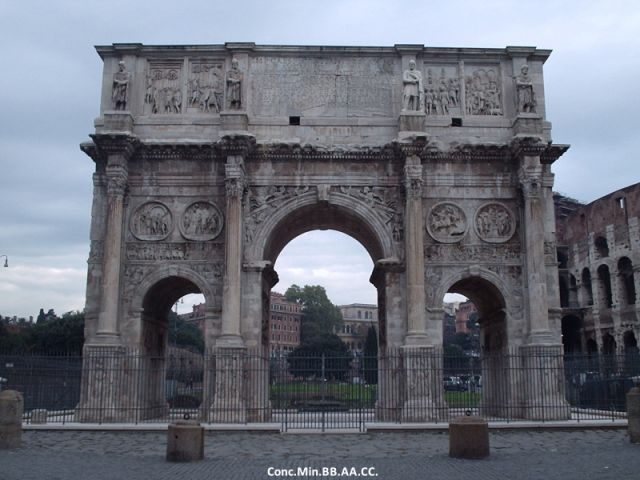
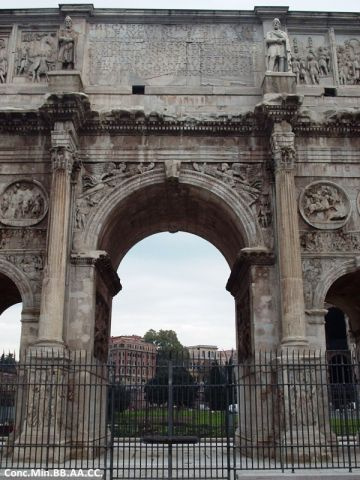
The inscription records the dedication of a triumphal arch to the emperor Constantine by the Senate. The same text is displayed on both sides of the arch, on the attic. This text is remarkable for a number of reasons, from the beauty of its letters to its phrasing. A general discussion can be found in Grünewald 1990, 63-92) 'Maximus', in line 1, uncommon in the third century, became common under Constantine, but less so under his sons and successors, until it disappeared after Gratian (Chastagnol 1988, 33-35). The reference to 'instinctu divinitatis' in line 3, is famously ambiguous on the subject of the emperor's religious beliefs (Gordon 1983, 169; Liverani 2005, 66). The inscription refers specifically to the victory over Maxentius (referred to as 'tyrannus', in line 5) and his faction - perhaps an explicit reference to the fact that the defeated emperor had had supporters in Rome.
Besides the inscriptions on the attic, there were two other sets of inscriptions:
[Above the lateral archway, on the western side]: Sic X, sic XX. // [On the eastern side]: Votis X, votis XX.
These inscriptions refer to the decennalia being celebrated and the vicennalia that was then expected and for which a vow was taken (see Gordon 1983, 169; Chastagnol, "Les inscriptions des monuments..." 1988).
[On the inside of the main archway, to the west] Liberatori urbis (to the liberator of the City) // [to the East]: Fundatori quietis (to the founder of Peace).
DESCRIPTION:
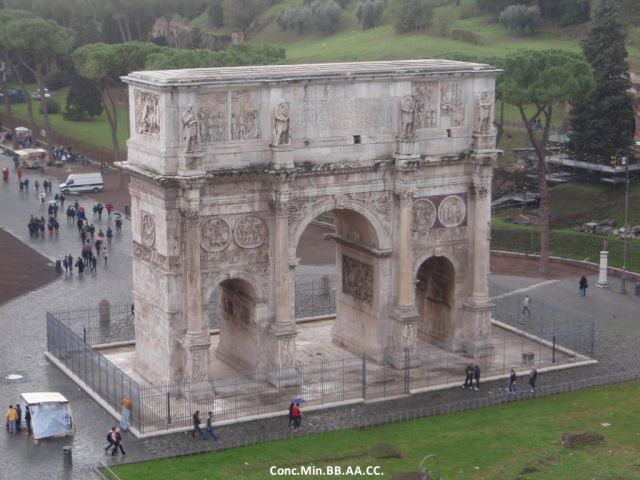
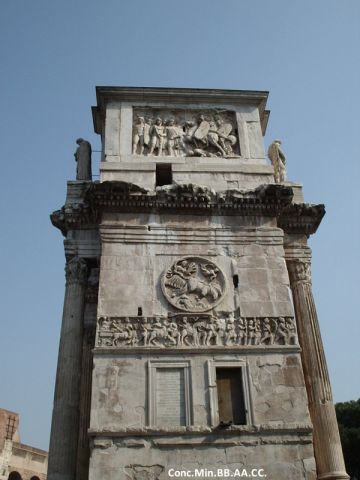
Triumphal arch, with three archways. 2100 x 2570 x 740 cm. The central archway is the tallest: 1150 x 650 cm; the two lateral arches measure 740 x 335 cm. The arch is built with re-used white marble, with coloured marble in places. The attic is built with brick, faced with marble panels (on the issue of re-use, see Pensabene 1999).
The bibliography on the decoration of the arch is endless, and here I will only point to its main features. For a more detailed discussion, see the fundamental publication of Giuliano 1955, with more recent bibliography cited in Capodiferro 1993, De Maria 1988 and Liverani 2005.
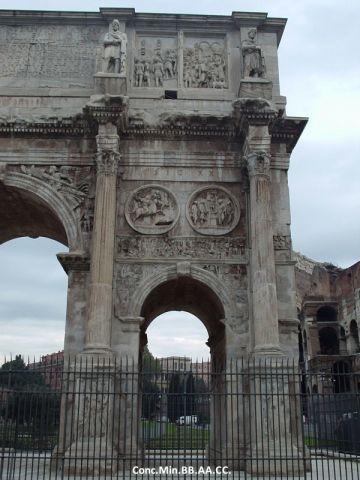
The central archway is flanked by columns sitting on bases with sculpted reliefs on their three visible sides, representing victories and defeated barbarians. There are reliefs of victories on the spandrels of the central archway, and representations of the seasons on those of the smaller archways (De Maria 1988, 316). A freeze runs around the entire arch, with reliefs narrating Constantine's march from Milan until his victory over Maxentius and his triumphal entrance in Rome. Above the freeze, one medallion on the western side of the arch represents the moon, and another on the eastern side represents the rising sun.
Besides these reliefs, unanimously dated to the Constantinian period, the arch was decorated with sculpted panels of different dates. There are two medallions of Hadrianic date above each lateral archway, on both sides of the arch (North and South). These depict scenes of the emperor (the head of Hadrian was recarved to show Constantine and another emperor) sacrificing and hunting.
The central part of the attic is occupied by the inscription. On both sides of the inscription, sets of two rectangular panels with reliefs datable to the time of Marcus Aurelius show scenes of the emperor (re-cut to show Constantine) addressing the people, the troops, sacrificing and performing other activities that characterized him as a good ruler. On both sides of the arch, an attic level, there are four statues of Dacians, of Trajanic date.
On the inside of the central archway, facing each other, are two large rectangular panels datable to the time of Trajan, also re-cut to represent Constantine. Further large Trajanic panels appear on each side of the attic.
The dedicatory inscription does not mention statues, but the dedication of an arch. It should be noted that there is no surviving trace of fittings for statues on top of the arch. Since no ancient representations of this monument survive, be it in coins or literature, we cannot be certain that it ever supported any such monument.
LOCATION:
The arch is still in situ, between the Colosseum and the Palatine hill. It was built on the route used for triumphal processions, emphasizing its celebratory nature.
HONORAND, AWARDER AND DATE:
As the inscription informs us, the arch was dedicated by the Senate and People of Rome to the emperor Constantine. The inscriptions referring to the celebration of the decennalia and the vows for the vicennalia allow us to date it to 315-316 (Buttrey 1983, 378; Chastagol, "Les inscriptions..." 1988, 22 n. 26).
Discussion references
- Buttrey, T. V., "The Dates of the Arches of 'Diocletian' and Constantine", Historia 32, 1983, 375-378
- Chastagnol, A. "Le formulaire de l'épigraphie latine officielle dans l'Antiquité Tardive", Donati, A. (ed.), La terza età dell'Epigrafia, Faenza 1988, 33-35.
- Chastagnol, A. "Les inscriptions des monuments inaugurés lors des fêtes impériales", Mélanges de l'École Française de Rome. Antiquité 100 (1), 13-26
- Gordon, A. E., Illustrated Introduction to Latin Epigraphy, Berkeley 1983, 168-169, n. 82
- Grünewald, T., Constantinus Maximus Augustus. Herrschaftspropaganda in der zeitgenössischen Überlieferung, Stuttgart 1990, 63-92
- Pensabene, P., "Progetto unitario e reimpiego nell’Arco di Costantino”, in P. Pensabene e C. Panella (edd), Arco di Costantino. Tra Archeologia e Archeometria , Rome 1999, 13-42
Cite: Last Statues of Antiquity, LSA-2669 (Carlos Machado).