
LSA-2672
Base for statue of Valentinian I, emperor. Alexandria (Aegyptus). 364-375
Record details
Photographs
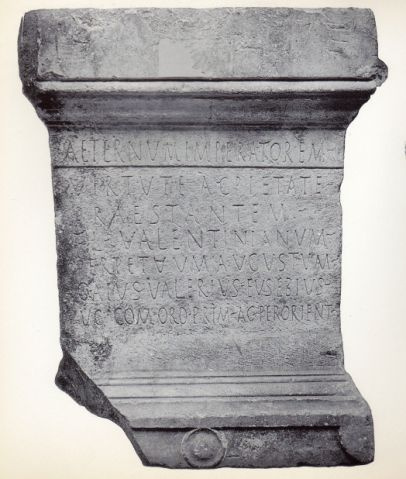
Inscription
Aeternum Imperatorem / virtute ac pietate / praestantem / Fl(avium) Valentinianum /(5) perpetuum Augustum / Caius Valerius Eusebius / v(ir) c(larissimus) com(es) ord(inis) primi ac per Orientem.
Inscription translation
To the eternal emperor, outstanding in virtue and piety, Flavius Valentinianus, forever Augustus. Caius Valerius Eusebius, of clarissimus rank, comes of the first order and for (the diocese of) Oriens.
Bibliography
- Breccia, E., Catalogue générale des antiquités égytiennes du musée d'Alexandrie, nos. 1-568. Iscrizioni greche ed latine, Cairo 1911, no. 92
- Stichel, R. H. W., Die römische Kaiserstatue am Ende der Antike, Roma 1982, 77 no. 9
- Tkaczow, B., The topography of ancient Alexandria (An archaeological map), Warsaw 1993, no. 277
Discussion
INSCRIPTION
In seven lines:
Aeternum Imperatorem / virtute ac pietate / praestantem / Fl(avium) Valentinianum /(5) perpetuum Augustum / Caius Valerius Eusebius / v(ir) c(larissimus) com(es) ord(inis) primi ac per Orientem.
'To the eternal emperor, outstanding in virtue and piety, Flavius Valentinianus, forever Augustus. Caius Valerius Eusebius, of clarissimus rank, comes of the first order and for (the diocese of) Oriens.'
Letter height 6 cm.
We reproduce the inscription according to Breccia 1911.
DESCRIPTION (from Breccia 1911, Tkaczow 1993 and the published image)
Large rectangular base with mouldings at top and bottom, H 150, W 175, D 50 cm. Our inscription is carved over an erased earlier one. The originally altar shaped base was turned upside down to be used for our inscription. The lower left angle is broken off, the lower right angle is decorated with an acroterium. At the centre of the bottom moulding (original top moulding) there is a patera standing proud. At the top face there are holes to insert a bronze statue.
PROVENANCE AND CURRENT LOCATION
The base was found in the surroundings of a lavish late Roman bath in the centre of modern Alexandria, between the quarters of Attarin in the west and Kom el Dikka in the east, south of the street running west from the Rosetta gate ('Rue de la Porte Rosette' in the 19th century, today 'Sharia el Horriya' or 'Horeya' for short; Tkaczow 1993, 42 with n. 56, fig. 33, plans II, III b and map A). On Tkaczow's maps, the Horeya Street is L1; the find spot is no. 44, south of L1, between R4 and R 5 (description of find spot Tkaczow 1993, 97-9). In the same area the porphyry chlamydatus in Berlin (LSA-1007) and the porphyry plinth with campagi (LSA-2561) were found.
HONORAND, AWARDER AND DATE
There are two emperors of the name Flavius Valentinianus, Valentinian I (364-75) and his son Valentinian II (375-92).
The awarder Caius Valerius Eusebius was comes of the East (line 7); he is known from a remark in the Chrestomathie which is datable to the reign of Valentinian I (PLRE I, 309 Caius Valerius Eusebius 42).
Discussion references
- Jones, A. H. M. et al., The Prosopography of the Later Roman Empire. Vol. I 260-395, Cambridge et al. 1971 (1975)
Cite: Last Statues of Antiquity, LSA-2672 (Ulrich Gehn).