
LSA-2693
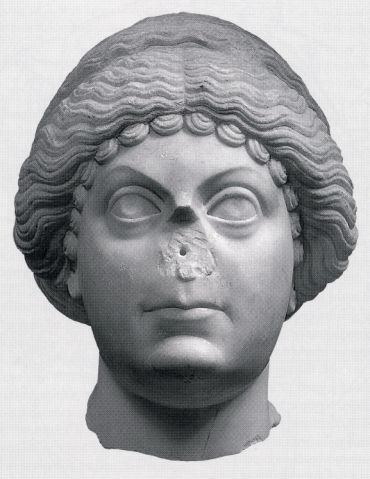
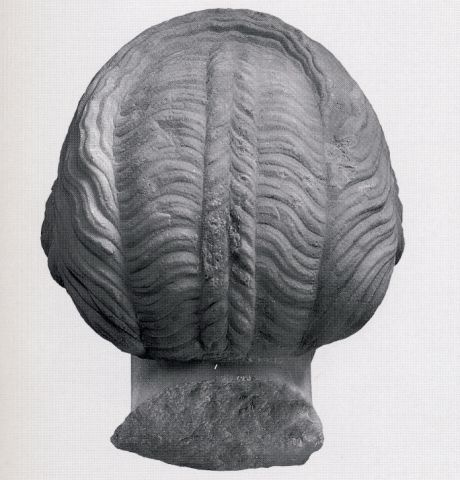
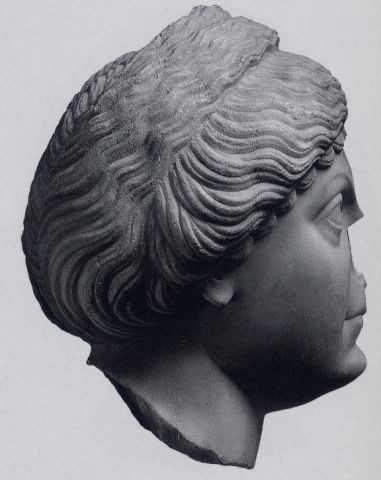
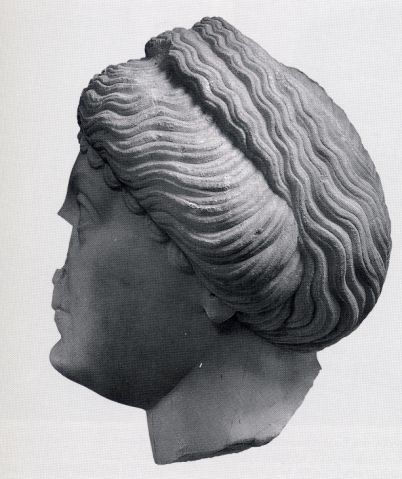
Portrait head of mature woman with crimped fringe. Athens. Late fourth to earlier fifth century.
Record details
Photographs
Bibliography
- Choreme-Spetsiere, A. 'Portreta tes Ysteres Archaiotetas apo ten Athena', Klasike Paradose kai Neoterika Stoicheia sten Plastike tes Romaikes Elladas, Thessaloniki 2012, 118-123, figs. 2-5 (Eudocia)
Discussion
DESCRIPTION (Object)
Head. H: 27.5 cm. H (chin to crown): 19.5 cm. Pentelic marble.
The head is broken through the neck. The nose is now missing but was repaired in antiquity. It has a hole for a pin, and the join surface has been worked. The high edge of the break at the back of the neck indicates that the figure was wearing a himation. The surface is highly polished.
PROVENANCE
Found in the block between the pedestrian path, Dionysiou Areopagitou, to the Acropolis and Makriyianni street. It was found during the excavations undertaken for the building of the new Acropolis Museum in 2005. It was found in a room of building Z in a destruction layer which contained pottery and frescoes of the end of the sixth to seventh centuries. The house was abandoned after a fire, probably connected to the Slavonic invasion of 586. It was found with LSA-2694
HONORAND
The head was displayed in a house and probably came from a bust. A. Choreme-Spetsieri suggests identifying her with the Empress Eudocia. There is no reason to assume that this is an imperial portrait.
DATE
The hairstyle is similar to that of LSA-144, also found near the Acropolis. There is however no fixed date for these female styles. The rendering of the face (eyes and mouth) recall those of the Theodosian prince, found at Beyazit, LSA-337. A date in the later fourth or early fifth century seems probable.
Cite: Last Statues of Antiquity, LSA-2693 (J. Lenaghan).