
LSA-2694
Portrait head of young woman with slight smile. Athens. Late fourth to earlier fifth century.
Record details
Photographs
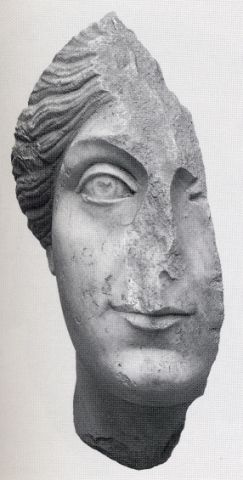
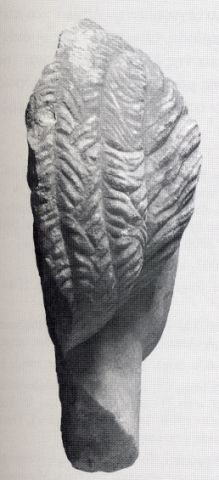
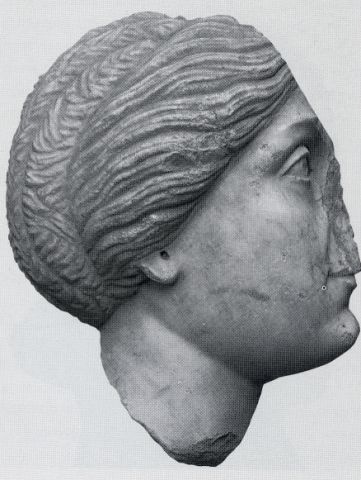
Bibliography
- Choreme-Spetsiere, A. 'Portreta tes Ysteres Archaiotetas apo ten Athena', Klasike Paradose kai Neoterika Stoicheia sten Plastike tes Romaikes Elladas, Thessaloniki 2012, 123-126, figs. 11-13 (c. 420)
Discussion
DESCRIPTION (Object)
Head. H: 26.3 cm. Pentelic marble.
The head is broken through the neck, and diagonally from the outside of the proper left cheek to the right side of the brow. Only the inner corner of the proper left eye is preserved. The nose is broken with the centre of the upper lip. The surface is highly polished.
The iris is indicated by a line of the flat chisel. The pupil is a broad crescent shape in the middle of the iris.
PROVENANCE
Found in the block between the pedestrian path, Dionysiou Areopagitou, to the Acropolis and Makriyianni street. It was found during the excavations undertaken for the building of the new Acropolis Museum in 2005. It was found in a triangular room of building Z in a destruction layer which contained pottery of the end of the sixth to seventh centuries. It was found with LSA-2693
DESCRIPTION (Subject)
The head shows a young woman with a full face and a slight smile. She has big eyes under fine arching ridges which represent the eyebrows. The eye has a a high arching upper eyebrow and a pointed inner canthus. The chin is round and projecting.
She wears her hair pulled back from the brow and covering all but the lobes of the ears. It rises from the nape of the neck in a series of braids (three extant) and reaches the top of the head a few centimetres back from the brow.
HONORAND AND DATE
The head was found in a house. In the same house was another female portrait which almost assuredly came from a bust. This is presumably another elite woman from a private setting. There is no reason to assume that this is an imperial portrait.
The workmanship recalls the portraits of the Theodsian emperors and especially a male portrait of the late fourth or early fifth c., LSA-907. A. Choreme-Spetsiere dates it to c. 420.
Cite: Last Statues of Antiquity, LSA-2694 (J. Lenaghan).