
LSA-2695
Base for statue of Flavius Severus, governor (proconsul) of Achaea, found with himation statue (LSA-2696). Elis. Fourth to early fifth century?
Record details
Photographs
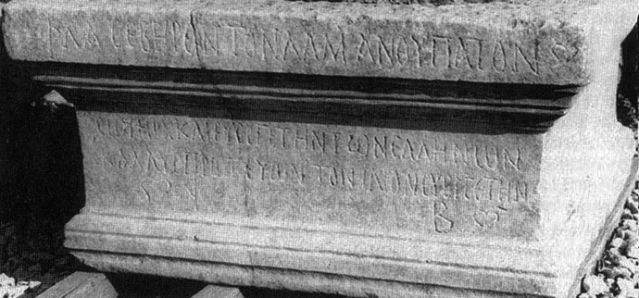

Inscription
Φλά(βιον) Σεβῆρον, τὸν λαμ(πρότατον) ἀνθύπατον, / σωτῆρα καὶ εὐεργέτην τῶν Ἑλλήνων, / Κάλλυς πρωτεύων τὸν ἴδιον εὐεργέτην, / Ψ(ηφίσματι) Β(ουλῆς).
Inscription translation
To Flavius Severus, of clarissimus rank, governor (proconsul), saviour and benefactor oft he Greeks. Kallus, leader (proteuon) (set this up to) his own benefactor. By decree of the council.
Bibliography
- Zoumbaki, S. B., Einblick in das spätantike Elis: Eine unpublizierte Inschrift zu Ehren des Prokonsuls Flavius Severus, Zeitschrift für Papyrologie und Epigraphik 164, 2008, 123-130
Discussion
INSCRIPTION
In four lines:
Φλά(βιον) Σεβῆρον, τὸν λαμ(πρότατον) ἀνθύπατον, / σωτῆρα καὶ εὐεργέτην τῶν Ἑλλήνων, / Κάλλυς πρωτεύων τὸν ἴδιον εὐεργέτην, / Ψ(ηφίσματι) Β(ουλῆς)
'To Flavius Severus, of clarissimus rank, governor (proconsul), saviour and benefactor oft he Greeks. Kallus, leader (proteuon) (set this up to) his own benefactor. By decree of the council.'
Letter height: 0.25 – 6 cm.
DESCRIPTION (from Zoumbaki 2008, and the published, image)
Low rectangular base with mouldings at top and bottom, H 40, W 74, D 72 cm. The top face of the base is finished with a point. At its centre it has a large oval cavity for the plinth of the marble statue.
The first line of the inscription is carved on the upper moulding.
The statue that was found along with the inscription was a reused marble himation statue of the early imperial period (LSA-2696).
PROVENANCE AND CURRENT LOCATION
The inscription and statue were found in 2003 during excavations in Elis. When excavated, it was standing in situ at the south western corner of the gate ( propylon) leading to the temple for the imperial cult. This was the crossroads of two major streets of the ancient city.
There is no published record of the monuments’ current location; both, statue and inscribed base are presumably in the Elis museum.
HONORAND, AWARDER AND DATE
Flavius Severus, the honorand, was governor (proconsul, Gr. anthupatos, line 1) of the province of Achaea. The province is not recorded in the inscription, but he is praised as ‘saviour and benefactor of the Greeks’ (line 2). He is only known from our inscription (but see below, next paragraph).
Zoumbaki, the editor of the inscription, dated it to the 4th century on base of the letter forms which she compared to an Athenian building inscription recording the proconsul (Flavius?) Severus Aetius, datable to 396-408 (Sironen 1997, 112-14 no. 38; IG II/III(2) ). Both, Severus Aetius in Athens and the proconsul Flavius Severus of our inscription bear the name Severus; they are just possibly identical.
Kallus, the awarder, is styled ‘proteuon’ in our inscription. This title is used to denote excellent social status of a person in the earlier imperial period; from the late 3rd century it records public office and authority. At this time, the ‘proteuontes’ were probably leading members of the local upper classes with several competences in finance and building activities who reported to the imperial authorities (Zoumbaki 2008, 125-6).
If the inscription is from the 4th century, then the title of the governor (anthupatos – proconsul) indicates a date after 324 when the provincial governorship of Achaea that had been downgraded to equestrian rank in the wake of the provincial reforms of the tetrarchy in the late 3rd century (LSA-93, LSA-94) was upgraded to the highest rank of proconsul again by Constantine I.
FURTHER DISCUSSION
The prose form of the inscription is unusual for a provincial governor of Achaea at the period (though not unparalleled). Likewise unusual are some properties of the epigraphic formula, the use of the traditional formula Ψ(ηφίσματι) Β(ουλῆς) (line 4) at the end of the inscription (for a similar case see the Corinthian inscription LSA-17), and the absence of a signum. This fosters some doubts as to the late antique date of the inscription.
Discussion references
- Inscriptiones Graecae, II/III(2)
- Sironen, E., The late Roman and early Byzantine inscriptions of Athens and Attica, Dissertation - University of Helsinki 1997
Cite: Last Statues of Antiquity, LSA-2695 (Ulrich Gehn).