
LSA-2696
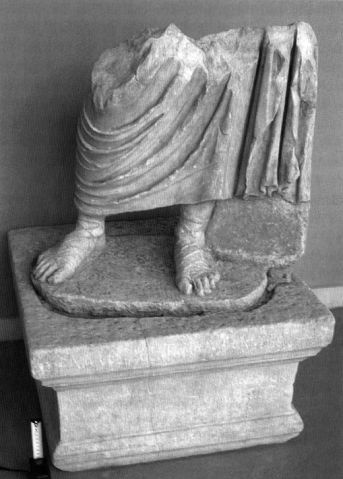
Himation statue of Flavius Severus, governor (proconsul) of Achaea, found with inscribed base (LSA-2695). Elis. Fourth to early fifth century?
Record details
Photographs
Bibliography
- Zoumbaki, S. B., Einblick in das spätantike Elis: Eine unpublizierte Inschrift zu Ehren des Prokonsuls Flavius Severus, Zeitschrift für Papyrologie und Epigraphik 164, 2008, 123-130
Discussion
DESCRIPTION (Object)
The marble statue is broken horizontally at the knees. No measurements have been published.
The folds of the garment are plastically rendered and follow the motion of the body. At the left side, the heavy fabric of the falling garment is made tangible.
The statue is standing on an elliptic plinth; the upper surface of the plinth is finished with a point.
PROVENANCE AND CURRENT LOCATON
The statue was found together with the inscribed base on which it stood in 2003 during excavations in Elis. When excavated, it was standing in situ at the south western corner of the gate ( propylon) leading to the temple for the imperial cult. This was the crossroads of two major streets of the ancient city.
There is no published record of the monuments’ current location; both, statue and inscribed base are presumably in the Elis museum.
DESCRIPTOIN (Subject)
The portrayed is standing over his left leg, the right foot placed slightly outwards. He is wearing an almost ankle-length traditional Greek cloak (himation) and elaborate sandals (krepides). At the left leg, a rectangular support is placed; its front surface is smooth, and the upper part of it is covered by the seam of the himation falling down at that side.
The dress is the traditional Greek costume, associating the portrayed with the civic values of the Greek East (see below, ‘Further Discussion’).
DATE
The inscription belonging with the statue was dated by its first editor Zoumbaki to the 4th century on the base of its letter forms; Zoumbaki quoted an Athenian inscription of the late 4th / early 5th century as a comparison (LSA-2695).
The statue is a re-used monument of the earlier imperial period. The vivid treatment of the folds by which the material of the garment is made tangible indicates a date in the 1st/ 2nd century.
FURTHER DISCUSSION
In the late 4th and 5th century, high imperial office holders like provincial governors were usually clad in the official, rank indicating dress (chlamys or toga); these garments enter the pictorial representations in the Theodosian period (Gehn 2012). The governor of Achaea appears to have worn the chlamys on official occasions, as is insinuated particularly by the sculptural evidence from the provincial capital of Achaea, Corinth (LSA-15, LSA-19, LSA-20, LSA-21, LSA-22, LSA-23, LSA-24, LSA-80; see also the chlamys statue in Megara, LSA-54. On Corinth Gehn 2012, 216-18 and cat. nos. O39-O47; Brown 2010; Megara: Gehn 2012, 220 and cat. no. O38).
The date of our monument is hard to determine; the comparison with the Athenian inscription proposed by Zoumbaki is all but decisive for a precise date (LSA-2695). Our statue, if from the 4th century, might well have a pre-Theodosian date. It is also possible that the new-type statues were not readily available at a remote location like Elis and therefore a traditional statue type was reused.
Discussion references
- Brown, A., Last Men Standing: Chlamydatus Portraits and Public Life in Late Corinth, Hesperia, forthcoming
- Gehn, U., Ehrenstatuen in der Spätantike. Chlamydati und Togati, Wiesbaden 2012
Cite: Last Statues of Antiquity, LSA-2696 (Ulrich Gehn).