
LSA-270
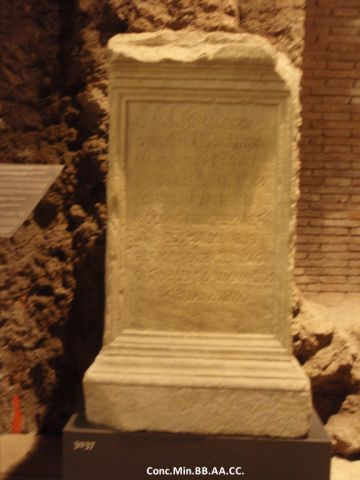
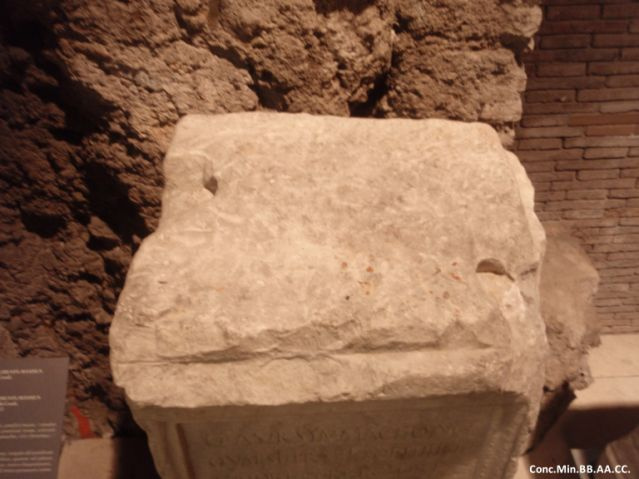
Base for statue of Quintus Aurelius Symmachus, consul and orator, probably posthumous. Rome. Early fifth century
Record details
Photographs
Inscription
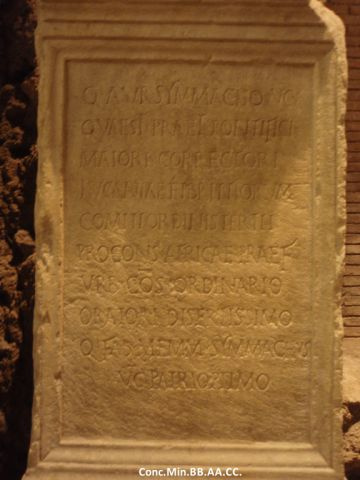
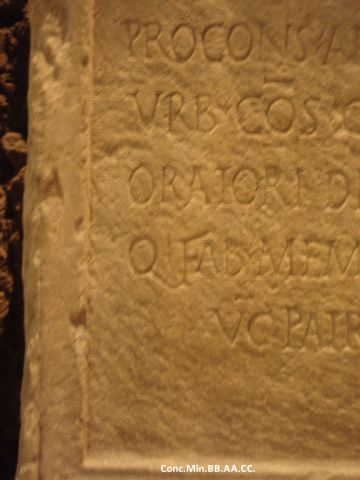
[Eusebi]i. / Q(uinto) Aur(elio) Symmacho, v(iro) c(larissimo), / quaest(ori), praet(ori), pontifici / maiori, correctori /(5) Lucaniae et Brittiorum, / comiti ordinis tertii, / procons(uli) Africae, praef(ecto) / urb(i), co(n)s(uli) ordinario, / oratori disertissimo, /(10) Q(uintus) Fab(ius) Memm(ius) Symmachus, / v(ir) c(larissimus), patri optimo.
Inscription translation
[Statue of] Eusebius. To Quintus Aurelius Symmachus, of clarissimus rank, quaestor, praetor, higher pontiff, governor (corrector) of Lucania and Bruttii, count of the third order, proconsul of Africa, prefect of the City, ordinary consul, most skilful orator. Quintus Fabius Memmius Symmachus, of clarissimus rank, to his most excellent father.
Bibliography
- Corpus Inscriptionum Latinarum; , VI, 1699 (+p. 4747-84748)
- Ensoli, S. & E. La Rocca, Aurea Roma. Dalla città pagana alla città cristiana (Exhibition, Rome 2000), Rome 2000, p. 463-464 (D. Velestino)
Discussion
INSCRIPTION:
In 11 lines. Epigraphic field: 63.5 x 40.5; letters: 3 cm.
[Eusebi]i / Q(uinto) Aur(elio) Symmacho v(iro) c(larissimo) / quaest(ori) praet(ori) pontifici / maiori correctori / Lucaniae et Brittiorum / comiti ordinis tertii / procons(uli) Africae praef(ecto) / urb(i) co(n)s(uli) ordinario / oratori disertissimo / Q(uintus) Fab(ius) Memm(ius) Symmachus / v(ir) c(larissimus) patri optimo.
'[Statue of] Eusebius. For Quintus Aurelius Symmachus, of clarissimus rank, quaestor, praetor, higher pontiff, governor (corrector) of Lucania and Bruttii, count of the third order, proconsul of Africa, prefect of the city, ordinary consul, most skilful orator. Quintus Fabius Memmius Symmachus, of clarissimus rank, to his most excellent father.'
The inscription is a dedication to his father by the son of the famous orator, Quintus Fabius Memmius Symmachus. It records the father's cursus honorum in ascending order. The inscription progresses from the cursus to the qualification orator disertissimus, creating a symmetry with the base of Flavianus (LSA-271: historico disertissimo). CIL records the first line (the signum Eusebi) as complete, indicating that the base must have been damaged after its discovery.
DESCRIPTION (based on personal inspection)
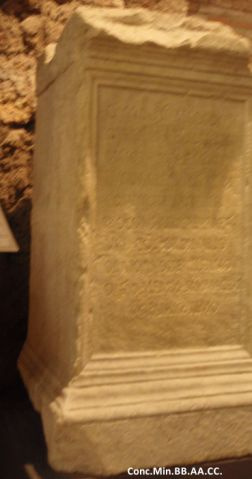
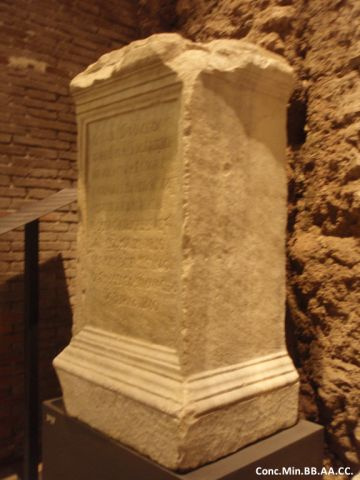
White marble base, well preserved. The base is surrounded by mouldings at top and bottom on three sides, showing damage at the top front. As a result, the signum is now only partially visible. The sides are smooth and finished, the back is rough but could not be properly inspected. The epigraphic field is framed by a moulding, worn at sides; the surface is deep and irregular in parts, indicating erasure of an earlier inscription.
Top has 2 dowel holes, possibly for fitting the statue above; it is possible, however, that they were made in later times (see Velestino, in Ensoli and La Rocca 200, 465).
PROVENANCE AND LOCATION:
The base was found in 1617 (Lanciani 1897, 348-350), in the gardens of Sertorio Teofilo (later the villa Casali, site of the modern Ospedale Militare) on the Caelian hill. It was found with LSA-271, dedicated to Nicomachus Flavianus by the same Fabius Memmius. This indicates a domestic context, a hypothesis that was reinforced by the excavation of a large Roman domus with late antique phases in the same area , identified by the excavators as the house of the Symmachi (although this identification relies heavily on the presence of the bases: see Pavolini 1993). Symmachus' ownership of a house in this area is however attested by a number of letters: for the full evidence, see Guidobaldi 1995, 183-184.
HONORAND AND AWARDER:
The Symmachi were one of the most powerful families in 4th century Rome. Quintus Aurelius Symmachus was a pagan, and an influential member of the senatorial aristocracy, urban prefect in 384-5 and consul in 391 (PLRE I, 865-870 Symmachus 4). His latest datable letters are from 402, when he was ill. His son, Quintus Fabius Memmius Symmachus, married the granddaughter of Nicomachus Flavianus in 401, the same year he was praetor (PLRE II, 1046-1047 Symmachus 10).
DATE:
391, when Symmachus was consul, is a certain terminus post quem. However our statue is clearly a pair to a posthumous statue to Flavianus (LSA-271), which has to be later than 401, and indeed both were probably posthumous honours, in which case after 402, when Symmachus is thought to have died (PLRE). It should not be much later than the beginning of the century, however. An outer terminus ante quem could be 431, when the memory of Flavianus senior was definitively revalued and a statue was dedicated to him in the Forum of Trajan (CIL VI, 1783).
Discussion references
- Guidobaldi, F., “Domus: Q. Aurelius Symmachus s. Eusebius”, Lexicon Topographicum Urbis Romae, vol. 2, Rome 1995, 183-184
- Jones, A. H. M. et al., The Prosopography of the Later Roman Empire. Vol. I 260-395, Cambridge et al. 1971 (1975), 865-870 (Symmachus 4)
- Lanciani, R., The Ruins and Excavations of Ancient Rome, London 1897, 348-350
- Martindale, J. R., The Prosopography of the Later Roman Empire. Vol. II A.D. 395-527, Cambridge 1980, 1046-1047 (Symmachus 10)
- Pavolini, C. et alii, “La Topografia antica della sommità del Celio. Gli scavi nell’Ospedale Militare”, Römische Mitteilungen, 100, 1993, 483-502 (A. Carignani)
Cite: Last Statues of Antiquity, LSA-270 (Carlos Machado).