
LSA-273
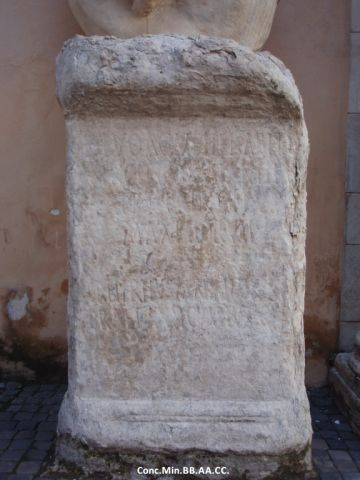
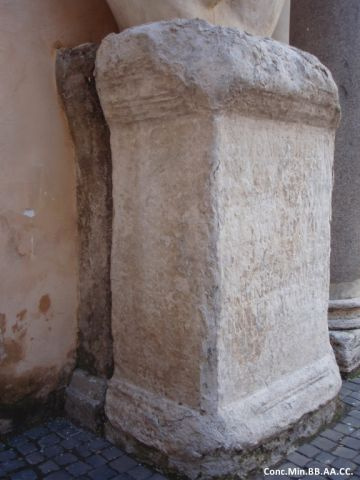
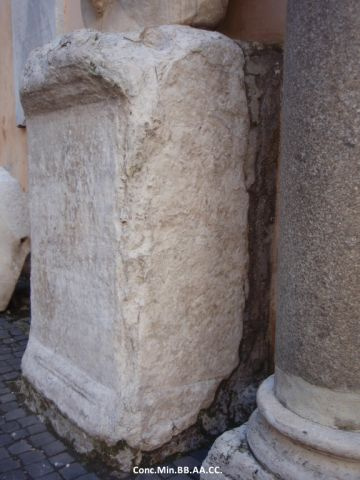
Base for statue of deified Constantine I, emperor. Rome. 337-340
Record details
Photographs
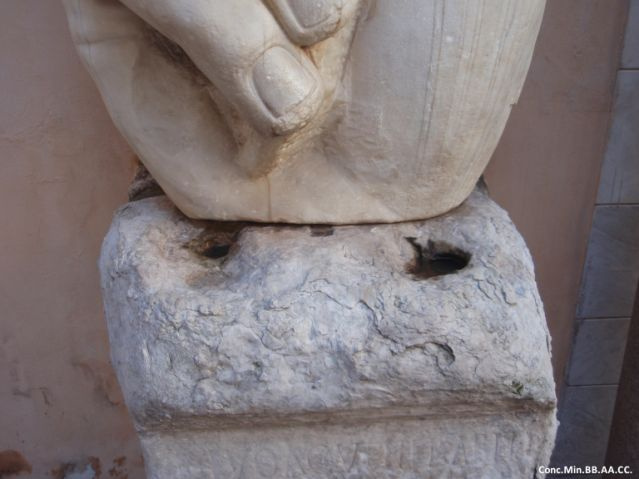
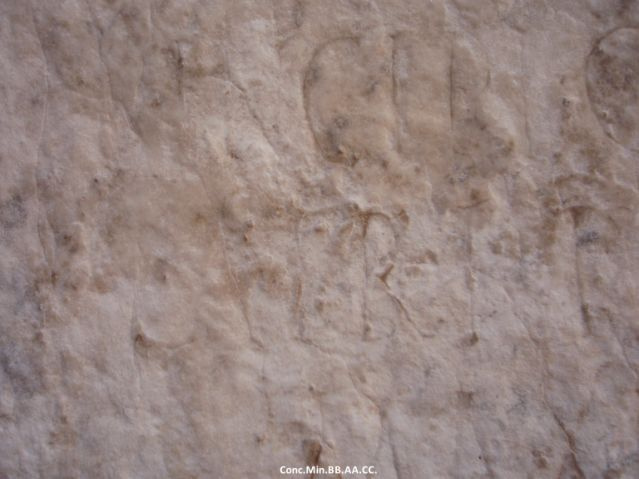
Inscription
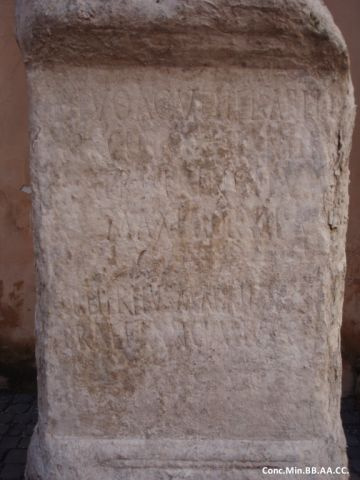
Divo ac venerabili / principi Constantino, / patri principum / maximorum, / Fl(avius) Creper[e]ius Madalianus, v(ir) c(larissimus), / praef(ectus) ann(onae) cum iure glad(ii).
Inscription translation
To the deified and venerable emperor Constantine, father of the most excellent princes, by Flavius Crepereius Madalianus, of clarissimus rank, prefect of the annona with judicial authority.
Bibliography
- Corpus Inscriptionum Latinarum; , VI, 1151 (+ p.4329)
Discussion
INSCRIPTION:
In six lines.
Divo ac venerabili / principi Constantino, / patri principum / maximorum, / Fl(avius) Creper[e]ius Madalianus, v(ir) c(larissimus), / praef(ectus) ann(onae) cum iure glad(ii).
'To the deified and venerable emperor Constantine, father of the most excellent princes, by Flavius Crepereius Madalianus, of clarissimus rank, prefect of the annona with judicial authority.'
Although badly damaged, the inscription is still (barely) legible. It is an important document because it is a rare example of a late antique statue dedication to an emperor as divus.
DESCRIPTION (based on personal inspection)
White marble base, badly corroded and damaged on all sides. The base has mouldings, top and bottom, at least on three sides. The back was probably cut, is fitted against wall of museum with cement, and cannot be inspected. The sides are finished but badly worn. The top of the base is badly damaged and partially obscured (since it now supports one hand of the giant statue of Constantine), but it is still possible to see two dowel holes, perhaps for fitting a bronze statue. There is hole at the centre. The epigraphic field is badly corroded, and the inscription is now barely legible.
PROVENANCE:
The base was discovered in 1715 during works at the 'Bocca della Verità' (Lanciani 2000, 36). The base was discovered on the late antique level of the Forum Boarium, and might be contemporary with the late antique building that was later incorporated into the church of S. Maria in Cosmedin (Fusciello 2001, 9). The area was of great importance at the turn of the 3rd-4th centuries, as indicated by a number of altars dedicated by urban praetors to Hercules Invictus in this part of Rome (CIL VI, 314, 315, 317). The fact that the base refers to the deified Constantine suggests, furthermore, that it might be related to the arcus divi Constantini mentioned in the contemporary Notitia Urbis Romae (now identified as the four-way arch traditionally called the 'arco di Giano') (Claridge 1998, 258-259). The base is now in the Capitoline Museums, at the courtyard of Palazzo dei Conservatori (inv. 6768)
HONORAND:
After his death, Constantine was celebrated through a iustitium in Rome, with popular demonstrations of grief, the closing of baths and judicial courts, and the display of images of the emperor. The reactions to his death in Rome are described in Eusebius' Vita Constantini, 4.69 (with further references in Cameron and Hall 1999, 345-6).
Awarder
The awarder should be identified as Lucius Crepereius Madalianus, and not Flavius as in the inscription. He was prefect of the annona of Rome between 337 and 341, and afterwards governor of Africa (PLRE I, 530 Madalianus). The dedication of statues to emperors by prefects of the annona was common in early 4th century Rome, but stopped during the second half of the century.
DATE:
The dedication was carried out after the death of Constantine in 337, as shown by the reference to his deification. The terminus ante quem is the war between his sons Constantine II and Constans in 340.
Discussion references
- Cameron, A. and Hall, S. (eds), Eusebius. Life of Constantine, Oxford 1999, pp. 345-346
- Claridge, A., Rome (Oxford Archaeological Guides), Oxford 1998, pp. 258-259
- Fusciello, G., "La piazza del foro boario e gli edifici romaninell'area di S. Maria in Cosmedin", Palladio. Rivista di Storia di Architettura e Restauro, 28, 2001, pp. 5-22
- Jones, A. H. M. et al., The Prosopography of the Later Roman Empire. Vol. I 260-395, Cambridge et al. 1971 (1975), p. 530 (Madalianus)
- Lanciani, R., Storia degli scavi di Roma e notizie intorno le collezioni romane di antichità, vol. 6 (1700-1878), Rome 2000
Cite: Last Statues of Antiquity, LSA-273 (Carlos Machado).