
LSA-2731
Base for gilded bronze equestrian statue of Theodosius the Elder, father of Theodosius I. Stobi (Macedonia) 379-395
Record details
Photographs
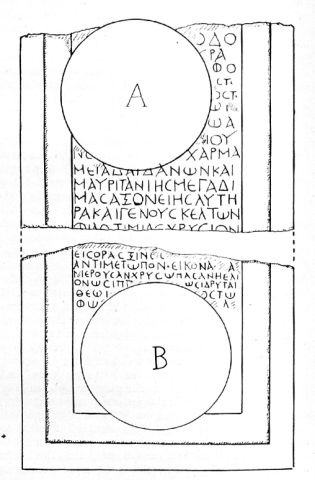
Inscription
Fragment A:
--- ΟΔΟ / ---ΡΑ / --- ΦΟ / ---ΣΤ /(5) ---ΟΣΤ / --- ΩΙ / ---ΩΑ / ---ΙΟΥ / --- χάρμα /(10) μέγα Δαρδάνων καὶ / Μαυριτανίης, μέγα δῖ-/μα Σαξονείης, λυτῆ-/ρα καὶ γένους Κέλτων /(14) φ̣ι̣λ̣ο̣τ̣ι̣μ̣ί̣α̣ς̣ χ̣ρ̣υ̣σ̣ί̣ο̣ν̣ /
--- /
Fragment B:
(15) εἰσορᾷς ΞΙΝ --- / ἀντιμέτωπον εἰκόνα -Α / ΜΕΡΟΥΣΑΝ χρυσῷ πᾶσαν ἠέλι-/ον ὡς ἱππ[ικὴν καθ]ὼς ἵδρυται ἵδρυται / θεῷ (?) ---- ΟΣΤΩ / ΦΩ ---.
Inscription translation
... great joy of the Dardani and of Mauretania, great fear of the Saxonians, liberator of the Celtic nation; the money of the foundation ... you see ... opposite ... a statue ... with gold all over, like a mounted sun, as was set up to the divine (?) ...
Bibliography
- L'Année épigraphique, , 1931, 53
- Stichel, R. H. W., Die römische Kaiserstatue am Ende der Antike, Roma 1982, 92 no. 80
Discussion
INSCRIPTION
Partly preserved in 20 lines, distributed over two fragments:
Fragment A:
--- ΟΔΟ / ---ΡΑ / --- ΦΟ / ---ΣΤ /(5) ---ΟΣΤ / --- ΩΙ / ---ΩΑ / ---ΙΟΥ / --- χάρμα /(10) μέγα Δαρδάνων καὶ / Μαυριτανίης, μέγα δῖ-/μα Σαξονείης, λυτῆ-/ρα καὶ γένους Κέλτων /(14) φ̣ι̣λ̣ο̣τ̣ι̣μ̣ί̣α̣ς̣ χ̣ρ̣υ̣σ̣ί̣ο̣ν̣ /
--- /
Fragment B:
(15) εἰσορᾷς ΞΙΝ --- / ἀντιμέτωπον εἰκόνα -Α / ΜΕΡΟΥΣΑΝ χρυσῷ πᾶσαν ἠέλι-/ον ὡς ἱππ[ικὴν καθ]ὼς ἵδρυται / θεῷ (?) ---- ΟΣΤΩ / ΦΩ ---.
'... great joy of the Dardani and of Mauretania, great fear of the Saxonians, liberator of the Celtic nation; the money of the foundation ... you see ... opposite ... a statue ... with gold all over, like a mounted sun, as was set up to the divine (?) ...'.
We reproduce the inscription according to the drawing given by Egger 1930, fig. 1. Egger, the first publisher of the inscription, suggested for lines 1-2 the completion [Φλάβιον Θε]οδό-/[σιον τὸν θεῖον πατ]έρα / ... - 'To Flavius Theodosius, the divine father'. The following lines probably contained the imperial name and titles of Theodosius I (see below, 'Honorand, Awarder and Date'); this was followed by the praise of the honorand’s deeds which is partly preserved in lines 9-13. For lines 16-20, Egger suggested εἰκόνα [μ]αρμέρουσαν χρυσῷ πᾶσαν ἠέλι-/ον ὡς ἱππ[ικὴν καθ]ὼς ἵδρυται / θεῷ [Κωνσταντίνῳ πρ]ὸς τῷ φω--- - 'a statue, flashing with gold all over, like a mounted sun, as was set up to the divine Constantine at Fo...'. We accept the completion in line 18 (... ὡς ἱππ[ικὴν καθ]ὼς ...) for our reproduction of the text, but are less confident about the other completions.
Lines 1-14 are apparently in prose; lines 15-20 in verse.
Letter height not recorded.
DESCRIPTION (from Egger 1930 and the published image)
Two fragments of a white marble statue base, W 90 cm. The front face carries an inscription in a framed field. The two fragments are built into the church of Drenovo (14th century) where they serve as column pedestals left and right of the main entrance. They are lying front face up; large portions of the inscription are illegible from the column shafts set on top of it; moreover, the visible surface is worn. Of the depth of the two blocks, 20 cm are above the floor level (this is the height of the blocks in their present use). One fragment (B on the published image) preserves 70 cm of the original height; this fragment has the the lower frame of the epigraphic field preserved. The other fragment (A) is broken at top and bottom; it preserves 63 cm of the original height (total 133 cm).
PROVENANCE AND CURRENT LOCATION
The inscription was first recorded in Drenovo, ca. 30 km west of Stobi. It was built into the 14th century church; Saria 1927 argued that it was brought there from Stobi when repair work was executed in the 19th century. Our inscription was 'doubtlessly from the basilica of Stobi‘ (Egger 1930, 9).
There is no recent account of the inscription’s location.
HONORAND, AWARDER AND DATE
The name of the honorand is destroyed in our inscription; however, Egger 1930 convincingly argued that the extant portion of the inscription which praises his military success in the Balkans (χάρμα μέγα Δαρδάνων, lines 9-10), in Mauretania (χάρμα μέγα ... Μαυριτανίης, lines 9-11), against the Saxons (μέγα δῖμα Σαξονείης, lines 11-12), and to the benefit of 'the Celtic nation' (λυτῆρα καὶ γένους Κέλτων, lines 12-13), fits the military career of Flavius Theodosius, father of the later emperor Theodosius I (PLRE I, 902-4 Flavius Theodosius 3).
Flavius Theodosius was comes rei militaris in the West in 368/9 and magister equitum in 369-75. He was executed in Carthage, probably in 375. After his son became emperor, he rehabilitated the memory of his father by encouraging the setting up of equestrian statues to him (LSA-1695, LSA-2725).
Theodosius I visited Stobi several times, in 379, 380, 388 (Egger 1930, 28). One of these visits was possibly the occasion on which the statue to his revered father was set up.
The name of the awarder is illegible in our inscription. However, as Egger 1930, 31 points out, the foundation referred to in line 14 (φιλοτιμίας χρυσίον) probably indicates that it was the city or its institutions (φιλοτιμία is the civic ambition which expresses itself preferredly through benefactions).
FURTHER DISCUSSION
A similar statue for the Elder Theodosius, also equestrian and also of gilded bronze, was set up in Canusium (Apulia et Calabria) (LSA-1695).
Discussion references
- Egger, R., Der erste Theodosius, Byzantion 5, 1929, 9-32
- Jones, A. H. M. et al., The Prosopography of the Later Roman Empire. Vol. I 260-395, Cambridge et al. 1971 (1975)
Cite: Last Statues of Antiquity, LSA-2731 (Ulrich Gehn).